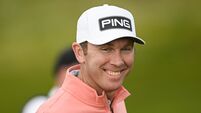
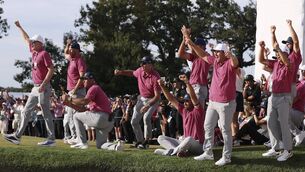
McGinley left nothing to chance
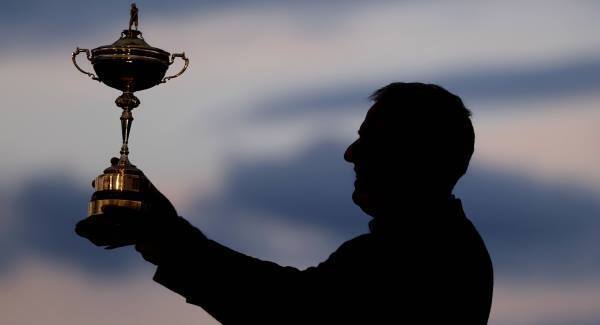
From the blue and gold fish in a team room decked out with inspirational quotes and imagery of European icons past to appointing an extra vice-captain to look after the four players required to sit out each of the four sessions over the first two days of competition, McGinley had thought of everything, leaving no stone unturned, no idea unexplored, during his 19-month lead-in to the showdown at Gleneagles.
It was an approach borne of the Alex Ferguson school of management, one which first begat Roy Keane’s fail to prepare, prepare to fail ethos and has had a new disciple from the moment McGinley was appointed captain, leading one to imagine just what the Irishman would have thought of Corey Pavin and his leaky rainsuits at Celtic Manor in 2010.
For all the effort, the 47-year-old Irishman was repaid by the total commitment of a dozen players who delivered a 16½-11½ victory over the United States on Sunday evening, reducing the Americans to also-rans and feeling like their captain, Tom Watson, was a bit of a dinosaur in comparison.
It is, after all, difficult to imagine a European player, even in defeat, feeling as much disaffection and displaying so much disrespect for McGinley as Phil Mickelson did for Watson during a remarkable USA press conference on Sunday evening.
No, it was quite the reverse. A winning team room will do that, naturally, but the outpouring of respect and affection by the players for their captain was no pretence. Even players McGinley omitted were impressed. Luke Donald had every right to feel aggrieved at being overlooked by his former playing partner for one of the three captain’s picks yet the Dubliner referred to the touching text message of congratulations he had received on Sunday evening from the Englishman with an exemplary Ryder Cup record.
Among the players who were in McGinley’s team, the praise of veterans Sergio Garcia and Lee Westwood, the man who edged Donald out of a pick, spoke volumes, underlining Graeme McDowell’s assertion that his compatriot was the best captain he had played under.
McGinley had suggested he would make mistakes yet both Garcia and Westwood, with a combined 14 Ryder Cup appearances, said their captain had not put a foot wrong at any stage.
“I’m lucky, I’ve a lot of experience,” was McGinley’s reaction. “Three Ryder Cups, two as a vice captain, that’s five. Then two Seve Trophies, that’s seven times in a team environment, plus all the Royal Trophies that I’ve played in and also all the Seve Trophies I played in. That’s a vast amount of experience.
“I’ve observed, I’ve listened, I’ve watched and if I wasn’t quite sure I’d ask, not afraid to ask, so I’m collecting information all the time and it’s a combination of a lot of those things.”
That experience led to some cool calculation, every decision thought through and backed by statistical and empirical evidence before being implemented.
‘They weren’t just decisions on instinct. They were evidence based on gathering information as well as my instincts. They weren’t decisions on a whim, they were calculated. They came about by studying and observing all kinds of sports, all kinds of management, but never losing sight of my own instincts too. Everything was a calculated gamble.”
Not every gamble paid off, and if Europe dominated the alternate-shot format foursomes, collecting seven points out of a possible eight over both afternoon sessions, the mornings’ better-ball fourballs could have delivered more than three points from eight.
“I think I asked a lot of Ian Poulter to play with Stevie Gallacher the first morning,” McGinley admitted. “It was a calculated gamble. The occasion was big.
“We had a Scottish player playing in front of his home crowd, Poulter loves the big occasion, and big noise. I thought that might inspire him to play well, he played nicely in practice. In fairness to Ian Poulter, very few people in either side can play the senior role, and bring a guy on. Lee Westwood can. And Graeme [McDowell] has stepped up and shown it.”
Not everything was cast in stone, yet even McGinley’s improvisations were well thought out, the captain having broken with convention and left his assistants to go out on the course as he prepared for the next session.
“You’re always evolving, you’re watching, you’re moving. I had a plan in place for every session, a skeleton plan. As the morning matches start, that plan was in my black notebook, the vice-captains are aware of it, and I’m plotting my next move.
“The guys don’t need a cheerleader out there, telling them to hit an eight iron instead of a seven iron. My job as captain was to be aware, so my communication with the vice captains on the course, was ‘how’s he playing? All ready go this afternoon?’
“One of the big things was the fifth vice captain. If I did have to make a change, I could speak to the fifth vice captain. Des Smyth was huge, Jose Maria [Olazabal] too. If I had to make a decision, I’d call Des, say ‘how is he? Is he ready? We’re thinking of bringing him in’.”
McGinley spent most of last week citing his adherence to the European template for Ryder Cup success started by Tony Jacklin during the 1980s. He has shown there is quite an allowance for flexibility and innovation within the framework which has now delivered eight wins in the last 10 Ryder Cups.
If Sunday’s outcome is anything to go by, the Irishman may well have added more than a few moves to the captain’s playbook.