No stopping Mother Nature so let’s give course a break
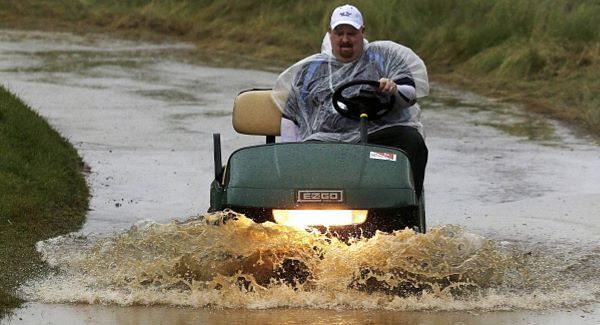
But we know that’s not the case. The man is the executive director of the United States Golf Association, for goodness sakes, and blessed to have spent countless hours at iconic courses from St Andrews to Gullane, Birkdale to St George’s. So for him to opine that Merion Golf Club “is maybe the best-draining golf course I have ever seen” makes you question his sanity, though in the end you have to cut him some slack and concede that he’s naturally in possession of rose-coloured glasses on the eve of his group’s flagship event, the US Open.
Guess if he tells himself that enough times, he might actually believe it.
To give Davis his due, he apparently was assuming that his audience understood the disclaimer. He was putting Merion into the category of golf courses built with “heavier soils,” and was not including those majestic links with their precious sand-based terrain. But if that’s the case, Davis and everyone else in attendance at the 2013 US Open needs to concede the harsh reality — golf courses with their “heavier soils” simply are no match for the fury that Mother Nature has unleashed.
Sad to say, but one of the world’s greatest golf courses is under siege. Rain has pounded the northeast US to spell misery for US Open organisers.
Having committed itself to the bold move of returning the national championship to Merion after a 32-year absence, what sat at the root of the USGA’s mission is drowning in mud.
To critics who said Merion and its 6,996 yards were not capable of providing a stern test to the world’s best golfers, USGA officials said: “Just watch.” With a series of punishing par 3s and handful of demanding par 4s, Merion would be up to the task — assuming conditions were firm and fast.
So much for that.
“It’s going to be very sloppy now,” Ernie Els said. “You’re not going to see a firm US Open this year. I don’t care if they get helicopters flying over the fairways. It’s not going to dry up.”
Mind you, Els said this Monday, and then it rained even more. And come Thursday, the first round is predicted to be in danger of being halted, given a forecast of thunderstorms.
All in all, misery for all concerned, but since there has never been any blueprint devised to combat Mother Nature, the game must go on. What everyone now embraces is the fact that the complexion of Merion has changed; forget trying to keep balls in fairways and on greens, the advantage swings to those who carry it a long way. Roll is out of the question.
“It becomes a little more simple,” said Masters champion Adam Scott. “The ball is just going to stop where it lands.”
In a championship that prides itself on keeping the winning score around par, that goal is out of the question. Talk is we could have a repeat of Rory McIlroy’s 2011 manhandling of a water-logged Congressional; the kid broke 70 each day, finishing at 16-under to win his first major.
The fear is, a parade of red numbers and a double-digit winning score will leave a sour taste in people’s mouths. But forget Merion’s “shortness.” Put the focus on the real culprit – Mother Nature. What is needed, beyond rain gear and patience, is perspective. This return to Merion should be commended. What will eventually determine the quality of this 2013 US Open is not the winning score but the quality of the leaderboard. So it behooves everyone to hold off judgment till the end. Venerable Merion deserves that.
CONNECT WITH US TODAY



Be the first to know the latest news and updates