To understand the son, look to the father

Step into the entrance hall at Stackstown Golf Club in the foothills of the Dublin mountains, turn to your right, and on the wall across from the ‘Harrington Room’, an impressive homage to Pádraig’s career achievements, hangs a giant frame.

To understand the son, look to the father

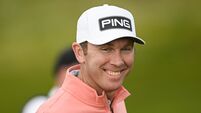
Within it are the photographs of each of the club’s captains since its formation in 1976. Thumb just one place to the right of the first mug shot and you come upon the face of Pádraig’s dad, Paddy, the 1977 captain. He was in his mid-40s when the picture was taken, only a few years older than Pádraig is now. Save for a little greying around the temples, there is everything of one in the other. The avuncular pose is familiar, so too the powerful upper body, though it’s the jutting Harrington jawline that is pure Pádraig. It’s true what they say; to understand the son, you must look to the father.

Paddy was a native of Castletownbere in west Cork and early in life developed a love for Gaelic football. He excelled at it and it was in this arena that the earliest sign of the acute work ethic that he would pass down to his five sons can be traced.

As a boy, Paddy was predominantly right-footed, like the majority of his friends and team-mates. All he required to perform magic on the field of play was that right foot and a football. But when he suffered an injury to his instep, his progress was halted. The advice was to stop playing, for a few months. Immediately, the world of mucky fields and sweat and tears that he adored was shut off from him.

He was crushed but, crucially, undeterred and after a couple of days concluded that there was indeed a way around the problem, through hard work. If he couldn’t kick off his right foot then he would simply kick off his left. At the outset, playing football off his weak left side was more a penance than a pleasure. But with the passion of a perfectionist he soon got there. It is said that in just months there was no discernible difference in the quality of his kicking from either foot.

When the injury eventually healed, he continued to strike off both sides. As a defender, and sometimes a midfielder, the rare quality of kicking strongly from both feet saved him crucial milliseconds in the heat of battle and won him many personal duels down the years in big games.

A powerful, combative, half-back, he reached the very top of the amateur sport in the 1950s with Cork and is remembered for contesting two All-Ireland finals, in 1956 and 1957. He must have smiled to himself at a tribute paid in the national media in 1959, describing him as “one of the most remarkable two-footed players the game has known”. If only they knew. Proficiency through practice, it was to be his calling card through life, whatever he turned his hand to.

Paddy moved to Dublin to work as a Garda Síochána member. His youngest son, Pádraig, grew to love Gaelic football too. Ask him about his memories of Ryder Cups or legendary British Opens from his early teens and he’ll draw a blank. Until Jack Nicklaus piqued his attention with that stirring comeback to deny Greg Norman at the US Masters in 1986, he was more interested in the national pastime. He was a handy footballer too, playing for the local Ballyboden St Enda’s club and captaining Coláiste Eanna to a Dublin Senior Colleges final at Croke Park as a 17-year-old. His position? Half-back of course, the same as his dad.

A funny thing happened during that Colleges final in May of 1989. Harrington was also the team’s free-taker and kicked one beautiful long range effort over the bar for a point. It’s common for goalkeepers to make a routine leap in the air in such instances, as the ball flies overhead. But the opposing St Vincent’s College keeper went a little further, leaping up, hanging out of the crossbar and bringing the entire structure crashing down. Thankfully, pride was all that was damaged and the game continued.

Harrington never recounted that incident publicly, not because his side took a heavy beating in the end, 2-9 to 0-5, but probably because the occasion turned out to be memorable for a different reason. He was marking rising star Dessie Farrell, the speedy young forward who would inspire an All-Ireland winning Dublin team six years later at the same venue. Harrington diplomatically recalls that Farrell, small and fast, “ran rings” around him, though the stats tell a different story – Farrell registered just a single score all afternoon.

Either way, the real damage suffered was not to Pádraig’s reputation but to his wrist as he attempted to get to grips with his elusive opponent. It was after a trademark Farrell swivel of the hips and dash, that Harrington turned to chase down his man but lost his footing, and came crashing down on his left wrist, spraining it badly.

As bad luck would have it, he was scheduled to play for the Leinster youths golf team the very next day, in the Interprovincial championship in Ulster. Michael McGinley, Paul’s father, was Leinster manager and the last thing he’d told Pádraig was not to get injured in the football game. Dessie Farrell takes up the tale: “So Pádraig went on up to Ulster, obviously had hurt the wrist playing football, and never said anything about what had happened. I don’t think he played particularly well in the golf. But it wasn’t until years later that he told Michael McGinley the real story.”

Critically, Pádraig never quite felt the same compulsion to grind himself into the dirt as a Gaelic footballer like he did when practicing golf. “I didn’t work as hard at my Gaelic football,” he admitted. “I look back at it and look at my training and say, ‘Yeah, I took part but did I give it 100%?’ No. Maybe I didn’t know better at 15, 14 years of age and maybe if I did I would have been a footballer. I loved golf and that must be why I’m obsessive about it. ”

At his old GAA club, Ballyboden St Enda’s, they wonder how good Pádraig could have been. As good as the auld fella maybe? “He was handy,” recalls Farrell. “He kicked the frees as well. He was tall, athletic and obviously came from good stock in terms of his father’s background.”

Another man well placed to answer that question is Niall Fitzgerald, a former Cork team-mate of Paddy Harrington’s. He first teamed up with Rochestown College student Paddy as a midfield partner on a combined colleges team in 1950. “Pádraig is big enough and he’s strong enough,” says Fitzgerald. “The only thing I’d have to ask of Pádraig is, would he have had the same dash as his Dad? Because Paddy was fast. A very forceful player.”

Fitzgerald, a retired army man, plays a little golf himself these days and watches Pádraig on TV when he can. At times, he says he could be staring at a mirror image of Paddy when the son of his old friend comes into frame. “They’re very much alike,” he says. “They both have a unique walk. Padraig’s is maybe a bit more exaggerated with the toes turned out slightly. But Paddy definitely walked a bit like that. And his features, facially, he’s quite like his Dad that way too.”

Paddy died in July, 2005 after a battle with cancer. His eternal resting place is a plot in Kilmashogue cemetery that looks out across a mature valley onto Rathfarnham Golf Club below. It is golfing country, a short distance from seven different courses. On a bench beside his headstone, the following words are etched, “Never get too high in victory or too low in defeat. In the heat of battle do the simple things simply.”

nPaul Keane is author of Obsessed: Inside Pádraig Harrington’s Head which is available nationwide

More in this section

Sport

Newsletter

Latest news from the world of sport, along with the best in opinion from our outstanding team of sports writers. and reporters

Cookie Policy Privacy Policy Brand Safety FAQ Help Contact Us Terms and Conditions

© Examiner Echo Group Limited