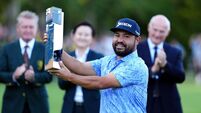
Dyson rewarded for risking all down the stretch
Holes to test not just the shot-making of the best pros, but their nerve.
Yesterday in the final round of the 2011 Irish Open, the Killeen Course in Killarney delivered all of that and then some.
All through the back nine Simon Dyson and Richard Green had been trading blow for blow, birdie for birdie. Along with David Howell they had shared the lead at the end of round three, all on 11 under, but Green was paired with Howell in the final group, which — ostensibly — left him with the advantage, knowing exactly what he needed to do as they closed in on 17 and 18.
Dyson was two shots behind at the turn but a pair of birdies on 10 and 11 soon levelled matters. A dropped shot by the Yorkshireman on the tough 13th gave advantage to Green.
No change to the par-five 16th, then a birdie for Dyson but even before he had teed off on the 17th he had followed suit — Dyson still a shot down.
“I’m one of those players who likes to look at the leaderboard and see what I have to do,” said Dyson.
“I saw Richard had made a birdie on 16, knew I had to make a birdie coming in.”
Which he duly set about doing. Now, understand 17 is not an easy hole, especially not with the pin-position directly behind a deep pot bunker on a narrow convex green yesterday.
Simon Wakefield, who managed to birdie it in a sterling final round, explained: “Seventeen was very tough. I hit a reasonable three wood off the tee but it’s into the wind, so I left myself about 170 yards, up the hill and into the wind — a good six iron. Luckily my ball just held on the left side but I had to run that 170 yards up to mark it in case the wind took it back down the slope!”
Still, for all its danger, 17 is a risk-reward hole and needing to make something happen, Dyson took on that risk.
“Three wood off the tee, wedge in to three foot,” he explained, matter-of-fact, but of course it was a lot more than that. It took guts. It was a make-or-break shot and it made Dyson — and ultimately, pressure now back on him again with the game tied, it broke Green. The Australian did manage par on that hole, a superb flop-shot from behind the green to a couple of feet leaving him with a simple putt, but a glance down the 18th fairway and he’d have seen Dyson in an absolutely perfect position for his approach shot.
“That is a smelly hole when you’re tied for the lead coming down the last, it really is,” was Simon’s colourful description of 18. “There’s no room for error in that one.”
So, how did Dyson do?
“I managed to hit the fairway and when you are where I was, nine iron in my hand, wind off the right, pin on the right, I thought nothing but go for it. I’ve been hitting my irons beautifully all week. I couldn’t have hit a better shot really.”
Ten feet above the hole he landed and, though he missed the putt, Green was in trouble off the tee, in the rough on the left and now, game on the line, hit another poor shot. “It was a great angle to go for the hole,” he explained. “But for whatever reason I just felt eight iron was enough, and it wasn’t.”
He left himself with a huge putt, which he steamed past the hole and didn’t make the one coming back. Game to Dyson.
“I’d rather have won it by birdieing the last but I’ll take it,” he said, but there was no need for apology.
Those two final holes said Spain’s Ignacio Garrido — happy to have parred both for a tied-fifth finish — are a true test.
He said: “They’re two good finishing holes. 17 is a hole where you can make birdie. The tee-shot (at 18) is demanding, you have to play the ball properly if you want to give yourself a birdie chance. The second shot is a mid-iron to a green with a lot of platforms — a good hole.”
In attacking those two tough final pins and with the game on the line, Dyson won this tournament. A champion, a true champion.