Harrington must play to strengths
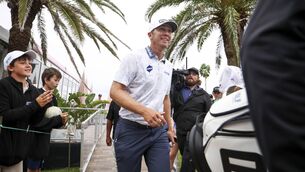
Of these, there is one outstanding world great, Pádraig Harrington. Of course, his record demands respect, but on current form I would argue that his game also demands greater scrutiny and honesty.
Of immediate importance to Harrington is the possibility that — unless his form improves dramatically — he will shortly lose his world top 50 ranking and with it the option to participate in the highly lucrative World Championship events, the money from which counts on both the PGA and European Tour Order of Merits. His absence from these events will also compromise his ability to pick up much valued world ranking points.
Should this happen, it will most likely spell the end of Pádraig’s membership of the PGA Tour which would be a great pity as he has been one of the great characters on the world golf circuit for much of the past decade.
Throughout his professional career Pádraig has always worked tirelessly to perfect his game. In the early years he relied heavily on his short game skills to keep him competitive. Over time, and an awful lot of hard work with Bob Torrance, he created a long game that complemented his short game, resulting in three major championships. However, since then there is no doubt (as reflected by his results) that his pursuit of even greater perfection has, in fact, led to a deterioration in his performances rather than a further improvement.
In August, Pádraig will turn 40, still young enough to be very competitive, but he now needs to be working on a more efficient swing, one that will put less strain on his body without compromising his competitiveness. He should take note of what Butch Harmon said of Tiger Woods recently, when asked why Tiger didn’t go back to his old dominant swing of 2000/2001. Tiger, he explained, was no longer capable of going back to that swing because his age and body shape would not permit him to do so. It was his belief that a professional golfer’s swing needs to grow and develop as he ages.
History has shown us that the most competitive players in their forties in recent years have all been great drivers of the golf ball and all have played to their strengths in order to remain competitive. Pádraig should particularly note the achievements of the likes of Fred Funk, Jay Haas, Bernhard Langer and Miguel Angel Jimenez — none of them over-powered the ball. They kept themselves competitive, through consistent ball striking, a superior course management strategy and most importantly their ability to make their experience count when it mattered most.
ON current form Pádraig’s game is not nearly good enough, but I would argue that he still has both the big game mentality and the ability to compete and win many more tournaments (even major championships) before he retires from the game. In order to do so, he needs to hit more fairways every round while also significantly improving his iron play into the greens.
He must play to his inherent strengths, namely his wonderful short game, his creativity around the greens and his mental strength and knowledge that he can deliver even on the highest of stages.
Now is the time for him to be bold and to look at the bigger picture. Let’s hope we see that change sooner than later.

CONNECT WITH US TODAY



Be the first to know the latest news and updates