How the GAA’s extensive data report can make you a better coach

Austin Stacks' Eoghan Carroll drives forward with Maidhci Lynch of Dr Crokes in pursuit. Pic: Mark O'Sullivan
In the age of shootouts that Gaelic football has now become, this was a modern extreme. Austin Stack Park has witnessed plenty of remarkable contests in its time, but it never saw a game quite like this.
Dr Crokes saw off Austin Stacks 3-26 to 3-21 in the Kerry SFC quarter-final in an end-to-end spectacle. Boiling such a tie down to its numbers can feel like doing a deep dive into the dimensions of a da Vinci painting, but it reveals so much about where the sport is currently.
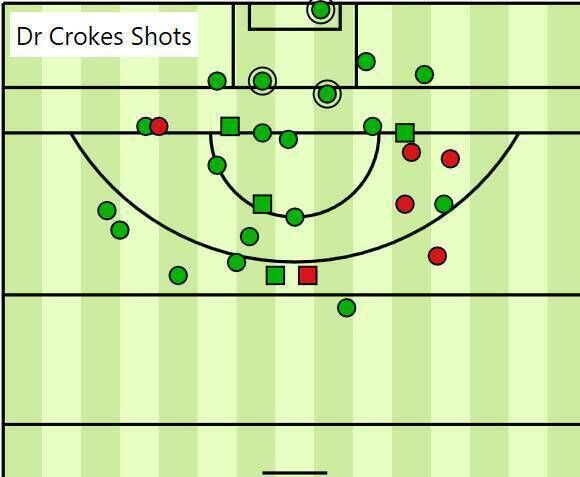
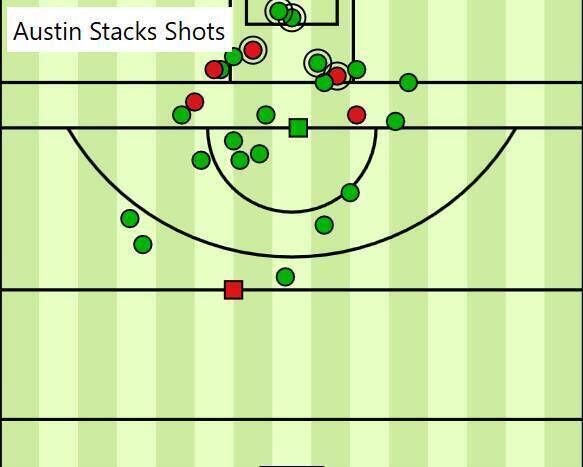
The first notable thing afterwards were the shot maps. More to the point, the scarcity of the mid-range point. Since the introduction of the two-pointer, there have been comparisons and parallels with the three-point line in basketball. Yet here was vivid proof of its impact. There were 11 attempts at two-pointers in the game, but the vast majority of shots came from the small D inwards, with strikingly few attempts in between. Charlie Keating’s telling impact off the bench was cut from the same cloth: four shots, three two-pointers and one fisted point.
This, it should be stressed, was a heavyweight clash between two proud clubs in a county that long defied fashion. When other teams stopped kicking into blanket defences, Kerry continued to do so because they had elite kickers who could still make it pay. But the new world is exerting its pull across the board now.
Read More
Another striking feature was the return from kickouts. Dr Crokes retained 80%, Austin Stacks 76%. An astonishing, and increasingly familiar, statistic from that is this: of the kickouts Shane Murphy retained, the Killarney side scored 1-13. Stacks’ return was 19 for 1-12. That is 39 total restarts for 31 points. Collect kickout, cash it.
The profit for opposition kickouts won was even starker: Crokes won six for 1-7 (3 two-pointers), Stacks won five for 1-4 (1 two-pointer). Consider what this remarkable return looks like for a moment: win restart, take shot, over and over. That is why there were 19 short kickouts in the first half and it is why so many have come to call it “a game of kickouts.”
There are a few intriguing elements at play here. The first question, we ask while ducking for cover, is whether this really does clear the threshold for a classic.
“All that is good about Kerry football,” said Kerry All-Ireland winner Seán O'Sullivan on Clubber co-commentary at half-time.
“The one thing I would say, somebody just texted me, ‘there isn’t a whole pile of defending going on.’ It is really hard to defend quality forwards, especially quality forwards that are getting quick ball and space.
“Obviously it is great for the neutrals and great for us to watch a free-flowing game, but I wouldn’t like to be a defender out there today.”
There were sensational moves and terrific scores all over the field on Saturday night, yet Gaelic football can be about more. Physicality and contests are high up on our wish list for a true, fully sealed epic. That said, they are not always requirements for a team to triumph. Never forget that Kerry won an All-Ireland title last year despite making just 16 tackles in the final.
Secondly, for some, shot location is simply a case of common sense. Why take a point from a foot inside the arc when a step back is worth two? (Unless you are Crokes substitute Tom Doyle, who came on and immediately took one of the few attempts from this range. He nailed it.) For others, it is one of the lessons from the recent Games Intelligence Unit (GIU) report on the 2026 season. Its comprehensive shot and kickout maps can paint a picture of the state of play.
The mere existence of such a resource can do wonders for the association. Imagine the improvement in punditry if entire team profiles, how they like to defend or attack, their kickout tendencies, were accessible. It has further implications for the coach.
For one, they now have an accurate picture of what “good” looks like. Teams across the country set all kinds of targets without any true grasp of what they are. This report sets out what a winning performance looks like.
In terms of on-field implications, it further strengthens the case to aggressively press kickouts. The strategic value is obvious.
This was something Johnny Bradley, who heads the GIU along with Ulster University’s Dr. Michael McKay, was keen to stress at the Expert Advisory Group press conference in Croke Park.
“I think to be able to say this is what the game looks like is really important, not only for the general public but also key stakeholders like coaches and players, referees, media, things like that,” he said.
“They can see, this is where the game is and teams can say, here is an edge we can get at. I think that is really important.”
This is an extraordinary era for Gaelic football. An association once allergic to change has embraced a new format, calendar and rules. We are still coming to terms with all of it. The GIU report is just another layer to be absorbed. It also signals a new challenge for all stakeholders, from rule makers to coaches. Never has there been such a wealth of information.
But, how do you make the most of it?


CONNECT WITH US TODAY



Be the first to know the latest news and updates