Is a change to GAA's referee age limit on the horizon?
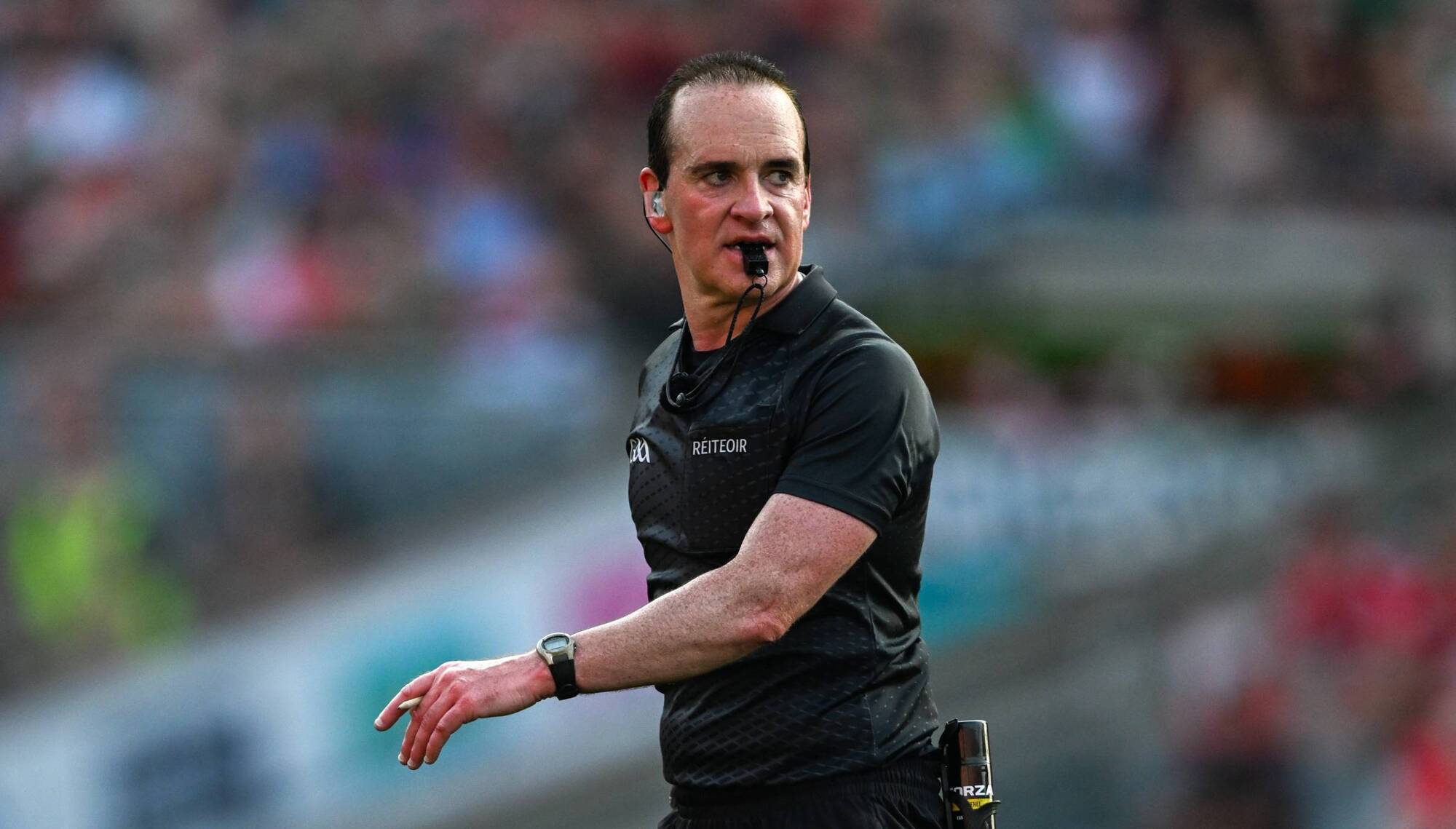
The Mayo and Louth All-Ireland SFC semi-final was the last game of inter-county football officiated by David Coldrick. Pic: Ray McManus/Sportsfile
With a tinge of sadness and an air of disappointment, David Coldrick bowed out of inter-county refereeing this past summer.
The Meath man did not want to go but was compelled by the 2011 regulation that those on the championship panel had to step away before the year they turned 50.
And so just like Gerry Kinneavy and Aidan Mangan became the first, Coldrick became the latest, the Mayo-Louth All-Ireland SFC semi-final in July his last appointment.
The rationale behind the decision was to clear the way for up-and-coming referees.
Read More
“We’re seeing the games moving considerably quicker, the players are getting younger,” said then national match officials manager Patrick Doherty, who is now head of operations in Westmeath GAA.
“We see (the media) speculating once a player turns 30 – you’re retiring him. It’s felt we need to move on. We need to get new and younger referees into the system and it’s certainly felt that that’s been hindered by the fact that we have a number of senior referees still there.”
But may there be a return for Coldrick?
GAA president-elect Derek Kent has indicated his opposition to the limit. Ageism is not a charge the GAA want to be saddled with, especially when other sports organisations don’t have upper age limits.
Fifa disbanded their cap of 45 years of age for international referees over a decade ago but reserved the right “to require referees over the age of 45 to undergo additional technical assessments as well as specific medical examinations and fitness testing on a case-by-case basis.”
They were also scored on performances on the previous 12 months.
World Rugby does not operate a maximum age limit. The IRFU’s affiliate referee policy, which relates to officials appointed when branch officials are not available, is open to those aged between 16 and under the age of 60.
Officials up to the age of 65 are permitted when they provide a medical certificate indicating fitness to referee.
“When it (the cap) was brought in 15 years ago, there was good reasoning for it but I think we’re in a very different time,” Coldrick told in August. “I do feel it should be fitness and performance-driven as opposed to purely age-related. But, look, that’s out of my hands. I do think that it should be reviewed. It’s pretty arbitrary and a pretty blunt instrument but it’s for others to maybe take it on.”
Coldrick’s former colleague, Eddie Kinsella, who refereed the 2014 All-Ireland SFC final would have felt the same when he had to step away in ’17.
John Keenan, who took charge of the 2023 All-Ireland final knowing it was his last game, has also called for the limit to be reviewed.
DCU professor and Dublin selector Niall Moyna, who was involved in the referees’ fitness tests, says there is no physiological reason why they can’t continue to operate at the highest level beyond 50.
The likes of Barry Kelly, James Owens and Pat McEnaney have all endorsed the ceiling but the regulation doesn’t take into account the loss of experience in such a short space of time.
Football-wise, Fergal Kelly joins Coldrick and in the next couple of years Barry Cassidy, Seán Hurson and Conor Lane are due to finish up.
In hurling, Liam Gordon, who missed this past season through injury, Colm Lyons and Johnny Murphy are all set to reach 50 in the next few years. Three referees who between them have taken charge of four All-Ireland finals.
Owens has just departed the scene after officiating in three.
“If you can pass the fitness test, you should be allowed an inter-county referee,” says three-time All-Ireland SHC final referee Fergal Horgan. “That should be the only criteria. It shouldn't be an age limit.
“It’s just a simple tweak. The referees committee should just say, ‘Look, until such time as you fail the fitness test, but if you fail it once when you're over 50, then you're gone.’ That should be the criteria.”
Horgan doesn’t like the idea that the limit on an inter-county referee should be determined by their years on the championship panel as opposed to their age.
“James Owens had done it for over 20 years. James Owens is fit enough to referee, so why would that come into it? You can't be making up more rules.”
Outside of Gordon, Lyons and Murphy, only Thomas Walsh in the national hurling panel has taken charge of an All-Ireland semi-final. In four years, a third of that 12-man panel have gone. The brain-drain is very real.
“You lost John Keenan and Paud O’Dwyer and myself, we all went at the one time (in 2023),” says Horgan, “I went myself, I was only 43. If you lose three referees like that, that have refereed All-Ireland semi-finals and finals and provincial finals, that's a big loss.
“You're losing quality referees there, maybe two or three at the one time, and you don't have them coming through to fill the gaps that they're leaving behind, so why would you want to get rid of them? It doesn't make any sense to me.”


CONNECT WITH US TODAY



Be the first to know the latest news and updates