Rewards and punishments: How hurling hones discipline
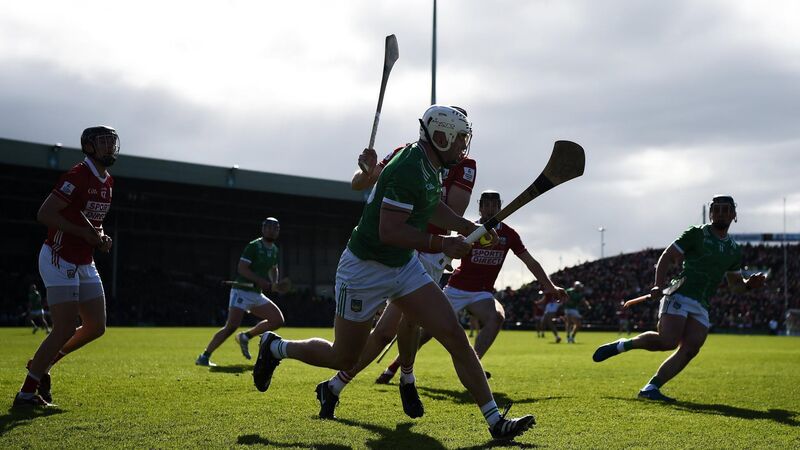
Aaron Gillane of Limerick in action against Robert Downey of Cork. Pic: John Sheridan/Sportsfile
Even in the war zone where hurley shrapnel cut through the air, where the creed was disrupt and destroy, where hitting was a currency, there had to be a line. In Kilkenny, Brian Cody was the architect, Martin Fogarty the watchman.
In training games, Fogarty took up a position like a sentry, policing certain players liable to stray too far. Jackie Tyrrell was a constant offender, belting and slapping away. His coach consistently rebuked him for it. Once, he produced a video of a club game to drive home the fact that Tyrrell had forgotten the limits.
Striking that balance between raw combat and reckless violations has been a constant battle for players and coaches throughout history. Now, though, it is even more important. Swarm tackling and the erosion of the traditional grid have driven physicality levels through the roof. The use of possession and short-passing by the game’s elite means a red card risks complete collapse. You have to bring the edge. You have to bring control, too.
At the Munster championship launch, Clare’s David Reidy smiles at the question.
“How do you coach discipline? There have to be rewards for good discipline and then, does there have to be punishment for no discipline? They are the two questions you would be asking.
“Rewards for good discipline have to be, you have to figure out what they are and what motivates a team. What is the culture in your team? It isn’t a straightforward answer. There is a bit of thinking needed.”
Hold up, rewards? How exactly do you reward good discipline? The stick is obvious; players who tip over the edge can expect to hear all about it. What is the carrot?
“That has to be something you work towards in a team. The players buy into it and develop it, I’d be big on that. The players have to decide what that reward is.” Even Cody, for all the mythology about lawless training matches and a bully-or-be-bullied ethos, would nail a player for a sloppy disciplinary breach.
“The only time he might blow for a free was if someone was stupidly pulling a jersey or if a player blatantly pushed someone into the back,” explained Tyrrell in his autobiography, The Warrior Code. “Brian hated those unnecessary indiscretions, those cheap frees.”
How can a team police it? Do they need to? It depends. The law applies on and off the pitch. In the aftermath of Clare’s 2014 All-Ireland triumph, Davy Fitzgerald bit back at allegations of ‘humiliating’ players. He went public after his 14-man team came from behind to beat Dublin in their first league win of the season. The same week, two hurlers left the panel, claiming they were unfairly disciplined and that another player had committed a similar breach but was not punished.
“There is a code of discipline and that is it,” said Fitzgerald, while contending that his management were content that they treated everyone the same.
That same principle applies on the field too. Tackles, tempers and technique all need to be controlled. Sometimes that comes through belief, other times it is boundaries.
“There is a place for both, but it depends on the group,” clarifies Reidy.
“Their maturity levels, the age profile, if you go back to 2014 when I came into the panel, the age profile was very young. So the stick had to be brought out more. Whereas now in 2026, the age profile is older and the stick isn’t used as often."
A key part of coaching the tackle is removing the temptation to foul. Academies often get players to tackle with tennis balls in their hands to eliminate any pulling or dragging. However, there is a gap between development and performance. One is focused on fundamentals. The other is ruthless about whatever you can get away with.
Optics are as important as execution. When it comes to body positioning, a tackler can’t stand square or with arms protruding out. It weakens their ability to make a hit and increases the chances of them looking out of control. Furthermore, the opposition can twist that shape to make it look favourable for them. A high arm is an invitation to duck down and throw the head back. None of this should be promoted in the game but it is part of it.
So players drill technique endlessly in order to minimise frees and maximise the chance of turnovers.
“It is definitely something you can improve,” says Cork defender Robert Downey.
“The picture you are presenting to a referee is definitely something you can improve. I’m sure it is being worked on in every intercounty team across hurling and football because the tackle technique is something referees hone in on. They are probably being told by assessors if there is anything high, it’s a free. So that is 100% something you can improve.” New dissent rules mean a referee can now move the ball forward 30 metres instead of 13. In an era of elite free-takers, that is a heavy penalty.
“Backchat to a referee is on you,” accepts Downey. “Keep the head down and move on. They won’t change their mind. The best thing to do is walk away. With the new rule, you are going to know about it anyway once the ball is brought forward. The fear of the ball being brought forward in a tight game is all the warning you need.
“In fairness, I think referees have a hard job. With the championship coming, you have full stadiums and everyone baying for blood. It can be an awful lot of pressure.”
Everyone has to deal with it. All stakeholders want a game that teeters between fury and control. The best teams find a home on a narrow ledge.


CONNECT WITH US TODAY



Be the first to know the latest news and updates