Jarlath Burns: The amount of people in Asia keen to invest in the GAA is mesmerising
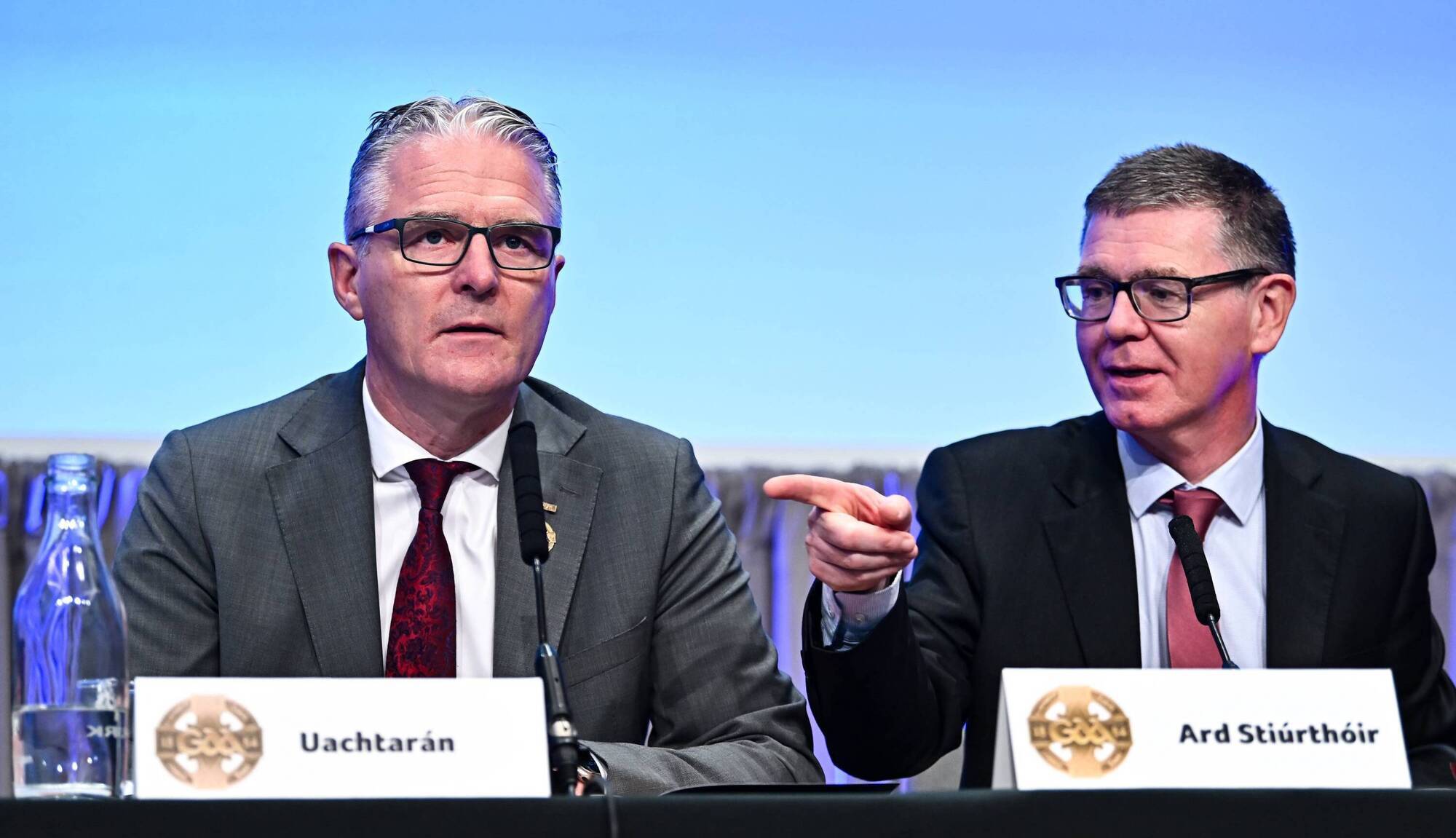
GAA president Jarlath Burns and GAA director general Tom Ryan, along with officials from the Camogie Association and LGFA, appeared before a Joint Oireachtas Committee on Arts, Media, Communications, Culture and Sport on Wednesday. Pic: Piaras Ó Mídheach/Sportsfile
GAA president Jarlath Burns said talks have been held with government ministers regarding how the integration of the GAA with the Camogie Association and LGFA will be funded. He described meeting the cost of building the required new infrastructure as the “biggest challenge”.
Those talks included the possible introduction of a philanthropic fund which would replace the Immigrant Investor Programme. The IIP, which allowed foreign nationals to claim residency in Ireland for a period provided they invested money here, was discontinued in 2023.
“I think of Midleton in Cork in particular - an explosion of population there. Without the IIP funding they would not have been able to build the three extra fields that they need to continue as a club,” Burns told an Oireachtas committee on Wednesday.
“We are trying to work with the government to change the focus of that: look at the lessons which have been learned from the IIP and to change it to the philanthropic fund where there will be a lot more scrutiny around it and it will be a lot more nimble.
“I think that if we get that across the line we could be in a position where we wouldn't be going to government for funding but we could be using the incredible goodwill that there is around the world towards our country to raise funding.
“Myself and Helen (O’Rourke, LGFA CEO) are just back from the Asian Games. The amount of people in that continent who are really keen to invest in the GAA, and in the new GAA, is mesmerising. If we could get that across the line, I think it would be a major assistance.”
Mary McAleese, the chairperson of the steering group on integration, said the 2027 date for the merger “is not ambitious; it is a realisable target”. Though, she also called it a “relaxed target date”.
“Resistance, of course yes, there will be pockets of resistance, there's no point in saying otherwise - your county might actually have been involved in recent comments in that regard,” she said in response to Wexford TD Brian Brennan.
She also hit back at suggestions integration could be more complex than the steering committee realise.
“We are the people, probably on the entire planet, who know more about the complexity than anybody else,” she said.
“We've been living with this for the last three years. We've been feeding off the complexities trying to iron them out, trying to make sense of them, taking all the bits of the jigsaw puzzle to put them into a manageable, navigable plan and we think we're there we think we're as close as darn it to there. We've been eating complexity for three years now and digesting it.”
Burns said one of the greatest sources of anxiety for county boards is the thought integration could triple the cost of running inter-county teams.
“In preparation for integration we have to make ourselves integration ready as well,” said Burns.
“We simply won't be able to sustain an organisation that's spending €120 million every year on preparing county teams. That won't work for any of us.”
The GAA will bring a proposal to Congress next year regarding the introduction of a high performance licence for inter-county teams with the aim of reducing costs at the top level.
“You'll find it hard to believe that up until now the GAA is a governance organisation where we didn't have a regulatory power,” said Burns.
“At Congress we have a new proposal that is going to redefine what it means to be an amateur athlete at the elite level. It is also going to obligate counties to have to apply for a high performance licence to run their county teams.
“Under that is going to be populated with lots of things which is going to really have a greater framework around the closed season, around the amount of money that's being spent, particularly given the interest that the Revenue have shown in matters around the payment of people who are around county teams.
“We hope that by an evolutionary process that we will start to get costs down.”
CONNECT WITH US TODAY



Be the first to know the latest news and updates