Maurice Brosnan: Five takeaways from Jack O’Connor’s big interview
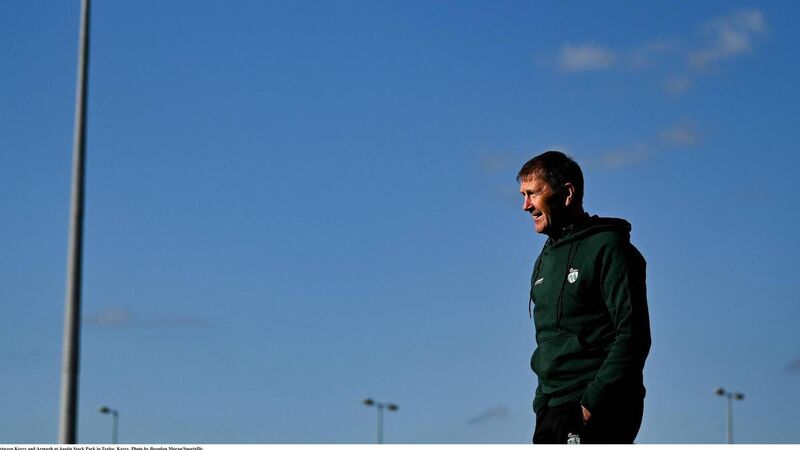
SHINING LIGHT: Kerry manager Jack O'Connor. Pic: Brendan Moran/Sportsfile
It was the only way he could do it. In 2019, Jack O’Connor retired from teaching and took the position of Kildare senior football manager. The commute, on top of the already mountainous commitments, meant holding down a job wasn’t a runner: “It really wouldn’t work if you had a full-time job so I’m glad to be able to get a good shot now,” he said at the time.
This is, increasingly, how it goes. Intercounty management is a brutal ask. Few can do it for an extended stint because of that old chestnut: work commitments.
It’s been another off-season with double-digit turnover in the management makeup. The time and demands are ever-increasing. Jarlath Burns’ recent suggestion that the Amateur Status Review committee would propose a stipend is the latest acknowledgement that this trend is irreversible.
O’Connor’s frank admission on the emotional toll is a revealing part of the entire gig. How many other managers have resorted to sleeping tablets during difficult periods? Will the exposure of that toll make the barstool critics stop and consider?
The scale of this devotion is stark.
“Conspiracy theories come from all angles,” said the Kerry manager. He wasn’t talking about rumours spreading from outside the county. The call was coming from inside the house.
In the aftermath of a remarkable All-Ireland title, one element that shouldn’t be overlooked is just how pervasive the insidious gossip and criticism was from inside the Kingdom walls. It fractured a relationship that the players themselves recognised as invaluable to their chances of success.
There is a world of difference between being a supporter and being a saboteur. The WhatsApp mill can do untold damage. It is hard-wired in us to crave the thrill of being ‘in the know,’ but that instinct turns corrosive when it feeds rumour rather than truth. At least media must verify before they publish. Others feel no such obligation before they hit ‘forward.’ After their extraordinary showing against defending champions Armagh in the All-Ireland quarter-final, Seán O’Shea said it best: “People weren't giving us any hope, even down at home.
"But we've a really tight group. Nobody knows what goes on in our dressing room. The fellas that are inside, we love each other. We are a really tight group.”
Paul Murphy has played in five All-Ireland finals, including replays. The Kerry stalwart, recently heralded by David Clifford as the one with the highest football IQ in their dressing room, knows every component of the big day. In these pages last month, he picked out what is consistently “one of the electric moments.” It was the parade.
It wasn’t a coincidence that Kerry savoured every moment of that walk. Donegal famously opted to break early for another bout of activation. But for five-time All-Ireland winner O’Connor, he had his message: “My whole mantra was enjoy the thing, lads. Enjoy the trip to Croke Park on the bus. The parade. The whole build-up. Don’t clench your teeth and close your eyes and hope that half past three comes around and goes quick.”
What a liberating attitude. It was evidently adopted by the players. Shane Ryan’s pre-game speech was about making sure they didn’t wish the game away. An All-Ireland final is a phenomenal thing. There should be space to savour that.
How wrong we were. In the dark hours of July 27, we confidently spoke about how Jack O’Connor would ride off into the sunset after what was undoubtedly his sweetest title yet. On both accounts, we were utterly incorrect.
Firstly, the case: The 64-year-old rebuilt his entire management team and then endured crippling injury after crippling injury. Their best midfielder, Diarmuid O’Connor, went down with a serious shoulder injury in the league. His partner Barry Dan O’Sullivan was ruled out for the season with his knee. His standout defender Tom O’Sullivan went the same way. Paudie Clifford and Paul Geaney missed significant time.
Despite all of that, they won the league, they won the Munster championship, they beat rivals Cork twice in Páirc Uí Chaoimh, they avenged their 2024 defeat against Armagh, downed Tyrone and Donegal on the way up the Hogan Stand steps.
But 2004 is still the lodestar. The best. The first. The one that proved his standing with the Kerry players and public. It proved to be the source of his own inner belief and paved the way for a golden spell to follow.
In a recent episode of the High Performance podcast, Nottingham Forest captain Ryan Yates explained how their club psychologist showed him the value of clarity.
“He has taught me to own myself. Own what I do best.”
Sport is frequently skewed by individuals who don’t understand their limitations or who aren’t anchored in their role. Even with one of the most gifted footballers of all time powering them, Kerry’s triumph in the All-Ireland final was a collective one. Everyone had a part to play.
It was their two men in the middle who perfectly encapsulated that. Mark O’Shea and Seán O’Brien did not kick a pass once in the decider. O’Brien scored two points, one with his fist. Yet they were crucial scaffolding around which the masterpiece could build.
Gaelic football is about sensational scores and silken skill. It is also about breaking ball, kickout contests and pure desire. In 2025, Kerry mastered both.
.

CONNECT WITH US TODAY



Be the first to know the latest news and updates