Mikey Sheehy: Farewell Micko, the greatest Kerry Gael of them all
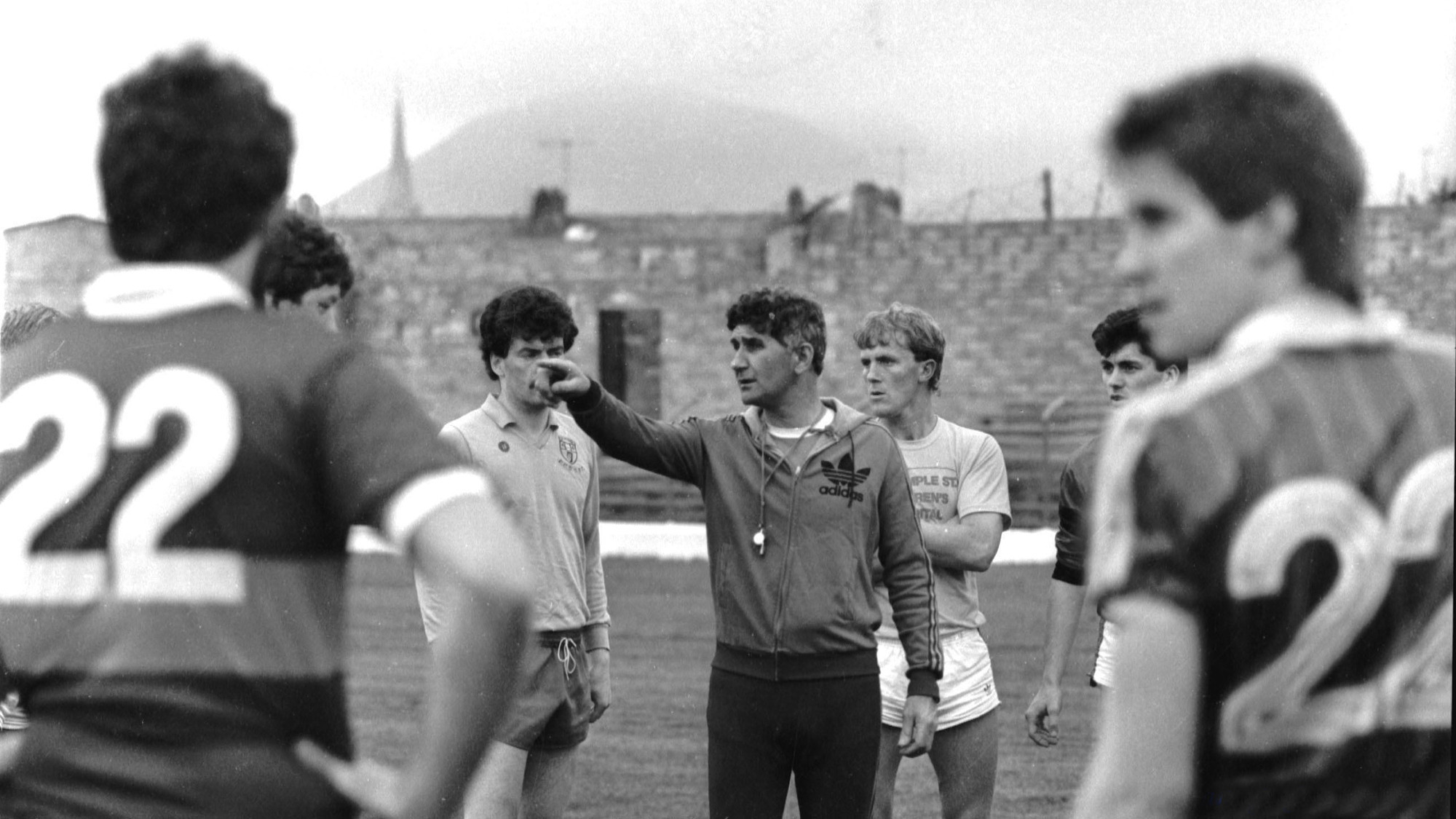
MASTER AT WORK: Mick O' Dwyer training the team in 1982. Pic: Don MacMonagle
FOR years, a lingering frustration that grates, like a stone under the back door.
There are folk, and I am amongst their number, who have little doubt Mick O’Dwyer is the most important figure in the history of Gaelic football. As a player, a mentor, coach, manager, a figurehead in many counties, an innovator and an agitator, primarily for his players. It could be that last quality is reason in itself why neither Kerry GAA nor the Association itself moved to create an ambassadorial or emeritus role for Micko when he was done in the dugout. Nor, we should remind ourselves, was he ever invited to manage the International Rules squads that represented the GAA in Australia, which remains, to this day, in the realm of the absurd.
For someone who was a father figure to so many of us who represented Kerry, that will always sting a bit, but we are biased. Perhaps it’s better for someone else to interrogate that sin of omission in the coming days, weeks and months. We will be otherwise occupied recalling the greatest Kerry Gael of them all.
A slightly younger generation may not be aware of some of his epochal achievements. Eight golden year All-Irelands in 11 seasons. A messiah’s hand in Wicklow, Kildare, Laois and Clare. He rewrote convention. Greybeards might even forget that he trained the Kerry seniors and the Under 21s at the same time when I started. Imagine it now.
This was a brilliant person who made Gaelic football mandatory mealtime conversation for the better part of 20 years across the country. To have been in any of those dressing rooms is to have been inspired. In life, we crave inspiration, levitation. We would do quite anything he asked us, knowing he wouldn’t ask to do something he wouldn’t do himself. We never had reason to cross him but woe betide anyone who did.
At half time in the (in)famous 1978 All-Ireland final, he caught my eye in the dressing room in Croke Park. Kerry had managed to turn around a fraught situation against the Dublin side chasing three All-Irelands in a row. There was that free, an undeserved one, and Robbie Kelleher handed me the ball. What was I to do? But I knew what Dwyer's look spoke to. There’d been a winter heave against him at home, and ’78 was die dog or shit the licence for us all. I knew what he was thinking. It wasn’t ‘marvellous ingenuity, Mikey’. It was: 'you’re a lucky boy that went in over Cullen, cos it was a tap over free and we needed every point…’
It's hard to rationalise from the distant end of a remarkable era there was a move to get rid of him after the ‘77 semi-final loss to Dublin. Gerald McKenna, the chairman at the time, saved him. The players knew he would have fallen on his sword before pointing in our direction but we’d let him down. There would have been stubborn loyalty in the group that we ferried into 1978. We started shockingly in that final and were 0-6 to 0-1 down before John Egan’s breakaway goal. Today, they’d marvel at the transition offence but the Dubs were riding high and left the back gate open. The rest is history. But I’d often wonder, if they’d got rid of Dwyer, how many of us would have been gone with him?
Read More
Five years before all that, in October, 1973, I was a young pup sitting in the dugout in Killarney when Andy Molyneaux, the secretary, ran up the sideline. ‘Where’s Mikey Sheehy? You’re on for the second half’.
Mick O’Dwyer was 36 and not just on the field still, but on the frees. I got one instruction from the Kerry mentor Johnny Culloty. ‘You’re on the frees’. That was tricky, because Micko was having a bad day. Next there was a free given, 30 yards out, and I got that eye I’d later recognise. The man from Waterville wasn’t going to let the boyo from Tralee steal his thunder. I was 19, he was nearly twice my age but he was a greyhound breed and even when he started in charge of the seniors in ‘75, he was doing the sessions in every sense of the word.
They talk about backroom teams now, and I’ve been involved in recent seasons with Éamonn Fitzmaurice, but Dwyer was the backroom team, full stop. He had four selectors, and they were good football men, but they were there to offer counsel. He was everything. He was the physical trainer, the physio who told you whether you were dodging training or actually carrying an injury. At time, you might literally have to break a leg to convince Micko you weren’t able to train. Moreso, he was the team psychologist. Dwyer could read you like a book. He knew if you were in good nick physically or in a bad place mentally. From a personal point of view, and everyone’s different, that was key.
There was one year I wasn’t going well in the league. It was 1981. I had torn ligaments and was out for a while, I missed the League semi and the final against Cork in Páirc Uí Chaoimh. The team was very settled, and we were playing Clare in Ennis in the Munster Championship. Clare were no joke. There was the odd mauling in Milltown Malbay, but most times you’d earn every ball. Mondays after Ennis, you woke up sore.
There was a bit of speculation that I wasn’t going to be started. On the Thursday before, they usually named the team but before that and after the showers, he went for spotting me. He had it planned. ‘A lot of oul talk around the place Mikey. Don’t you worry. You’re No 13 on Sunday, as always’. I could have run from Killarney to Tralee. Little things like that.
In March 1975, we were well beaten by Meath in a League quarter final in Dublin. Then Dwyer walked into our lives. All changed. The famous 28 sessions in a row. That is true. There was some training every night. It was mad, but fellas were mad for it.
He’d been to England, leaned on some contacts to get him into First Division training sessions. He’d filled his notebook and infectious enthusiasm did the rest. But you’d notice the difference as we progressed. He’d encourage us to play with the clubs and against good teams, they’d stay with you for 40 minutes before you’d burn them off for fitness.
As bellies spread and years progressed, he’d tailor things for the fatties, the lads who wintered better than most. If you were off it, you’d be back early but he never, ever embarrassed fellas. He’d tell you quietly if firmly.
From 1975 to 1986, I listened to him in dressing rooms after training and before games, and he used the tools he had been gifted – a powerful voice, a magical orator and a supreme motivator. He’s the best speaker I’ve ever heard in the dressing room. I never tired of listening to him.
We failed to do the ultimate five in a row and it hurt him more than the players. It hurt us, but it killed him. In fairness to Jim Gavin, it’s tough to compare eras and in relative terms the two are comparable but in a different, less sophisticated era, Dwyer won eight All-Irelands in 11 years. To come back after ‘82 and Tadghie Murphy in '83, and have the defiance to drive on and win three more in a row was truly remarkable in terms of staying power, energy and pure ambition.
It’s often said that Kerry team would have won All-Irelands whoever was in charge. They might. But not eight. I might be wrong but I’ve always felt if we’d won the five in a row, we’d hardly have won from 1984 through to 86.
Of all the counties who could beat us, Dwyer was best relieved it was Offaly. In 1981 they could have caught us, Gerry Carroll hit the crossbar in the second half. They deserved to win their All-Ireland but privately it broke Micko. We played Offaly the following February in Tullamore, we put in a bit of an effort for it and we beat them up there. His reaction said so much about what he was carrying from the previous September.
Seamus Darby et al were moments that changed GAA history but could never diminish Dwyer’s legacy. He knew it could have all washed up in 78 when Dublin were playing champagne football and Bomber went over to the sideline to come off because his back was at him. Dwyer told him to fuck off back into the edge of the square. Liston would go on to bag a hat-trick. Things that day didn’t just change the course of the game, they altered history. Kerry built to four in a row. Myself and Paddy Cullen, Lord rest him, would be great mates. Was it even a free? The referee Seamus Aldridge reacted to the Kerry crowd because Ger Power had come in late on Cullen a few minutes earlier and got a bit of a clip in return. The Kerry lads in the Hogan stand reacted, so they were still riled up.
Jimmy Keaveney was a huge loss to Dublin in 1979, but they were on the way down at that stage and Dwyer had us primed to capitalise. We were hitting our straps now, Jacko maturing, Bomber unplayable. His kicking wouldn’t have been good, but with Dywer down in Waterville, he developed a good kicking basis off both feet. Playing alongside him, Bomber was totally, totally unselfish. And Dwyer knew if we were ever struggling in the middle of the field, he would give Bomber the beck to break opposition momentum.
He had a bagful of man management tricks for the heavy brigade, the likes of Kennelly, Páidí, Egan, all sadly passed before the great man. He’d have a couple of hares at these sessions too and he’d give the rest of the crew the week off. We’d do four nights, including a Saturday morning, no-one else there except himself and his sadism. Wire to wires. Two laps to warm up, stretch yourself. He had five or six PE teachers in that squad but he seldom sought their counsel. He would do it in fours. When things were going well, he’d be doing the two inside backs running against the inside forwards - and John and Ger O’Keeffe were flyers.
What they call periodisation now, Micko had copped 50 years ago. When the cuckoo came and the evenings lengthened, he’d say to me on the quiet to go down to John Dowling’s in Tralee and secure eight or nine new footballs. He had more balls than O’Neills. Fellas would be mentally exhausted at the prospect of more wire to wire pain. Then he’d pull out the piece of paper with two teams and you knew the lottery numbers had come in. Football!
The value he’d get in those games. He’d ref and whistle three times – the start, for half time and to start the second half. Absolutely killing fields. Deenihan would have me or John Egan for lunch. Ger Keeffe was woeful fast and the f*cker would never buy a dummy. You might catch John O’ eventually but ‘Gadocha’ was sticky out, the best I’ve seen at staying on his feet.
If our loyalty to him and his methods was firm, it was embellished by the way he was always wanting players to be looked after. The story of the gear and Bendix and team pictures are legendary, but all well-meant. I used to wear Puma boots, they looked after me with gear etc. Then there was a deal done with Adidas, a performance-related bonus scheme to help the players’ holiday fund for a trip. I wanted to keep wearing my Puma Kings. He took the boots, sorted three stripes on them and handed them back to me. Don’t ask me how. He kept the Bendix thing very quiet, and limited to a small group of players. Many now will have little notion what I am referring to but many older readers will. It was essentially the first commercial deal done on behalf of GAA players, and Dwyer’s smarts were all over it. He had his men lined up in the dressing room in Tralee, a washing machine brought in, and a full page ad in the Sunday papers.
There was another time with a team photograph where he orchestrated for two or three players to miss out on the pre-match picture. Nobody said a word, I knew nothing until it was done. He was years ahead. Croke Park frowned on all that. And maybe that’s where he put some official noses out of joint. Some in Kerry didn’t like the idea either of him heading off to Kildare and beating his own county in the 1998 All-Ireland semi-final but what did he owe us? It’s a pity he was never appointed director of football in his own county.
Darragh O Sé rang me one Monday and said was heading down to Waterville. Darragh and Micko’s son John would be good friends. I was shocked when I landed, because I hadn’t seen him since before Covid. But the brain was as sharp as ever. We had a great old chat about wonderful, unforgettable times. His memory was fantastic, his recall of detail and witticisms unbelievable. We never spoke of All-Irelands but rather old challenge games and pitch openings where he’d carry lads to see would they make it. How did that young fella get on, Micko?
"Well I hope he had a good look at the place, that’s all I’ll say…"


CONNECT WITH US TODAY



Be the first to know the latest news and updates