Eight observations from the AHL: Hurling could benefit from football's new advantage rule
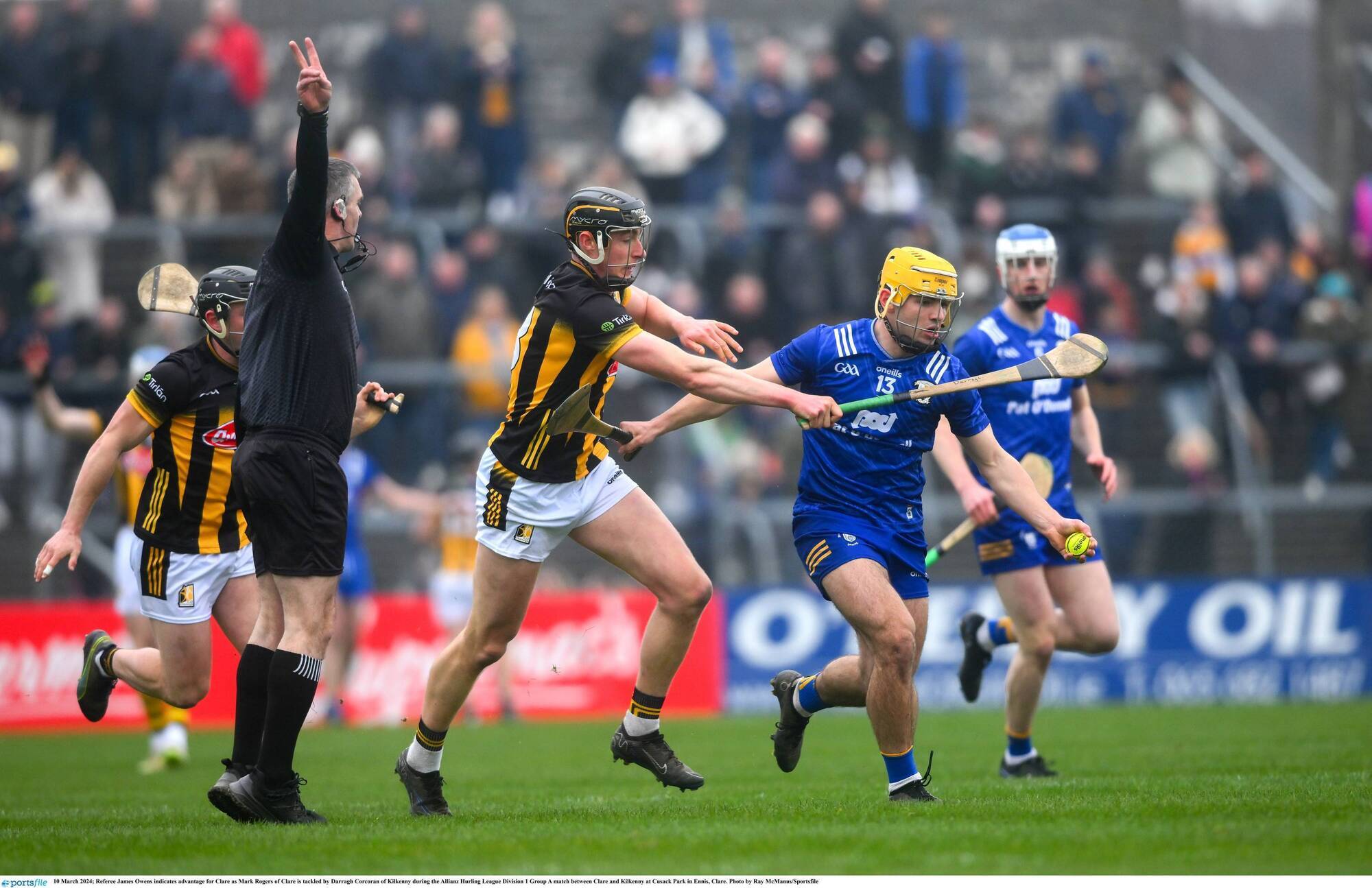
Hurling rarely embraces the idea of carrying across Gaelic football rule changes but the new advantage rule with no time limit has its benefits. Pic: Ray McManus/Sportsfile
The league has not been kind to All-Ireland champions. Limerick distorted the perception, but great teams tend to do that. The reality is that rising for a successful league campaign after climbing the Hogan Stand steps the previous year is tricky.
“I don’t think the league will define us,” said Tipperary’s Liam Sheedy after the 2019 All-Ireland winners started the 2020 league with three defeats in a row. Galway in 2018 failed to gain promotion from Division 1B and bowed out at the quarter-final stage. Tipperary reached a final in 2017 where they were hammered by Galway. The last team before Limerick to back up the Liam MacCarthy Cup with a subsequent league title was Kilkenny in 2013. One long campaign can bleed into the other.
For Clare, their focus was never likely to be retaining the league. At their medal presentation earlier this year, two-time All-Ireland winning manager Ger Loughnane pointed to the Munster final as the next summit to be scaled. It is all about Cork in Cusack Park on April 20.
“Realistically now we are about eight weeks out from championship, so we have to have one eye on that and try get our ducks in a row,” reasoned selector Ken Ralph after their six-point loss to Wexford.
Hunger is one of the great GAA clichés, a catch-all term ascribed to all losing outfits. In this case, it at least touches on an obvious reality. Wexford’s need was greater. A demoralised support base needed to see something. Keith Rossiter’s side found an appropriate response.
In sport, panic is a seductive thing. It bounces off reason and ignites nerves. Clare will know it is far too early for that. The year is long and the best teams – those who have already proven their credentials – tend to work it out.
The main priority now is resolving that lengthy injury list and ensuring the likes of Peter Duggan, Diarmuid Ryan, Conor Cleary and Shane O’Donnell are primed for the coming ascent. Despite the fact that relegation is now staring them in the face, their remaining three fixtures will still be utilised for that sole outcome. Even after lining out with a stronger team on Sunday, it is what cost them.
“Big names but probably no games,” said Ralph. “No matter who you are, if you are not match fit, you are going to struggle.”
Here are eight observations from the National Hurling League.
Liam Cahill’s stated ambition was to land on a settled 15 during this league. They are well on their way to realising that desire.
Craig Morgan lined out at corner-back for the 18-point Cork mauling in Semple Stadium last year. He has started every league game in 2025 alongside Willie Connors in midfield. Morgan assisted 1-2 on Saturday and added a point from play. Alan Tynan assisted 1-3 and also scored. Both of them were immense in the middle except for one error right at the end.
Teenager Darragh McCarthy stole the headlines yet their delivery from the half-back line gave him the platform. Bryan O'Mara and Man of the Match Ronan Maher had two assists each. Eoghan Connolly is holding his own at full-back, although his tendency to shoot from frees outside his range will require readjustment.
In the aftermath of a 17-point loss, Antrim manager Davy Fitzgerald found himself in familiar territory. He was on the back foot, defending his sweeper.
Niall O’Connor wore number 15 but played as a seventh defender in Corrigan Park. Afterwards, Fitzgerald said they would have conceded five or six goals without him. Antrim were playing against a strong wind that temporarily interrupted the BBC’s live match coverage. At half-time they were 2-14 to 0-4 down. Even with the wind, they only scored seven points.
Antrim’s problems were so deep and diverse that pointing to any one issue in particular seems unjust. The system itself, though, is something teams across the country continue to evolve. Sometimes it is simple maths. Teams stopped playing six traditional forwards with certain players retreating out the field. It left the six defenders with a numerical advantage. They had a surplus. It isn’t a structured sweeper.
Others preferred to stack the back, like Fitzgerald. However, long distance shooting makes this a dangerous game. So much of Antrim’s troubles stemmed from the middle, where they were often outnumbered.
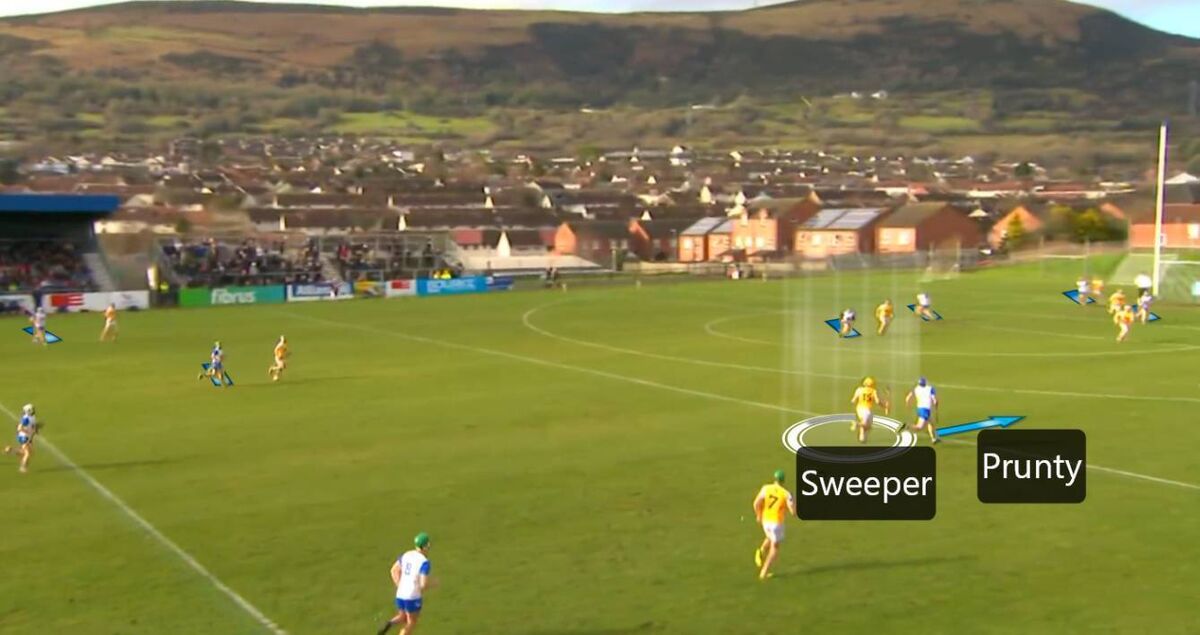
Waterford completely conquered their puckout. Not accounting for the few minutes of lost coverage, at half-time Antrim had won just 39% of their own restarts and managed to score a single point from it. Peter Queally’s side responded cleverly to the seventh defender. Their first goal came after a James McNaughton free. Billy Nolan still went long with his restart. Waterford had seven players forward to match Antrim’s seven backs. Conor Prunty drove on from number 3 and it was his flick that allowed Kevin Mahony to land his goal.
Their second green flag was a penalty from Antrim’s puckout. Stephen Bennett won the break and raced towards goal. He flicked over the head of O’Connor before Keelan Molloy brought him down. It was deemed denial of a goalscoring opportunity.
Just before the turnaround, O’Connor and Joe Maskey tried to work the ball out from their own half. They couldn’t go long because they were outnumbered up the pitch. The move broke down and presented Waterford with a tap over free.
When the new advantage rule was brought up for hurling at Congress five years ago, it attracted little attention. The motion was passed and everyone got on with it.
Now, the referee may allow the play to continue if it “presents the potential of a goal-scoring opportunity or another advantage to the team offended by creating or capitalising on time and space.” What this has led to is more frees.
Hurling rarely embraces the idea of carrying across Gaelic football rule changes but the new advantage rule with no time limit has its benefits. It lasts, “until it becomes clear that no advantage has accrued.”
Consider this minor moment from the Tipperary victory on Saturday. Cormac O’Brien went up the wing from a sideline. Bryan O’Meara got their first and was fouled by Robbie Cotter. O’Meara went back to Eoghan Connolly who prepared to deliver long, only for Liam Gordon to sound his whistle. Play stopped, Connolly protested that a Cork forward was standing over the free, eventually play resumed with a long ball down on top of the set Cork defence where Cormac O’Brien is fouled.
Would Tipperary not have preferred to be allowed play on without the free?
Dan Ravenhill's monster free from deep in his own half secured a terrific win for Offaly against Dublin in Croke Park. Dublin will be disappointed with the final result, having almost overcome the setback of Conor Burke’s red card, but there were moments of quality from both teams during the late stretch.
With one minute left, Offaly scored to go one point up. They outscored the home side 0-11 to 1-3 from the hour mark on. Dublin’s response to that point was to strike fast with a high-tempo puckout. Eddie Gibbons grabbed a sliotar beside his post and went short. It was so quick that the ball that went between the posts was still bouncing on the field having come down off the net.
They worked a point chance. It was blocked down and Brian Hayes responded first, capitalising for a well-taken goal. Dublin conceded the Offaly puckout and actually regained possession, except John Hetheron’s delivery to his inside line was poor and Johnny Kelly’s men hit them on the counter.
Gibbons took his time and did a lap of the goals to allow his forwards to set up. They went look to a pod and won a free, pushing two clear with the clock in the red. Even that final free came after they worked a scoring opportunity, until an apparent throw handed Ravenhill his chance.
A stunning second-half comeback saw Donegal stun Kerry in Division 2 last weekend. Captain Conor Gartland scored a goal in Letterkenny and told former senior footballer Brendan Devenney on what the win meant to him.
“The closest game I could compare the feeling after was that Nicky Rackard final last year in the Donegal colours, to be honest,” he said.
“That is where it ranks for us. You know yourself from your playing days, there is no better feeling in going out and beating a team that you just have no right to beat. You are completely written off before the game. I think the feeling is echoed by the whole time. That was as good a feeling after a win as you’ll get.”
Not only was it one of their greatest triumphs, it was also a historic occasion. According to the great X account, GaelicGamesStats, that win was not only their first time beating a county who have won an All-Ireland title, it was also their first time playing one. That is limited to the 32 counties and the league, they did play Limerick in the championship 102 years ago.
The Games Intelligence Unit produced their first report on the new Gaelic football rules last weekend. They analysed 47 games across the opening three rounds after all teams agreed to share their footage. It is the first ever in-season statistical report that will benefit the association in so many ways.
All of the footage is broken down and shared. It means referees can see every foul and their specific data. Teams can access game events like kickouts, shots and turnovers easily, a huge addition for counties with fewer resources. The GAA’s communications department can produce packages based on lower tier games, providing clips that have been sorely lacking until now.
If the GIU is consistently supported and expanded, all of this will benefit hurling. The issue of a lack of highlights is even greater in that code. Recent failure to properly acknowledge the scoring feats of TJ Reid and Patrick Horgan would be resolved with centralised data. The means exist already. Two of the three Insight Development members, Johnny Bradley and Denise Martin, have published a paper on the difference in performance indicators between winners and losers in intercounty hurling.
The double. It was an outstanding weekend for London GAA as their footballers beat Tipperary away while their hurlers overcame Mayo away. It leaves their hurlers top of Division 3 with four wins from four. They are managed by Birr’s Neil Rogers while former Cork goalkeeper Anthony Nash is coach.
Making many headlines last weekend was the fact that a hurling hand-pass motion club was defeated at the GAA Annual's Congress in Donegal. Former Tipperary and Nenagh Éire Óg hurler Conor O'Donovan brought the proposal which received 32.4% of votes.
Wexford’s 1996 All-Ireland SHC winning manager Liam Griffin withdrew his call for all dual clubs to establish hurling teams under the model from U7 to U10.
While it didn’t generate as much debate, the fall of motion 17 was also noteworthy. This motion proposed that there would be an entitlement for Central Council to determine the representation at any Special Congress. That used to be the situation a number of years ago, but recently it has been a full representation at Congresses. This could have had a major impact on what unfolded at future Special Congresses. Strikingly, 72.8% voted against it.


CONNECT WITH US TODAY



Be the first to know the latest news and updates