'We’re all letting each other down' on training ban, says GAA boss Ryan
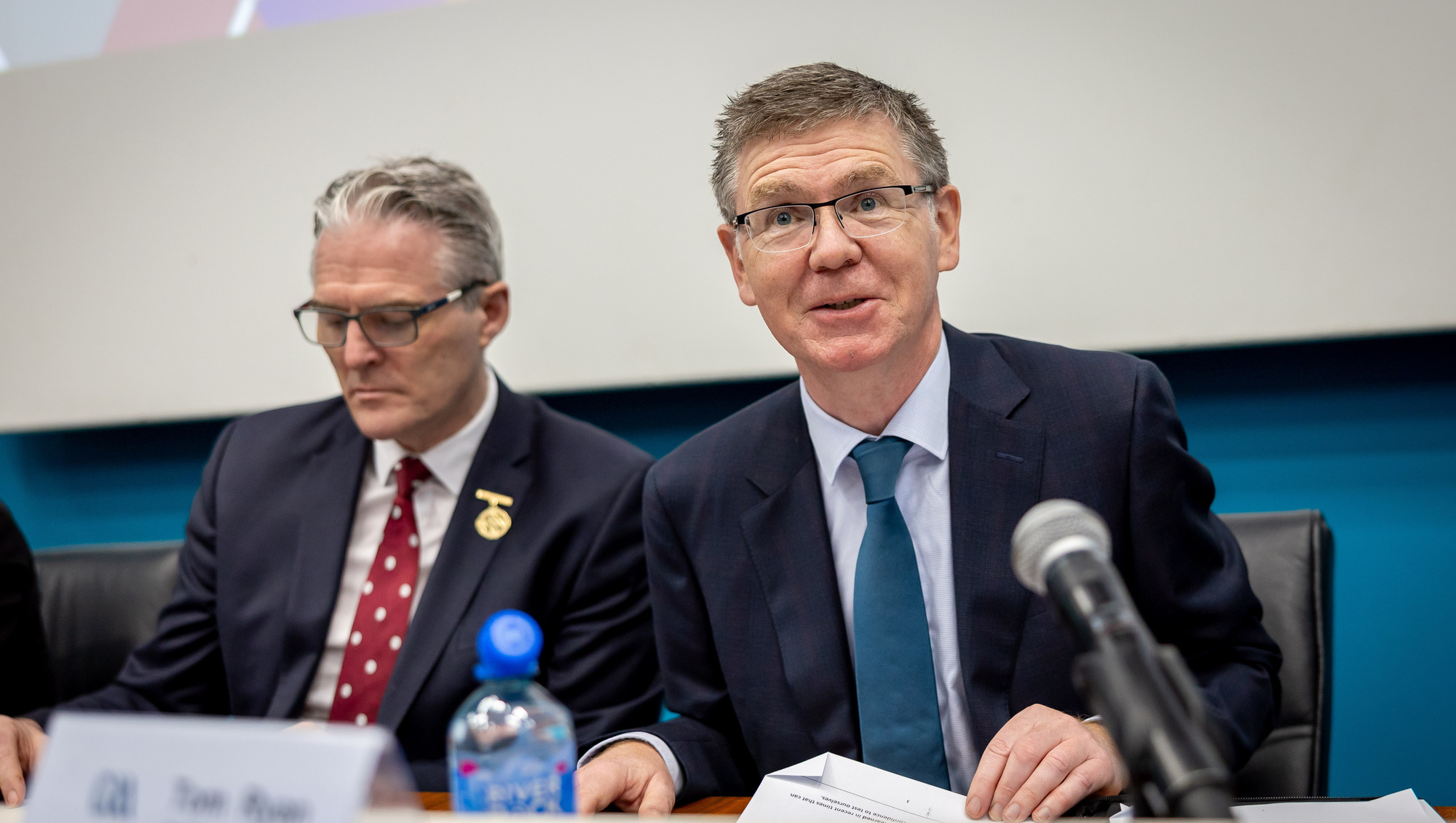
GAA President Jarlath Burns with GAA Director General Tom Ryan. Pic: INPHO/Morgan Treacy
GAA director general Tom Ryan says the association may have to consider strict enforcement of the closed season after admitting “we’re all letting each other down”.
At January’s Central Council meeting, GPA chief executive Tom Parsons reported four or five county teams commenced training prior to the official start date of December 7.
That figure is widely considered a conservative estimate after the GAA agreed with the GPA to disband the pre-season competitions and push training start dates back from November 24 so that November could become a zero-contact month for players.
In his annual report published on Thursday, Ryan admitted he was “underwhelmed” by the impact of that decision for the sake of player welfare. “If this structure is to persist, we must make it work, otherwise the sacrifice of those competitions is just pointless. So that means everybody stretching their thinking a bit.
“Counties not permitting or sanctioning training, managers trusting and minding their players, and the GPA telling us where breaches arise, and the Association enforcing. It’s a shared responsibility and we’re all letting each other down.” Asked at the subsequent press conference if counties mentioned by Parsons will be investigated, Ryan responded: “An investigation has all manners of other connotations and so on. I think we'll definitely assess it and we'll do our best to gauge what the actual adherence, observance and otherwise was.
“And then thereafter, we'll have to look and see the (pre-season) changes that we brought in. No, they achieved certain things. Of course, they did. And they're really valuable. But if the core of it is to give a rest for players, if that didn't work, we're going to have to either look at doubling down our efforts or come out at a different angle.” The recommendations from a forthcoming report by the amateur review committee could provide solutions, as they might for the €44 million spent on inter-county teams in 2024, the latest total that Ryan described as “unsustainable”.
He said of the figure: “There's nothing I can do on my own to change that. That's a responsibility that sits jointly between counties and ourselves. I think a lot of it really will be around the common commitment we have with the GPA at the moment regarding contact hours for players and making the lot of players a bit more reasonable. And that's not purely from a cost point of view. It's from a point of view of the efforts that they have to expend to reach the levels that they do at the moment.
“It's difficult to see how the level we have now, where that's going to take us in five, 10 years’ time if we don't arrest it. So what it means is spending less, spending less effort. Maybe we centralise procurement and we put some of the burden at this table here (national GAA leadership) for procuring, whether that be travel or whether that be related ancillary services around teams.” Ryan indicated counties other than Galway, Mayo and Wexford will be subjected to risk reviews by the Revenue Commissioners. Referring to those audits at the end of 2024, he remarked: “Clearly, this presents a risk of financial penalties in the counties concerned and a risk to our collective reputation.
“The latter was not helped by the extent of public commentary on the topic. There was also the risk that outcomes in any given county could have wider-reaching implications for others.” He continued: “Suffice to say that our engagement with the Revenue has been positive thus far and we will work together towards an orderly resolution in the counties concerned.
“That resolution will involve participation by other counties in a review process. It may well come at a financial cost, and it will certainly entail significant work, but it will bring certainty as regards how we treat matters and peace of mind for officers going forward.
Ryan played down the prospect of club referees in future receiving fees in vouchers. “A lot of what we're finding around the Revenue stuff is about documentation. And it's about a trail around transactions.
“And to the extent that that hasn't been available to the Revenue to look at. I suppose what we'll try and do is make sure that counties have a mechanism in place and have a trail in place that they're able to record the correct details and they're available to whoever needs to inspect them going forward.” Following on from his remarks last year about the GAA being involved in using facilities with other sports, Ryan has gone as far as suggesting units of the organisation should share their own infrastructure.
“We need to approach GAA capital projects differently. Shared development have long been anathema to our thinking, I know, but if we can share with universities, share with other organisations then why not share between ourselves? What would our infrastructure landscape look like if we were to prioritise half a dozen facilities around the country for priortised investment, remove the local funding burden, and designate them as provincially or nationally shared? Don’t dismiss it out of hand.”
Ryan said while the integration process by 2027 is continuing, “many more issues have arisen, and there are still as many questions as answers”.
He added: “Appetite for integration is overwhelming, but views differ on what exactly ‘integration’ means and looks like. The key demands of us are a single organisation with a single membership, with universal availability of facilities and aligned fixtures.”


CONNECT WITH US TODAY



Be the first to know the latest news and updates