Eight observations from the opening two rounds of the Allianz Football League
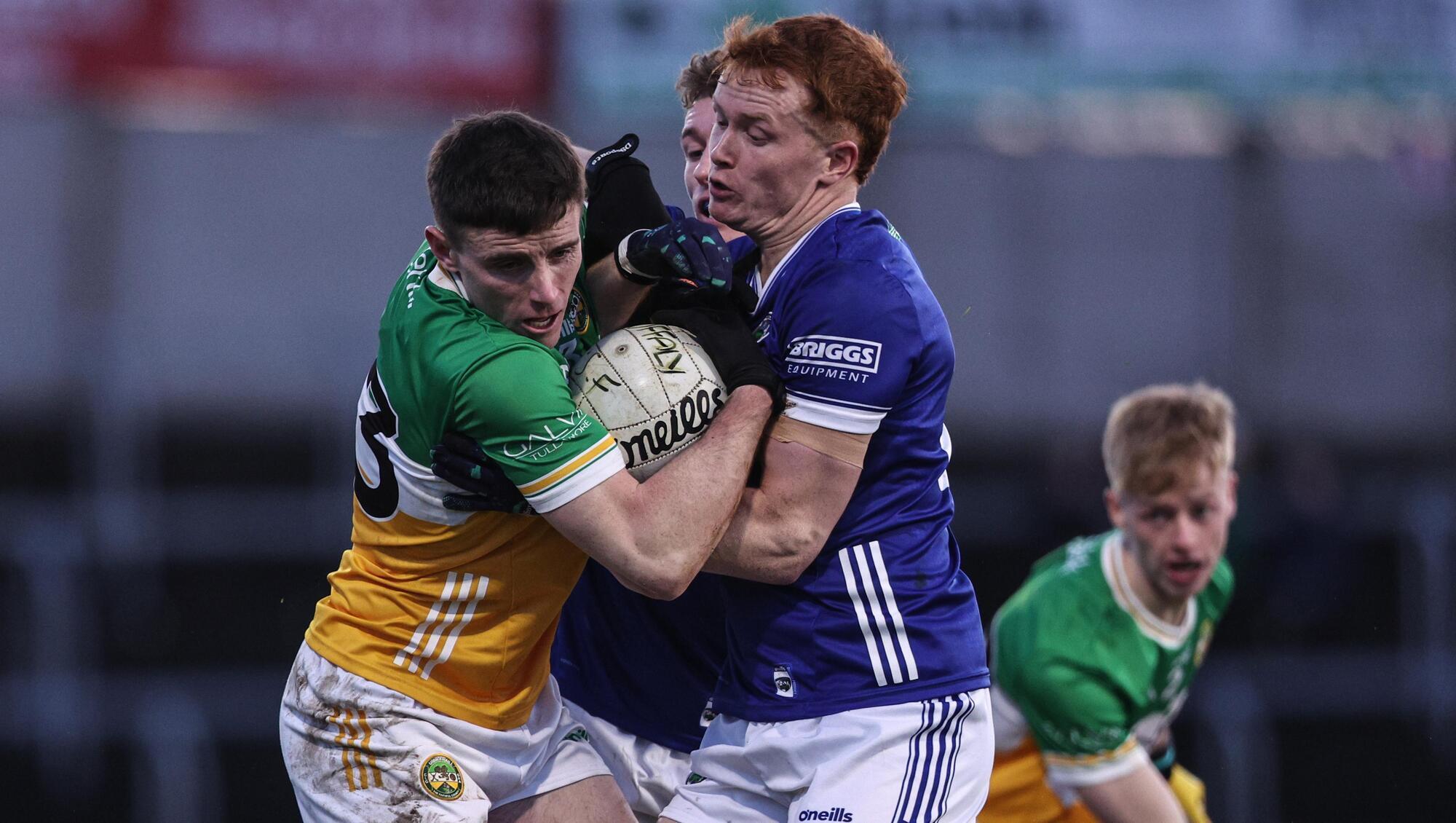
MY BALL: Offaly's Dylan Hyland with James Kelly of Laois. Pic: ©INPHO/Ben Brady
Kieran McGeeney does it on his own terms. He won’t be rushed or corralled.
In his post-match huddle outside the Armagh dressing room after a comprehensive win over rivals Tyrone, it was clear he had something he wanted to say.
The question was about what the new rules did to the match. McGeeney sought to focus on what they will do for the sport.
“They are trying to be positive about the game and that has to be applauded. There is too much negativity.”
Later he was asked about an issue with clarification they had requested around the three-up breach punishment.
“We all have opinions on the rules and the admin side of things… I suppose the best thing for me is we have a positive PR machine behind it now. Instead of all the clowns on TV telling everybody how great they were and how bad everybody is nowadays. I am delighted with that.”
A day earlier, referee David Gough referenced the “media spin put on” the enhancements during a contentious radio interview with . This complaint is a common refrain for critics of this comprehensive change. Where are the sceptics?
The thing is, they are out there too. There was a time when GAA media felt like a singular space. National conversation was steered by one vexed pundit or blockbuster broadsheet column.
This was a game with fewer televised games, where large swathes of the nation had to settle for 30 second highlight packages and empty cliches. Did you hear about the so-called-weaker county that is actually a tough place to go?
That time is gone. The ground is shifting beneath our feet. Streaming boomed and while the county game lags behind the club in terms of wide availability, that industry is only heading in one direction.
Local and national podcasts fill the void left by a lack of any midweek analysis shows and uninformed commentary.
No television coverage for Offaly vs Laois? It doesn’t matter, the county will post goalkeeper Paddy Dunican’s glorious goal for you. Carlow will provide all of their green flags from a triumph over Waterford.
can talk you through Ryan McAnespie’s form. Conor Sweeney will bring you through Tipperary’s forwards on
An unfortunate side-effect of this is the cherry-pick contagion. If someone wants to make a case that there is too much blind positivity about the new rules, they point to Cahair O’Kane’s enthusiastic report from last weekend’s thriller in Derry, Peter Canavan’s blessing or Padraic Joyce’s wide smile as evidence.
Too much negativity? Sure, didn’t Joanne Cantwell grill Éamonn Fitzmaurice about the lack of a rulebook and Colm Boyle’s column suspects the two-point arc will be scrapped and what about all these managers going on about injuries?
There was a remarkable case of this a few weeks ago. Niall Morgan’s scepticism about the prospect of Michael Murphy lining out in goals for Donegal was heralded as proof that the 12v11 debate was overblown.
This is despite the fact that in the very same interview, one of the best goalkeepers in the country flagged that he was coming out at least six times a half and that he’d consider going back to soccer if they got rid of the rule.
Casual or diehard, vibe or data driven, an intercounty snob or club zealot, pro the new rules or anti. Regardless of the need, right now there is something out there that will satisfy it. That should be welcomed.
Here are eight observations from the opening two rounds of the Gaelic football league.
There was a mixed reaction to the 2024 All-Ireland final but there was always going to be a curiosity to see how Armagh and Galway adapted in 2025. Across the opening two rounds, the most noticeable change is how they used their goalkeepers.
They were two teams who favoured an old school number one. Connor Gleeson had single-digit possessions in the 2024 final. Blaine Hughes racked up 17 but it was predominately as an outlet. Not anymore.
Last weekend Connor Gleeson did something he didn’t do once in the entire 2024 season. The Dunmore MacHales man took a shot from play. He didn’t have a single assist last year either. That run is at an end.
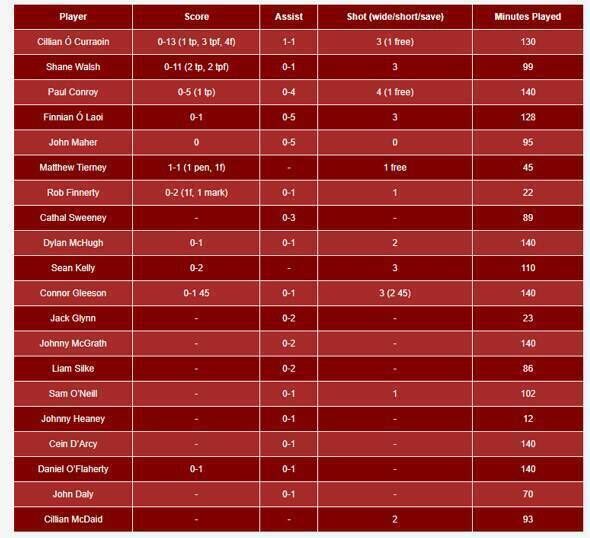
In Salthill for a rematch of the 2025 decider, Padraic Joyce’s side used Gleeson as a means to slow play down and keep-ball while playing against the wind. He consistently came forward.
Meanwhile, All-Star nominee Blaine Hughes started that tie for Armagh. He was replaced after an hour by Ethan Rafferty.
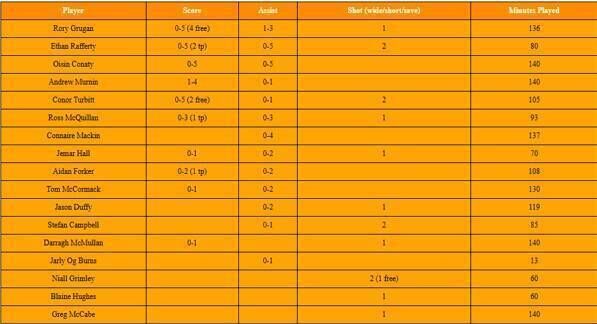
The goalkeeper is currently Armagh’s second-best attacking weapon, tied with Oisin Conaty for scores and assists behind Rory Grugan.
“I do feel like a bit of a fool,” admitted former Offaly chairperson Michael Duignan in his Mail on Sunday column last month.
At Central Council, he had championed the training ban. Counties were not to return until December.
As several provincial secretaries pointed out in their annual reports, that date was flouted across the country.
In a candid article, Duignan admitted 2024 hurling captain Jason Sampson challenged him on the decision.
“Joint senior football manager Mickey Harte made the point about all the new rules putting pressure on players and management to train them in as much as possible, but we all agreed to stick by the directive.”
The two-time All-Ireland winner felt stupid when he heard about counties training in October. He went to Croke Park in search of reassurance and didn’t get it.
His primary concern was if Offaly would “pay a price for abiding by official policy and doing what’s best for the players?”
Harte and Johnny Kelly’s outfit took a break, went on a team holiday in December and are currently joint-top of Division 3 having beaten Sligo and Laois in their opening two games.
Per the GAA website, if a team receives a black or red card, they can adjust so they will always have a maximum 11 attacking or a maximum 11 defending players (excluding the goalkeeper).
“A team will not be disadvantage defensively or in attack, due to the 3/3 structure rule.”
Should a team not be disadvantaged defensively or in attack if they receive a black or red card?
Two weeks ago, Armagh’s response to Niall Grimley’s red card was to bring on Ethan Rafferty and chase the game.
They defended with 11 players (leaving two up) and attacked with 12 (leaving two defenders back, while Galway had to keep three up). Armagh won that stretch 0-2 to 0-1.
Cillian Ó Curraoin’s black card had minimal impact on Galway’s dominance over Mayo. Stephen Coen was also sent off before the final whistle.
here is a consequence for kickouts and teams transitioning up the pitch, but if they are efficient in possession, a team with 14 can still create a 12v11 in the opposition half, playing keep-ball if they want to kill clock or creating numerical advantages if they are pushing for a comeback.
The alternative is to make it a 2v2, but as a results teams could attack 13v11. An entire contest could be decided based on those ten minutes, a harsh black card producing an enormous swing.
A tricky side-effect of the popular 3v3 structure rule might see cards prove to be less impactful.
Last December, the Football Review Committee outlined how they would keep track of the data from the trial window. They would create a Games Intelligence Unit who would receive GPS information from counties.
The plan was for it to be anonymised and made available to the public after 72 hours. That is yet to occur.
Another part of that Unit was tagging key metrics. That work is being led by Johnny Bradley, a Programme Director for Sports Performance Analysis at SETU and leading GAA analyst. It is the start of an encouraging move that could see every league game analysed.
Finally, the association would have the means to provide a comprehensive collective database across all four divisions.
The solo and go is great for the game. The rule provides a welcome injection of pace and cuts out unnecessary delays. Is it always great for a team?
Galway opted for it throughout their opening game against Armagh. Nine minutes into that fixture, Connaire Mackin went quick after a free on a kickout. He handpassed to a sprinting Darragh McMullan and the move broke down. Galway countered fast, Finnian Ó Laoi was fouled and went for a solo and go. He seemed to be tackled inside four metres, however there was no 50m advancement and Galway were also turned over.
He was fouled again 24 minutes later. This time he kicked forward into space. Sean Kelly fed Cillian McDaid, he sent Cillian Ó Curraoin away and the end result was a penalty.
Last weekend in the Athletic Grounds, Tyrone’s Shea O’Hare opted to solo and go instead of taking a free from just outside the 40m arc.
He shipped the ball on to Kieran McGeary and it ended in a wide. A minute later, McCurry kicked a free from much further out.
“Poor decision by Tyrone,” said Enda McGinley on commentary.
“It was a two-point score straight in front of the goals just outside the arc that is perfect.
"Instead took it short and tried to play it forward, that was such a good position to take to take a free kick and get two points.
"Instead, we rush a one pointer under pressure. Players will learn so much from these games.”
On the flip side, Down’s Danny Magill scored a terrific goal against Cork from this source.
In this case, it was a ‘go and solo.’ It has already been clarified that a player may take his four steps first and then solo.
After a dip in the number of Irish players making the move to Australian Rules, 2015 saw numbers surge once again.
During a three-year window a host of Gaelic footballers tried their hand at AFL. Covid had a considerable impact on their development and experience Down Under.
Encouragingly, a whole host of them have returned.
This year, former Hawthorn player and Leinster rugby academy graduate Fionn O’Hara made his Westmeath senior debut.
Luke Towey’s injury-blighted 2024 is at an end as he came on for Sligo. The wing-back returned from Gold Coast Suns in 2021, the same year Armagh talent Ross McQuillan left Essendon.
His former club-mate Cian McBride is back in the Meath fold and excelling for TU Dublin as they prepare for a Sigerson Cup semi-final this week.
James Madden departed Brisbane in October and immediately earned his spot in the Dublin team to start against Mayo and Donegal.
On Sunday, ex-Collingwood man Anton Tohill impressed beside Conor Glass for Derry.
“The real difference at the minute is the high metres per minute, there is a lot more distance covered in that high metres zone. That comes with the style of play obviously,” said Glass after the Kerry defeat.
“I guess it is suited to the likes of us who have been exposed to that high intensity in the AFL.”
Against Derry, Jack O’Connor made five changes. Donal O’Sullivan hit 1-2 from three shots and assisted a goal.
Paul Geaney scored two goals and was integral to O’Sullivan’s effort. Keith Evans created a point for O’Sullivan, Cathal Ó Beaglaoich was fouled on a kickout that led to Sean O’Shea’s late score, Listowel Emmets’ Eddie Healy came on in the final minutes for his debut.
On this week’s , Noel McCaffrey made the case for CLG Clontarf’s motion that will be considered at this month’s Congress.
It proposes that adult players would have to play a minimum of four club league games to be eligible to play inter-county championship.
There are merits and drawbacks to the proposal which have been outlined in full on the club’s website. One of the reasons McCaffrey supports it is because of the fringe panellist’s plight.
“It is particularly unfair to fringe players of matchday squads who travel with the county team, 25 or 26, they never get to play and they never get to play with their club either. It is a terrible abuse of those players and it is profoundly unfair.”
Across the next two months, the club league will start in several counties. For players outside the matchday squad, there are few better places to get familiar with the new rules and stay sharp.
Intercounty managers should make the most of it.
CONNECT WITH US TODAY



Be the first to know the latest news and updates