Christy O'Connor: Cuala and Errigal combine for record as Con joins elite club
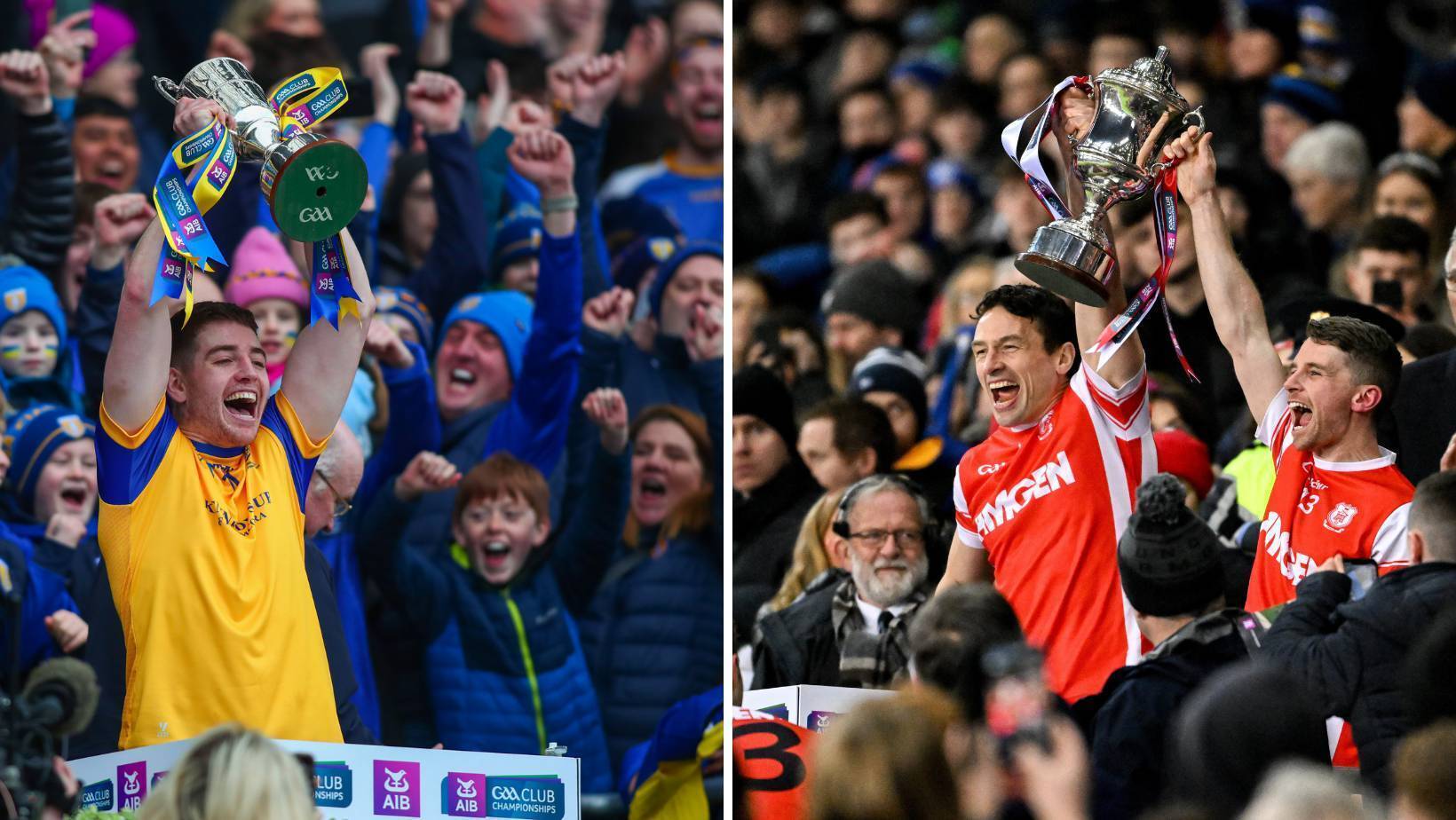
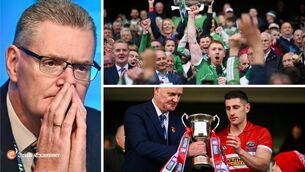
DUBLIN DOUBLE: Donal Burke of Na Fianna lifts the Tommy Moore Cup and Cuala captains James Power, left, and Luke Keating lift the Andy Merrigan cup.
Eighteen minutes into yesterday’s All-Ireland club hurling final, just after Ben Graham had made a fine save from AJ Murphy, everyone in Croke Park – outside of the Na Fianna supporters – inhaled a deep breath. A goal at that stage would have put Na Fianna nine points ahead and, effectively, ended the match as a contest.
Nine points is never an insurmountable lead in hurling. Errigal Ciarán proved over an hour later that it was possible for a team in their first All-Ireland final to extricate themselves from a far more perilous position, but there was still an air of inevitability about the result from early in the second quarter.
In any case, Graham’s save was only delaying the inevitable. Colin Currie nailed the subsequent ’65 and Na Fianna had the ball in the net just 90 seconds later, another score engineered by a Na Fianna runner (this time from the excellent Jack Meagher) cutting Sars open down the middle of their defence before popping the sliotar off – this time to Tom Brennan – to a Na Fianna forward on the outside.
Already, the game carried the tone of a rout. Two minutes into the second half, Na Fianna had a colossal 1-18 on the board. Physically, they were bullying and bossing a Sarsfields side that looked nervous and jittery and overwhelmed by the occasion. Sars may have come into the match expecting to prosper in Croke Park with their pace and athleticism but Na Fianna were on a different level again in terms of their athletic capacity.
Na Fianna were superbly coached; their hurling was slick, their movement and ability to create space – especially off their own puckout – was outstanding, while they savaged Sars on breaking ball all afternoon; in the first half alone, Na Fianna sourced an incredible 1-13 off puckouts.
Na Fianna were relentless. By the time of their second goal from Brennan at the end of the third quarter, Na Fianna’ s conversion rate was a staggering 78 per cent up to that point of the match. The game was long over by stage. But this final was already effectively over half an hour earlier.
After Peadar Ó Cofaigh Byrne’s goal in the 25th minute yesterday, Cuala looked on course for more than just a maiden All-Ireland title – they also looked set to smash the record for the biggest winning margin in a club football final.
That record – an 18-point win – had been set by Nemo Rangers in the 1982 final when they smashed 6-11 past Garrymore. After that third Cuala goal yesterday, the Dublin side led by 14 points. Errigal had only had four shots, and had just one point on the board. Where was this going to end? How much could Cuala actually win by?
It was unrealistic to expect Cuala to keep their foot pressed to the gas – especially with their tendency to switch off – but Errigal Ciarán were so flat and lethargic, while Darragh Canavan was gone off, that Cuala looked capable of continuing to pile up the digits on the scoreboard.
Errigal appeared to have paid a heavy physical and mental toll from the gruelling 80-plus minutes against Dr Crokes eight days earlier, but a team with their class and experience was still bound to find something within themselves to stir up some kind of a comeback. And they did.
The spark had been lit just before half-time with four points in four minutes, before Errigal then got the first score of the second half from the throw-in. Errigal were suddenly playing with the energy, pace and intent that was missing in the first 25 minutes, but Cuala had also dropped off. And Errigal began to make them pay.
Cuala had only turned the ball over four times in the first half, but Errigal sourced 0-6 from Cuala turnovers after the break. Errigal had been under massive pressure on kickouts in the first 25 minutes, but nine of their 13 scores between the 27th-45th minutes came from restarts.
Cuala would never have forgiven themselves if they had blown the match from the position they’d been in, but they were lucky to have Con O’Callaghan to steer them through those choppy waters; from his last five possessions, O’Callaghan scored one point and assisted two more.
Cuala were just delighted to win a first title – whatever the margin. For a finish, this was the highest-scoring club football final in history, with the combined total of 42 points one point higher than the previous record, the 41 points St Vincent’s and Castlebar Mitchels had accumulated in the 2014 decider.
Less than an hour earlier, what odds would anyone have got on that outcome?
The build-up to yesterday’s All-Ireland final began in Na Fianna last Friday. After a festival of camogie, hurling and handball, a ‘Friends of Na Fianna mentors night’ preceded a juvenile disco.
On Saturday, a series of camogie and hurling mini-leagues, and a puc fada competition, was followed by two more juvenile discos in a marquee before an ‘Up for the Match’ event with special guests was hosted in the clubhouse.
After a pre-match breakfast yesterday morning, a huge parade of people marched from the clubhouse to Croke Park. It was the club’s third time organising that march with over 1,300 people, after the 2023 and 2024 Leinster finals.
Their supporters are lucky to be within walking distance of Croke Park, especially when Sarsfields had to travel up on Saturday. Cuala didn’t have to travel far either, but home advantage has long been an advantage for Dublin teams in All-Ireland finals.
In the last 20 years, Dublin clubs (in hurling and football) have now played in 12 finals and lost just two, both of which were narrow defeats; Ballymun Kickhams lost to St Brigid’s by one point in 2013; Kilmacud Crokes were beaten by a late Kilcoo goal in the dying seconds of extra-time in the 2022 decider.
Does it make a difference? On the biggest day of all, it has to be a help for the Dublin clubs.
When St Finbarr’s won the 1978 All-Ireland club hurling title, they completed their All-Ireland series in one weekend; on Easter Sunday, they defeated O’Donovan Rossa in Togher before travelling across to Thurles the following day, Easter Monday, to take down a Rathnure side that had beaten Four Roads from Roscommon in Wexford Park the previous day.
When St Finbarr’s showed up in Croke Park for the 1981 All-Ireland football final against Walterstown, the grounds still weren’t open. It was a different time but that St Finbarr’s group were still the most unique collection of players in the history of the club championships.
Between 1975-87, they contested six All-Ireland finals and won five - three in football, two in hurling. And eleven of those players won medals in both codes. Jimmy Barry Murphy, John Allen, Christy Ryan and Donal O’Grady are the only players to win four medals on the field of play, but Bertie O’Brien, John Cremin and Denis Burns also won four club All-Irelands, while Eamonn Fitzpatrick, Christy Myers and Jerry McCarthy won three medals, with Niall Kennefick securing two.
Over two decades later, Alan Kerins joined that elite group when winning a football All-Ireland with Salthill-Knocknacarra in 2006, and bagging a hurling All-Ireland with Clarinbridge five years later.
And now, Con O’Callaghan has joined that club.
CONNECT WITH US TODAY



Be the first to know the latest news and updates