Jarlath Burns buoyed as GAA worth 'staggering' €3bn to society
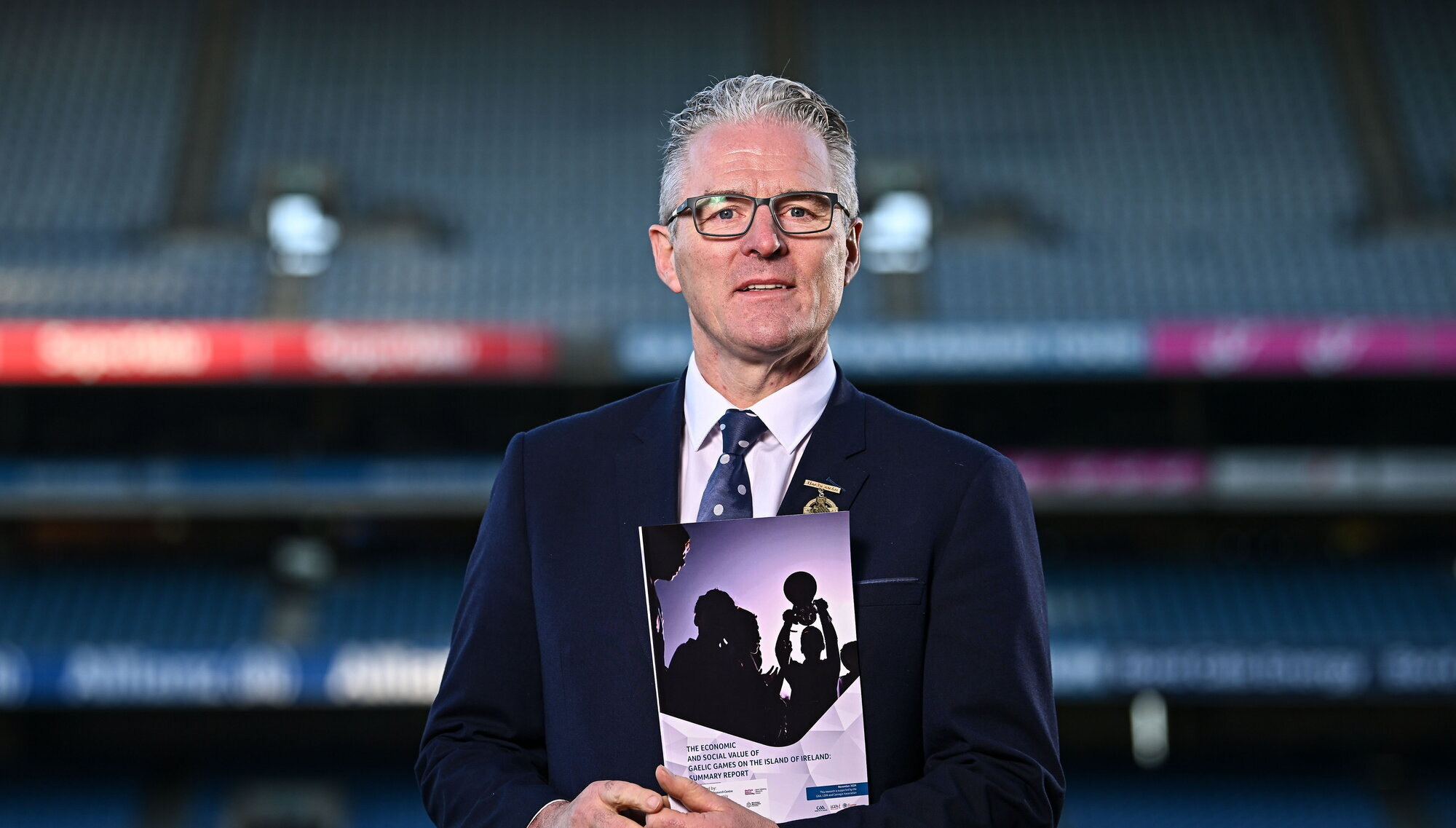
Uachtarán Chumann Lúthchleas Gael Jarlath Burns stands for a portrait during the launch of the Economic Impact and Social Value report on Gaelic Games, at Croke Park in Dublin. Photo by Seb Daly/Sportsfile
GAA president Jarlath Burns says fresh figures showing the amateur association is worth almost €3 billion to Irish society are 'staggering'.
The figure, estimating that the social value of Gaelic games is 'at least €2.87 billion', is contained in a report described as the 'first of its kind in Irish sport'.
Sheffield Hallam University's Sport Industry Research Group was commissioned by the GAA, LGFA and Camogie Association to provide the report which took 13 months to complete.
As part of the study, it was found that this year's Munster hurling final was worth €3.2 million to the town of Thurles and €4.5 million to county Tipperary. It emerged that the crowd of 44,206 at Semple Stadium that day spent an average of €62.82 each in Thurles on non-accommodation items. The total non-accommodation spend for Thurles on Munster final day was €2.8 million.
A similar investigation found that the Ulster final yielded €1.5 million for the town of Clones and €2.1 million for county Monaghan.
Distilled right down, it was determined that for every euro invested in Gaelic games, the return to society is at least €2.30 and possibly as high as €3.96.
Speaking at the launch of the report at Croke Park, lead researcher Professor Simon Shibli described it as 'a good news story' and said the research was an eye-opener in terms of just how beneficial Gaelic games are to Irish society.
The Sheffield based professor said that he attended the 2015 All-Ireland hurling final between Kilkenny and Galway and was struck by the experience, describing it as 'religious almost, bordering on spiritual'.
GAA President Burns said it is an important document with volunteerism in the association costed at €840 million within it.
"The biggest one is the €2.87 billion figure, which is the social capital, that is a figure we have never been able to quantify," said Burns. "We have always known that, for example, the year that Mayo went up to play a backdoor game against Down on Saturday evening.
"The people in Newry, who are very well used to shoppers, said that they descended on Newry like a plague of locusts and the shops were left empty.
"It's that sort of thing that you are constantly asking, how much of a dividend does the GAA give on the day of a game? But also in terms of the general economy as well."
On the figure that quantifies exactly how much volunteers are worth, Burns set it in the context of a hypothetical U-10s game.
"Somebody will have gone into the changing rooms and brushed them out, somebody will have to have lined the field, put out the flags," he said. "Somebody will have to have put the nets up.
"Somebody will have to go and referee the game. Somebody will have to manage, to coach, three or four times a week, so all that infrastructure around the children as they are running out onto the field are things that we have never been able to properly quantify before but we can now and it is really staggering."
Burns said that the document shouldn't be interpreted as any sort of tool to push the government for increased funding or financial backing in the future.
But he did reference the issue of taxation with the government receiving €192.6 million in 'direct and indirect taxation from Gaelic games'.
Asked if he was surprised by that figure, Burns said he was.
"That's a significant amount because we are a volunteering organisation and at the moment we are grappling with how to look after our players as best we can by staying within the terms of reference of the existing Revenue framework," he said.
"That is proving a challenge for us and also for the GPA because we do want to look after our players within the current confines of the amat€ status, without going beyond the legal frameworks of Revenue. Maybe it's now time for us to have a conversation with Revenue."
Professor Shibli said the bottom line figures in the report compared favourably to other sporting organisations with the English RFU, for example, recording a social value figure of £2.03 billion, compared to €2.87 billion for Gaelic games.
CONNECT WITH US TODAY



Be the first to know the latest news and updates