Christy O'Connor: Slaughtneil and Cushendal epic battle great advertisement for Ulster hurling

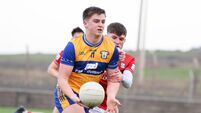
EPIC BATTLE: Ronan McAteer of Ruairí Óg looks to make a pass. Picturel: ©INPHO/Andrew Paton
At the end of Saturday night’s brilliant Ulster semi-final, just before he squared up to a sideline cut, Cormac O'Doherty turned around to the Slaughtneil hordes and waved his arm in a signal of defiance and jubilation. It was Doherty’s way of announcing that the victory was finally theirs, but it was also a symbol of what it represented for hurling in the province.
With it being the first live televised Ulster club hurling match on RTÉ, this was the perfect opportunity to showcase everything good about the game. And both Slaughtneil and Cushendal gloriously embraced that challenge, giving the loudest declaration possible of Ulster hurling’s pedigree and quality.
This was an epic game; enthralling, breathless, laced with class and intrigue and drama, surely the best game in the history of the competition. For certain, it was the highest scoring hurling game in the province – by a distance.
It was no surprise, given the history between these two sides. Prior to Saturday evening, the two highest scoring games in Ulster were matches between Cushendall and Slaughtneil in successive years in 2014 and 2015, epics which Cushendall won after extra-time by one score.
After 80 plus minutes in those games, Cushendall had posted tallies of 1-24 and 3-17. After 60 minutes on Saturday evening, Cushendall had 3-21 on the board. And it was just about enough to scrape them into extra-time.
Despite it being such an intense and tight match, Slaughtneil had already hit the highest number of white flags (27) ever recorded in an Ulster hurling championship match in normal time.
In the history of the Ulster club championship, there had only been 13 previous occasions when a team had hit 20 points (white flags) or more. Yet Saturday was the first time that two teams crossed that threshold, which is all the more impressive again considering they had surpassed those numbers in normal time.
After Ballycastle hit 1-20 in the 1980 Ulster final against Ballycran, it took another 19 years for a team to surpass the 20 points (white flags) barrier. It happened twice in that 1999 Ulster campaign, when Ballygalget scored 2-22 against Dungannon, and Cushendall posted 2-21 against Maghera-Lavey. When Cushendall won that final though, the score was 1-12 to 1-8.
When the great Loughgiel team of the early part of the last decade won four successive Ulsters between 2010-13, they were a scoring machine, the first side to break the 25 points (white flags) barrier in the province. In the 2012 semi-final and final, Loughgiel posted tallies of 1-25 and 2-25 against Middletown and Portaferry. Yet they did as they pleased in those games, winning both by margins of 16 and 19 points.
Ballygalget hit 2-26 against Lisbellaw from Fermanagh in the 2017 semi-final, but Slaughtneil’s managed 28 scores in normal time of an epic on Saturday. No team had breached the 30 points barrier (white flags) but Slaughtneil smashed that record to smithereens, accumulating a colossal 1-36 from 56 shots.
Slaughtneil were incredible but imagine if their conversion rate was even better again than 67%? When was the last time a club team got off 53 shots from play? Maybe in a total rout but certainly not in a match of this quality.
Incredibly, Slaughtneil’s total score (39 points) was not the highest ever recorded in the Ulster championship; Cushendall recorded 4-28 (40 points) in last year’s semi-final against Portaferry. Yet that match was level at 1-20 to 3-14 at the end of normal time before Portaferry ran out of gas and Cushendall cut loose in extra-time when scoring 3-8.
Cushendall showed their scoring power last year but they were gunned down by a better team on Saturday. What made the match even more impressive again was that there was a staggering 90 shots from play.
What a game. What a contest. What an advertisement for Ulster hurling.
When Ballina Stephenites last won a Connacht club title in 2007, it marked the end of a remarkable decade for club football in the province – it was the county’s eighth Connacht title in 11 years, which also included a maiden All-Ireland title (won by Crossmolina) and a second title (secured by Ballina).
In the 16 years since though, Mayo clubs have won just two titles, both of which were bagged by Castlebar Mitchels in 2013 and 2015, with Mayo clubs having only reached three finals in the intervening decade.
Ballina ended a 16-year drought without a county title last year but they also realised how far the standard in the county had fallen off in the province when getting whacked by Corofin. The Galway side can do that to any team but it was still strange for Ballina not to reach a Connacht final; in their previous seven sojourns in the province, the Stephenites had reached six finals.
Twelve months on, and another defeat, this time around to Coolera Strandhill, has completely skewed Ballina’s history in the competition. In their three previous games in Sligo, Coolera had only averaged 0-9. They only scored 0-9 after 80 plus minutes here but it was enough to get them to penalties, which they won 5-4.
It was Coolera’s day but Ballina’s woes have reflected Mayo’s, and how far the standard has slipped in senior club football in the county; outside of two wins against the London champions, Mayo clubs have won just two games in the Connacht championship in the last five seasons; the highest score any team recorded in that time was the 1-12 Westport put up against Moycullen two years ago – and they were still hammered by 12 points.
It was Coolera Strandhill’s day but yesterday was another bad day for Mayo senior clubs in Connacht.
The response was clinical. Ruthless. Efficient. Devastating. And game-defining. When John McGrath reduced the deficit to one point in Walsh Park just before half-time yesterday, with Loughmore-Castleiney having the aid of the breeze to come in the second half, Ballygunner knew what they needed to do to arrest the trend. And they did it.
A laser Stephen O’Keeffe point found Pauric Mahony, who arrowed the ball over the bar. Ballygunner then won the next five Loughmore puckouts, which led to five successive points for Mahony (2), Dessie Hutchinson, Mikey Mahony and Peter Hogan, all scored within the space of just three and a half minutes.
When Loughmore finally got off a solitary shot before half-time, a Noel McGrath wide from a free, O’Keeffe (after being yellow carded for taking another quick puckout) arrowed another peach of a restart to Hutchinson, who dinked the ball into Patrick Fitzgerald, who spotted Kevin Mahony across the goal. When Aidan McGrath failed to cut out the pass, Mahony buried the ball from an acute angle. The power play was devastating – 1-6 from eight shots in seven minutes and 45 seconds. Game over.
The Gunners had 1-20 on the board by the 39th minute. They only scored 0-6 for the remainder of the game but that devastating power play before half-time had already ended the match.
That has been a theme of this side, and especially in this campaign to date. After O’Keeffe saved a Jack Ryan goal attempt in the quarter-final, which would have put Doon seven points ahead, the Gunners hit back with six unanswered points from seven shots in the space of just eight minutes.
Devastating, especially when the need is greatest.


CONNECT WITH US TODAY



Be the first to know the latest news and updates