An apolitical community with an American majority: The GAA club with big dreams in Washington DC
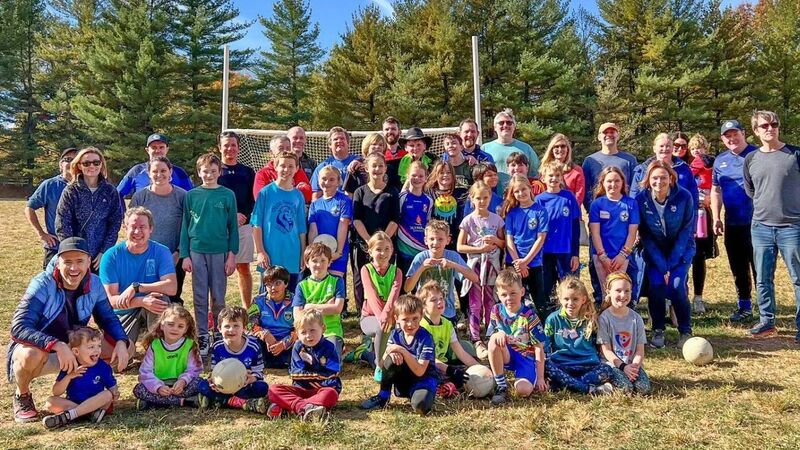
BIG DREAMS: DC Gaels' youth players. Pic: Maurice Brosnan.
Where all the action happens. Ronan Kelly was 33, living in Washington DC and had never playing hurling in his life when he went in search of a connection to home. He found the DC Gaels.
“I only played Gaelic football up until the age of 13 in Naas,” the now club chairperson explains.
“From then on, I played rugby until my early 20s and then I went to Boston. I didn’t pick it up there even though there was a very strong GAA scene.
“It wasn’t until Covid came and I was homesick, I personally wanted to get involved in an Irish community.
"The learning curve was great, I was dealing with beginners who were American as well. The enjoyment I got from that, basically I had the time to pour into it and wanted to get more involved.”
He is speaking from The Dubliner, an Irish pub and Capitol Hill institution. At the back of the bar, a guitar player from Kerry is picking out faces in the crowd and vetting their connection to home.
Someone thinks their uncle went to the same Tralee school as him. There is always a link.
The heart of democracy, with its payoffs and its price. This is one of the most expensive zip codes in the country.
The majority of members work in technology or financial industries, often with some connection to federal government
That makes it more transient than other Irish strongholds. DC Gaels has 109 registered members across four codes. This year their underage setup had 76. About 30% of them are Irish. The rest are made up of ‘homegrown players.’

When calls first came for Joe Biden to be replaced on the presidential ticket, Joe Biden joked that he finally understood President Harry S Truman's famous saying, "If you want a friend in Washington, get a dog."
DC Gaels are out to prove there is another way.
“We have a huge reliance on attracting new people to the club. That is a big driver. This year alone we’d several people who went on holiday, saw it on TV, went to a live match, googled it afterwards and found the club nearest to them.
"Irish friends bring them in, that is the strongest link to convince someone to give it a go.
“We do promotional events throughout the year; the Irish embassy has its open day in the spring. We know we need to promote the club and have people see it for what it is.”
They train on public pitches dotted across DC. 2024 was based out of Maryland, a 30-minute drive and essentially only accessible by car.
Soccer goals, just about big enough for 13 a side, are only available from St Patrick’s Day onwards and a dustbowl by August.
DC Gaels compete in the Atlantic Division, with clubs relatively nearby in places like Baltimore and Alexandria, Virginia.
Not all of them have four codes. Their hurlers are most fortunate with the possibility of four games, depending on numbers available and the weather. The women’s footballers only have one rival.
There are tournaments in other leagues, the odd 7s tournament in Philadelphia, but that isn’t ideal preparation for nationals where they play 13 a side.
To make it attractive to new prospects, they need to have everything ready. A programme of training and games, hurls and helmets, a sporting and social club wrapped into one.
And why? Why invest here rather than the other readily accessible and less challenging sports? Why double down and go from player to committee member to chair? Kelly laughs knowingly at the question. He has heard it before.
“Previously I was working with Enterprise Ireland and the part of the job I enjoyed most was representing Ireland on that stage. You chat to people curious about the country, who want a connection and I missed that.
“My first season with the club I just played hurling, I got more involved after that. I became the development officer, getting sponsorship and players in the door basically. So seeing new faces and getting more funds coming in was great.
“As it happens, the previous board had done it for a number of years, they moved on and I was one of the only ones staying on.
"Looking after the schedule of games, does the team have everything they need, have we communicated with all the people needed on game day.
"Four codes, so you balance different people’s expectations. The club is going on 36 years old and a lot of chairs have gone before, so you carry that weight with you. This is a key tenet of the Irish community in DC.
"When you bring new people in, you have to make sure it is what a GAA club should be. You feel honour bound to do your best to represent your country and community. That is what the GAA is built on over here.”
In a city that brings history with every step and constant reminders of American political power, DC Gaels strive to exist outside of that.
They maintain a completely apolitical stance. A world of lobbying and electoral soft talk is at their fingertips, what the GAA club offers is harder to reach.
“We’re really grateful for the funding that helps us,” says Kelly.

“The Global Games Development fund via the Department of Foreign Affairs (DFA) has been a huge support for us. Especially being able to pay for field permits, they are not cheap. Having new playing equipment is huge.
“For an American turning up, especially for kids, they can’t go to the local store to buy a hurl and helmet. You have to have certain things in place to bring new players in.
“Youth sport and adult sport in the US is not cheap. You can spend a couple of hundred dollars on playing equipment alone, never mind dues.
"The GAA is an alternative, it is significantly more affordable. Accessible to everyone. The DFA and the GAA have been very supportive.
“Jarlath (Burns) was over for St Patrick’s week and we had conversations about the DC Gaels, our story. They were really supportive. It was almost like, ‘tell us what you need.’
“I wouldn’t like to go back with too broad a request. So I took those conversations literally and we are putting together a five-year strategic plan; subsequent executive committees need a north star to aim for.
"This can be from a short-term goal like having four codes turn up at nationals to a long-term goal of having a club house in DC. Those are two very different goals, but we have to dream.
"To be able to be a real hub, that is the goal.”


CONNECT WITH US TODAY



Be the first to know the latest news and updates