Future unclear for Tom Ryan and GAA’s long-term vision
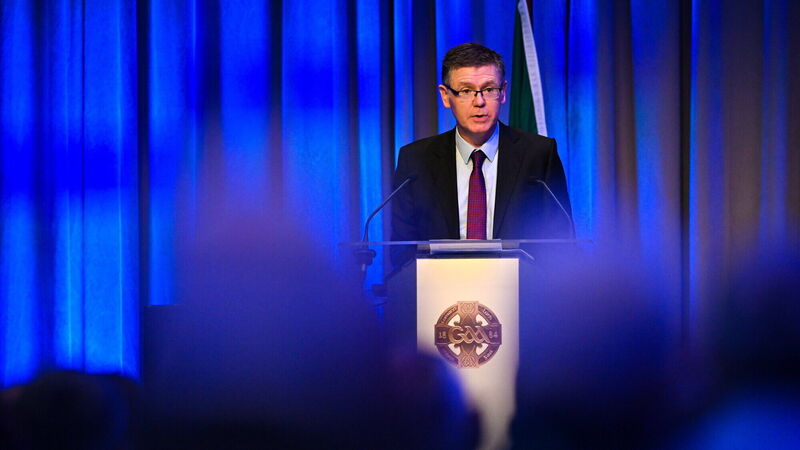
FUTURE: GAA director general Tom Ryan future is unclear as he enters the final six months of his seven-year contract. Picture: Ben McShane/Sportsfile
Next week, GAA director general Tom Ryan enters the last six months of his seven-year contract.
For a term in the most important administrative job in Irish sport to run down without a word about an extension is not odd: it wasn’t until a month before Páraic Duffy’s original seven-year agreement was to elapse in January 2015 that he accepted a new one offered by the GAA’s management committee.
The hush around Ryan’s future is in keeping with his nature. Mild-mannered and dignified, the 54-year-old goes about his business subtly. There is a perception that he can be too quiet. Only two or three times a year and often in the space of a few weeks at his annual report launches and post-Congress, does he speak publicly.
That reluctance is in contrast to his predecessor Duffy but Ryan was never going to be like him. His steady 11 years as the GAA’s director of finance had demonstrated exactly what type of chief executive he was going be.
And just like his handling of the GAA’s accounts during the economic downturn after 2008, Ryan, with the able assistance of director of club, player and games administration Feargal McGill, guided the organisation through and out of the pandemic.
Twelve months ago this weekend, Ryan received much kudos for steering the GAA away from a potential funding crisis when he convinced Special Congress delegates to vote for 40% female representation on the association’s management committee.
In the build-up, the threat of State monies being withdrawn if the gender balance vote didn’t go through hadn’t been received favourably by several counties. However, Ryan’s calm explanation won over the room and the motion received almost 79% support.
In moments of crisis, Ryan has stood tall for the GAA but there would be strong schools of thought in officialdom that he could be a lot stronger in peace times. Whereas Duffy’s pockets were packed with policies, Ryan’s aren’t and it means the GAA president of the day has often taken the lead in driving forward courses of action.
Given that can change every three years (notwithstanding Jarlath Burns’ long-term plan to develop hurling), it’s not exactly conducive to clear, long-term planning. Gaelic football had started to become a turn-off well before Burns deployed Jim Gavin to save it.
Likewise, the amounts spent on preparing inter-county teams were eye-watering before Burns assembled an amateur status workforce. When Ryan took over from Duffy, the total figure was €25m. As counties finalise their end-of-year accounts for this Monday, the counties’ collective number will run close €45m.
Ryan alone can’t be landed with failing to arrest that excessive expenditure but the question can be asked what has he done to stop it. Most probably, he has tried but that message, like other decisions, hasn’t been conveyed.
For instance, there may have been nearly three million good reasons (and probably more on the way) behind allowing a Britpop band to confirm the retention of July All-Ireland finals but it could have been handled better.
Tipperary’s two-time All-Ireland SHC winning manager Liam Sheedy, who was shortlisted for Ard Stiúrthóir alongside Ryan in 2018, hasn’t held back about how hurling is being governed and its place in the GAA calendar. In this newspaper last November, he admitted to being “genuinely concerned” about where the game was going and the lack of attention it was receiving for six months of the years.
Pointedly, he wrote: “I am fortunate to work with leadership teams in business environments. Passive and silent leadership are not sought-after styles in the business world. Nor will they get the association to where it needs to go in the years to come, I can guarantee that. We hear very little from our people in positions of power. And when we do there is not much of substance.”
Two months later, Ryan wrote in his annual report that the GAA playing calendar had “largely been resolved” by the split season. It was hardly a response to Sheedy but the report, his sixth in total, was his most assertive and expansive yet and perhaps underlined how comfortable Ryan has become expressing his views.
In it, he called on the organisation to have a more open mind about making their county grounds available to other sports. “Our future lies with new models of ownership, municipal facilities and shared grounds. These could well present our best opportunities for expansion.
“In that context, perhaps it is time to adopt a more liberal attitude to opening existing county grounds and trusting local county committees to make those decision based on practicalities and opportunities.”
From protecting the GAA’s reputation to lessening the burden of volunteers (the recent decision to split the Disputes Resolution Authority into legal and GAA panels being an example), Ryan as director general has shown himself to be more than an accountant. It is counties, not he who are seeking the provision of replays for All-Ireland finals level after normal time next year to be returned and possibly provincial deciders from 2026.
Yet his qualifications still scream to him. Integration makes sense but the sums, if it is truly to be achieved, don’t. Perhaps he will seek to remain in charge to try and oversee it becoming a reality but that vision, like Ryan’s future, is unclear right now.


CONNECT WITH US TODAY



Be the first to know the latest news and updates