Eight observations from the Gaelic football championship
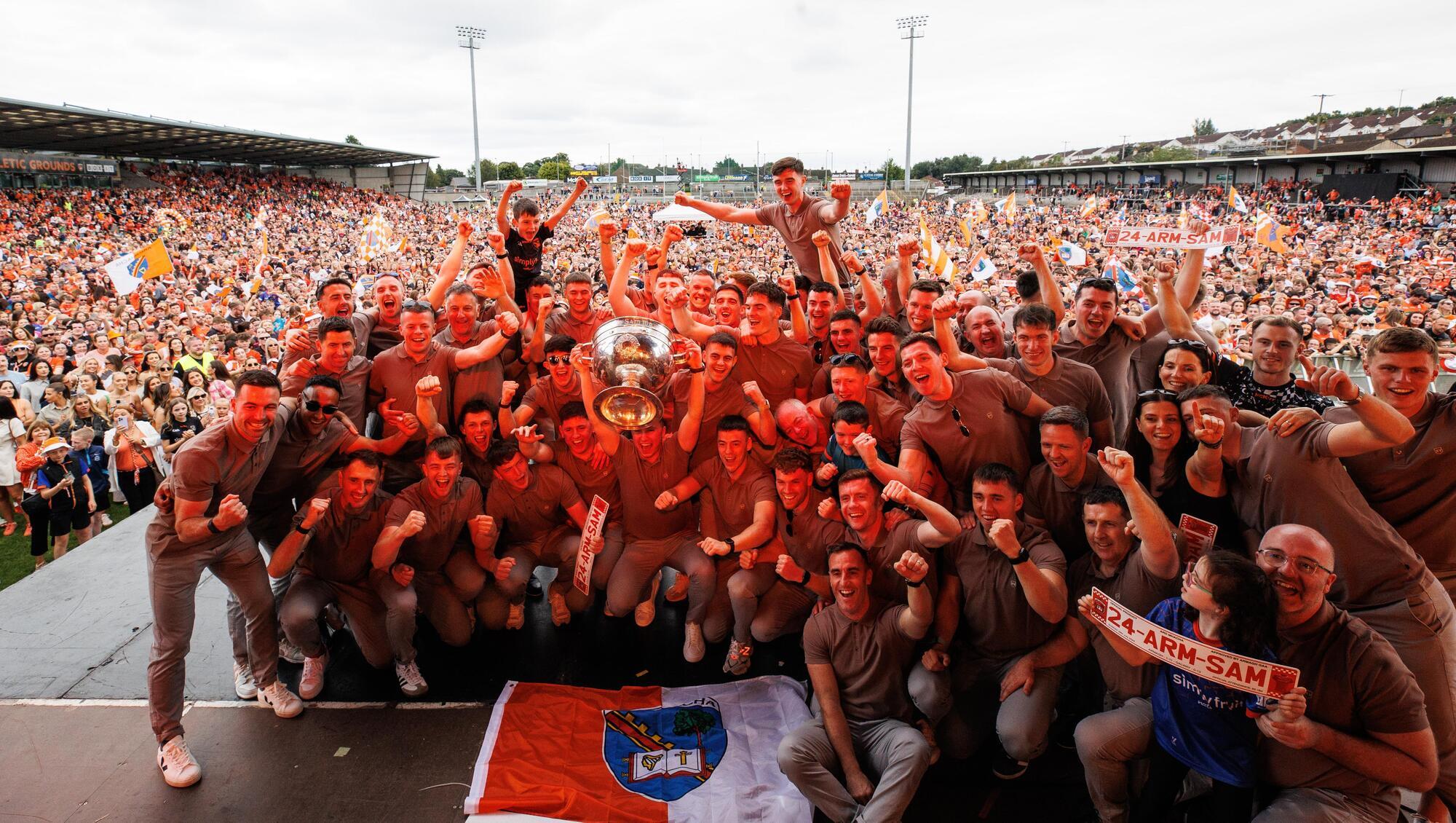
EIGHT OBSERVATIONS: The Armagh team celebrate with the Sam Maguire Cup on stage at the Athletic Grounds. Picture: ©INPHO/Ben Brady
“When you manage a team, eventually you are going to be disliked.” That was, in its own Kieran McGeeney way, the most realistic of all managerial greetings. Nine years ago, he saw dark storms approaching. That ensured he was well-equipped to persevere through it.
On the 28 August 2014, the news broke that McGeeney had been handed a five-year term at the helm of his native county. 9 years and 11 months later, they are All-Ireland champions. In between there was a five-year run with only one Ulster championship win. A litany of heartbreaking losses came after. He was the subject of a vote of confidence at county board level this time last year.
As predicted. In his opening sit-down interview with Armagh TV, McGeeney offered several prophecies. He knew where he wanted to go. He knew what it would take it get there.
“In terms of winning and targets, they are not really up to me. Anyone who thinks any different is only kidding themselves. You can’t control another man’s drive, another man’s heart or desire. The players have to come wanting that. They are going to have to set their own goals and decide what they want out of this.”
All he could do is create a suitable environment in which those ambitions could flourish. That would prove the ultimate challenge. Under his reign, Armagh became reliably competitive. Little has truly changed over the last four years. This outfit push to stay in the race as the home straight approaches and finally, an opponent couldn’t last with them.
That is often the reality of elite sport. He knew that would be the case. He also knew that he would prove unpopular in his bid to do so.
“That is just part and parcel of what you do,” he explained. “It doesn’t matter how good you are or how many things you win. I just hope within that particular period I do what is needed first of all.”
Mission accomplished.
Here are eight observations from the Gaelic football championship.
The turnover breakdown was even on Sunday with both teams winning ten in total. A clear difference came in how they utilised them. Galway scored 0-2 from that source. Armagh scored 0-5.
At the start of the second half, Galway demonstrated the benefit of this sort of possession. Conor Turbitt took on John Maher deep in the Galway 45 and was striped in the tackle. Johnny Heaney won the break and the counterattack began.
Four handpasses later, Heaney laid off to Cillian McDaid who clipped his second point of the game. Galway went on to squander three similar opportunities before the final whistle.
Maher instigated a similar breakaway and once again, the Connacht champions ran from deep. Liam Silke had a sight of goal but elected to pass to Shane Walsh. His shot blazed wide.
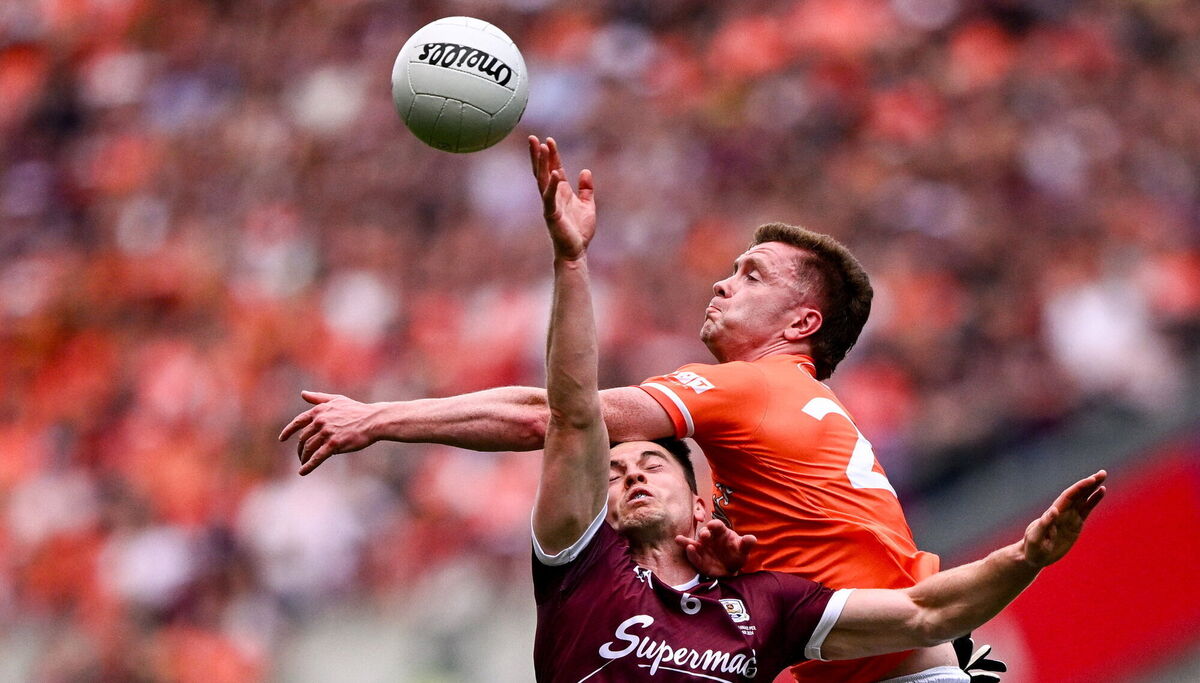
Stefan Campbell was able to briefly stop one counterattack after he dropped the ball as he fouled Johnny McGrath. Galway still managed to go fast, working a shot for Cein D’Arcy who hooked it wide.
A foul on Matthew Tierney saw Walsh curl over a left-footed free but it was only after a goal chance broke down due to a wayward handpass. That play kicked off with Walsh standing up Aidan Forker.
Paul Conroy’s last gasp effort and the incredible Joe McElroy block started with an Armagh effort that hit the post. Galway ran the ball the length of the field without kicking it.
It should be said, both teams did occasionally try and kick long. Sean Mulkerrin pumped a ball towards Damien Comer and Matthew Tierney on the square just before half-time. McDaid overcooked a floater to Walsh that landed in Blaine Hughes’ hands. Rian O’Neill looked for Conor Turbitt early, but McGrath spoiled it. Andrew Murnin earned a free while competing for a long pass. Oisin O’Neill produced an awesome assist for Niall Grimley.
Yet Armagh knew Galway have a clear system of play and set out to neutralise the big weapons. Their defence was able to swarm and shift as runners made their move. They knew a significant portion of their back six aren’t shooters so let them handle plenty of ball.
Walsh and Comer will inevitably bear the brunt of a harsh winter. Neither were able to impact the game sufficiently on limited supply. Galway’s methodical approach also meant they were toiling in the margins rather than the focal point of a productive attack.
In the two matches where they conceded goals in this year, Galway failed to win. No team in history has won an All-Ireland by going out not to lose it. Despite this defeat they remain a unit primed to compete over the coming seasons. With a couple of adjustments, they can build on 2024. The most important move now is a forward one.
Before the All-Ireland semi-final between Kerry and Armagh, the match programme provided a listed of each player, their championship appearances and scores. Armagh’s number one, two and three were all in a similar bracket.
Goalkeeper Blain Hughes was listed as having played 26 games, scoring 0-1. Paddy Burns was at 19, scoring the same. Aaron McKay had logged 34 appearances at that stage and scored 0-1 too. Burns made his debut in 2018. Hughes and McKay made their debut in 2017 against Down. McKay’s sole point came in that tie.
At various points throughout the final, the full-back was the furthest forward. He followed up Ben Crealey’s early point in the first half, ready to challenge for the drop if a chance fell to him. In the second half, Stefan Campbell’s handpass dropped in the same zone. They were one point down as the ball zipped across Connor Gleeson’s square. They never trailed again.
Pádraic Joyce made no attempt to hide his devastation post-match. He was particularly pained when asked about Dylan McHugh’s late miss: “He has been a fantastic player for us all year. He is devastated the crater after the game. What do you do? At least he took the shot on.”
That sense of hurt for his players was evident as Armagh celebrated. Joyce walked to Damien Comer and Seán Mulkerrin, pulling them to their feet and offering a consoling embrace. They arrived at the homecoming in Tuam Stadium on Monday evening and that sorrow was just as evident.
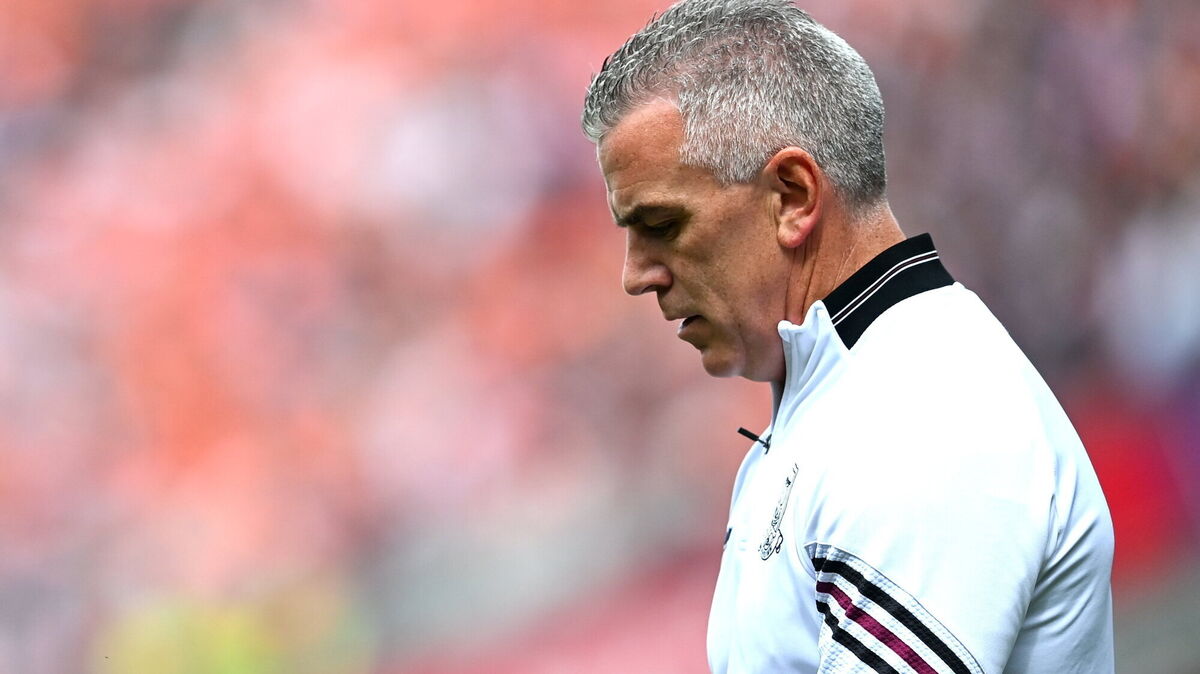
“I can guarantee no matter how heartbroken ye are, we are doubly heartbroken,” he told the crowd. “We were here two years ago and we said we’d come back with something. We are back with our hands in our pockets. I can’t let you know how much the support has meant to us. I’m involved in Galway a long, long time. I played... I’ve never seen support we had for the Donegal semi-final and again yesterday.”
On stage beside him was the squad, selectors, county board officials and his family. He turned to them before finishing.
“From the bottom of my heart, I cannot speak enough for what is on stage here. The effort these lads put in is unreal. As ye all know, I love my family. I even got my dog on stage here. And I love these lads.”
Derry man Conleith Gilligan announced his retirement from intercounty football in 2012. By then his coaching career was already up and running.
In 2010, he worked with Donegal club Naomh Conaill as they secured their second ever title. In 2015, he was part of the Coalisland management team that lost out in the Tyrone county final after a replay.
Gilligan was involved as a coach for Kilcoo’s drive to a first ever All-Ireland club title in 2021/22, a trophy he had also lifted as a player. He took over as manager and led the Down club to the Ulster final where they were bested by eventual champions Glen.
The Sunday Game's Footballer of the Year went to Barry McCambridge after his extraordinary run in Croke Park. The defender took on Donie Smith, David Clifford and Shane Walsh in successive games and also scored in every one of them.
McCambridge came on as a substitute in the opening Ulster clash but he did not play again in their provincial run. In the Sam Maguire series, Luke Loughlin, Shane McGuigan and Shane Walsh all had terrific tussles with the man-marker, albeit all three had him in trouble at times too. Loughlin finished with a point and an assist, Walsh scored two from play and created another two, McGuigan landed three from play.
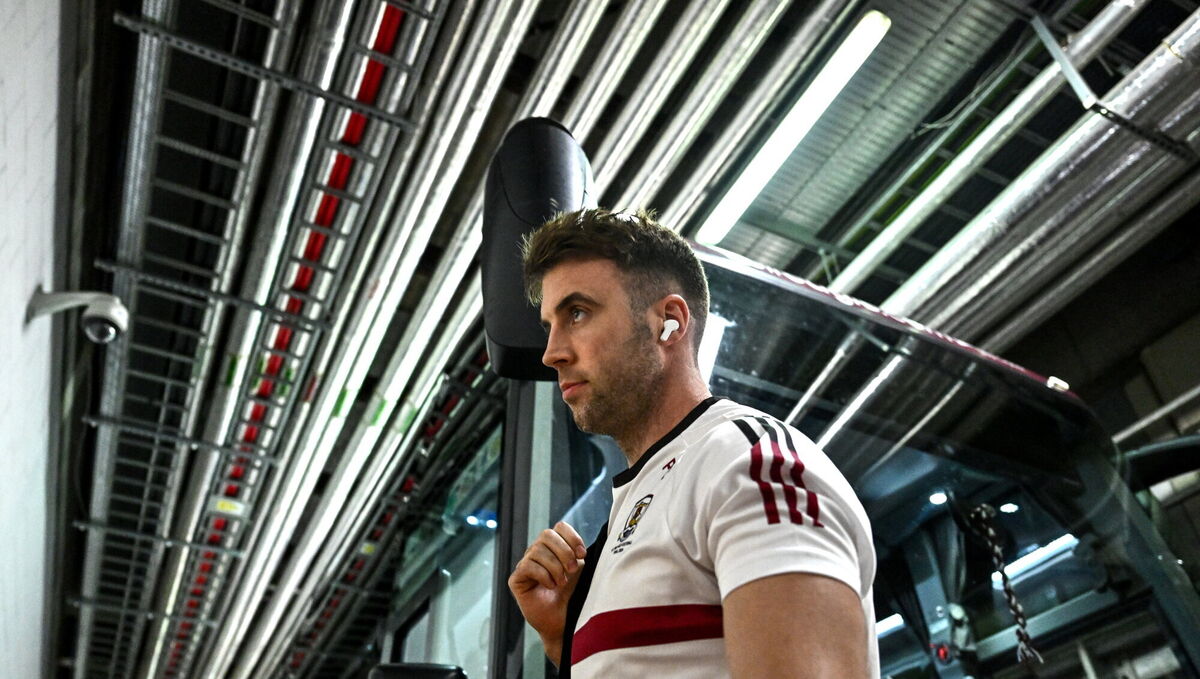
Galway’s best bet is Paul Conroy. His footballing case is strong too. As highlighted by respected analyst Dave Morris on social media, the veteran midfielder came into the decider as Galway’s joint top scorer from play in champ with 2-13. He was their third highest assister and won 14/19 long kickouts targeted at him.
The 35-year-old was Man of the Match against Derry and Monaghan this season. He had 30 possessions in the semi-final against Donegal and not one of his passes failed to find a man. In the final, he had 38 possessions, kicked 0-3 and continued to operate as a formidable kickout weapon. As an all-round footballer, he was awesome.
He should be there with them. That is what Oisin O’Neill revealed in the post-match press conference. He was wearing a ‘Care for Caolan’ t-shirt, as part of a campaign for his Crossmaglen club-mate. Caolan Finnegan is currently battling against an aggressive form of brain cancer.
“Geezer said he would have been in with us this year,” O’Neill explained.
“He is 21/22 years of age and he has got a massive battle but he has the support of Armagh and Gaels across the globe.
“He is going back out to Germany tomorrow for more treatment. He will be in our thoughts this week and for the next couple of weeks and please God he can pull through.”
His GoFundMe is still open for donations.
A new dawn. There is every chance Sunday will endure as the last All-Ireland final under the current rules. As the intercounty season comes to a close, Jim Gavin-chaired Football Review Committee’s rule trials are accelerating the process.
Last week we brought news of an Interprovincial Railway Cup-style competition that will take place this October. The games, which are set to be played in Croke Park, will be open to the public. In the meantime, the FRC are hosting trial matches across the country.
On the same weekend as the All-Ireland hurling final, they were in Cusack Park, Ennis to host Éire Óg vs Clondegad. The original plan to use intercounty players eliminated from the championship proved too problematic.
Members Gavin, Colm Collins, James Horan, Colm Nally, the GAA’s National Participation and Programmes Manager Seamus Kenny and Director of Coaching & Games Development Shane Flanagan were all in attendance. They played four quarters and one, final segment (more on that later.) First to the caveats.
This was an experimental contest and the published longlist will be whittled down shortly. Everyone concerned, including the match officials, were getting to grips with the new rules. For example, the rule on keeping 3 players in a certain area of the field was expanded for the day. The defending team’s 65m line was the new border.
Referees used vanishing foam to mark the spot for frees inside the 65m line and lines umpires no longer had to wait for a break in play. The four-point goal resulted in dramatic scoring shifts; a three-point lead still left a team vulnerable.
There was only one point from outside of the two-point arch and only one player was penalised for steps. In contrast the solo and go, where a player can solo and go rather than take a freekick, was used widely. Often even when it made little tactical sense and resulted in player’s running into contact.
That was our lasting impression. What is good for the game might not necessarily be good for a team. The 2025 league and championship could be defined by who adapts quickest.
The sandbox game also experimented with a new alternative to deciding drawn matches. Instead of penalties, they have introduced overtime showdown. It starts with a throw-in on the halfway line. The teams will get at least one possession to decide the outcome. The team that concedes the first score will have an opportunity to kick out the ball with the aim to equalise or better the opponents score. If they better it, they triumph.
If the first attacking team turn it over or put the ball out of play (wide/line ball), the opposition team must score on the next play. If the team attempting to be the second to score turn it over or put the ball out of play, the team that scored first wins the game.
If the score is equal after the second team scores, the game will re-start with a throw-in on the half-way line and the next team to score wins. There will not be another opportunity for the other team to score.
CONNECT WITH US TODAY



Be the first to know the latest news and updates