Armagh and Donegal have held a mirror to each other
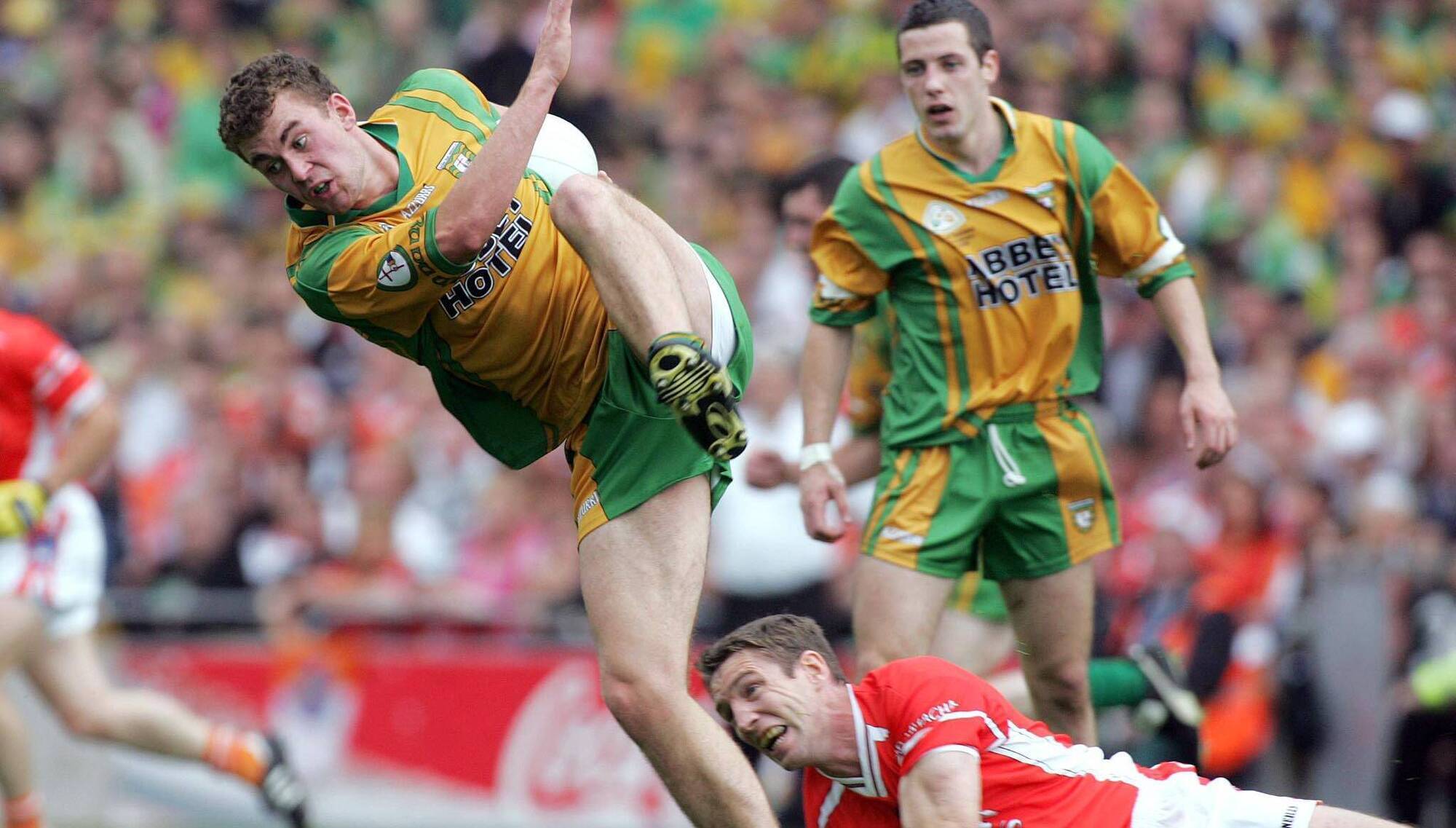
Ulster Senior Football Championship Final 9/7/2006 Donegal vs Armagh Eamon McGee of Donegal gets tackled by Kieran McGeeney of Armagh Mandatory Credit ©INPHO/Lorraine O'Sullivan
Minutes before Donegal took to the field to win their first Ulster title under him and the county’s first in 19 years, Jim McGuinness produced five sheets of paper, each a blown-up photograph from other Ulster final days.
The common denominator was that Donegal had played in each of those finals and on every occasion it wasn’t a Donegal captain that had taken home the cup. Instead it had been a couple of Derry men – Henry Downey in ’93, Kieran McKeever in ’98 – and one particular Armagh man in 2002, 2004 and again in 2006.
Those images of Kieran McGeeney had seared a piece of McGuinness’s soul: his ‘This is not the cup that we want’ demeanour in ’02; then smiling while lifting one ear of the Anglo-Celt while Paul McGrane held aloft the other in ’04; then the injured John Toal gleefully joining the pair of them on the steps of the Hogan Stand in 2006.
For effect McGuinness that July afternoon in 2011 threw each photo onto the Clones dressing room floor and promised his players they would remain there until Donegal had the Anglo-Celt to put on top of them.
“I told them what I felt: that I was sick of watching other captains walking up those yellow steps and smiling out at the crowd and lifting trophies at our expense,” he’d write in his 2015 memoir, Until Victory Always. “I was sick to the heart of Donegal players with hands on their hips watching them.”
The losses to Derry were heart-breaking for each been a case of so near so far. What was galling though about the defeats to Armagh was that while the scoreboard on a couple of occasions had indicated that there was only a kick of a ball or two between them, in reality they were in different orbits. Armagh weren’t so much perpetually holding the Anglo-Celt as a mirror up to Donegal and if they ever chose to look up at it the reflection was not generous.
“We did not work hard enough in training,” Rory Kavanagh would admit in his own book, Winning. “We were too damned nice as footballers. There was no hard edge. We were Donegal people. We were all softly spoken. When it really mattered, we fell on our faces. We crumbled. The Tyrones and Armaghs knew that Donegal would not stand up. Not when everything was on the line. They 100 percent believed that. Armagh especially.”
Kavanagh would go on to tell the story of the 2006 final when “they made sure to let us know what they thought of us”. For the ninth time the counties had met in the championship in seven years and for the ninth time Donegal had failed to emerge victorious. The Donegal manager at the time was Brian McIver who a few years earlier had guided Ballinderry to a club All-Ireland title. After going into the Armagh dressing room to congratulate them he was stopped on his way out. Hard luck, Brian, but not even you’ll win anything with a bunch of cubs like them yon boys.
McIver returned to the Donegal dressing room, fuming, but in the one he had just left what could he say? That member of that Armagh group had only verbalised what they’d always radiated and McGuinness sensed. “You haven’t got it. You’re soft.” We’re winners and youse aren’t.
“Tyrone and Armagh had been driving me demented for years,” he’d profess in his book. “I was sick of watching them win Ulster titles and hearing about the great players and the coaches and the facilities. I was tired of it. And I admired them. I admired them so much because they were smart enough to put systems and structures in place to make things happen.”
What made it all the more admirable and sickening for him was that there was a time when Armagh themselves were just like Donegal. Five years before he became Donegal manager he contributed to an article about Armagh-Donegal relations and how much hinged on a dogfight between the counties in the mud and the depths of winter in the national league of 1997.
“We gave them a terrible beating in Ballybofey,” he’d recall. “Apparently they stayed in the dressing room until around nine o’clock that night.” Brian McAlinden, Armagh’s joint manger back then, would confirm they remained there for over two hours. “There was a full-blooded and frank conversation and a lot of things were said and questioned. It even came down to the exact role of the captain. It got that detailed.”
What other matters were raised, McGuinness wasn’t privy to, but the next time he met Armagh in championship in the early summer of 1999 there was a tangible difference about them.
“Armagh committed to something,” he’d say in 2005. “They reached a point where they had enough and they made an agreement with themselves.”
Ten minutes into that first-round game in ’99 Armagh were trailing 2-1 to 0-0. By half-time they had clawed their way back to within three points. In the same Ballybofey dressing room in which his captaincy had once been under the microscope, Jarlath Burns told the group to recall an evening they had trained in Sir Thomas and Lady Dixon Park in south Belfast.
John McCloskey had pointed to a tree about half a mile away at the top of a steep hill. They were to run up that hill, touch that tree, come back down, then run up that hill a further four times.
When they’d descended it for a second time, McCluskey told them they’d done enough, he’d made his point: they could head to their cars. But simultaneously a handful of players piped up: No. We’re going to go up it again. After the fifth time they touched that tree, then slumped back against it, sat around and told themselves that they were going to win Ulster.
In Ballybofey, Burns reminded them of those runs, that tree and that promise.
They ended up forcing a draw that day. Won the replay. Won Ulster.
By 2002 when they next encountered Donegal in championship, Armagh were, in Oisín McConville’s words, “a different animal”. And Donegal? “They were their usual selves,” he’d write in his 2007 autobiography. “They never had a chance.” Back then McGuinness went by Jimmy rather than Jim and as a player rather than a coach and with 10 minutes to go in that Ulster final scored a brilliant goal with roughly 10 minutes to go to bring Donegal back within a point. As far as McConville was concerned though all it did was “cause us to wake up a little and get over the line”.
McGuinness himself was struck by Armagh’s response. “A goal at that stage would upset a lot of teams,” he’d say a few year later, having retired. “They just kicked the ball out and went about their business. They never panicked. That stayed with me.”
What stayed with Kevin Cassidy, a rookie and All Star that year, was Armagh’s physicality. In the brilliant This Is Our Year, he’d recount how just before halftime that day in 2002 he was going down for a ball when “one of their boys kneed me in the head.” At halftime he approached Mickey Moran and the late John Morrison and informed them he had blurred vision. Morrison was as player-centred and sport science-friendly a coach as you could find in Gaelic Games at the time but as he like everyone else was ignorant of concussion he merely offered the then standard protocol: a dig in the ribs and an instruction to “Just f***ing keep going!” Cassidy duly completed the game but made further little impact in it. At one stage he was about 25 yards out, had a chance to level the game. “I don’t even know where I put the thing,” he’d say. “It wasn’t a score anyway.” For him there was nothing accidental about that hit. “At that time Armagh were renowned for being dirty,” he’d tell Declan Bogue with the kind of candour that infamously alarmed McGuinness. “They were rugby tackling and getting away with it.
“I’d say over the course of playing them all the time, we would lose at least one player a game to a dirty tackle. Like, they were known for falling on top of you, with their knees and everything. Fair play to them.”
To McGuinness Armagh’s defending was more far more sophisticated than that. In 2005 with a coach’s eyes that would help bring his club a county championship later that year, he’d tell Keith Duggan about how Armagh were “masters” at trapping opponents in the corner and “just circling, keeping the arms raised and letting the player get himself into trouble with the ball.” What should have concerned Donegal more though was how they had a different definition of afters to Armagh. Instead of knees in, they were all about the knees up.
After the 2002 Ulster final defeat the Donegal panel were to report to training the following Tuesday evening. The players however were still in throes of another recovery process. When Moran rang Rory Kavanagh that day to check in if he’d be there, Kavanagh, perched by a bar counter in Letterkenny, let it ring out.
It was the same story when the teammate beside him saw Moran’s number. One by one it went. “Almost in order around the counter,” Kavanagh would recall in his book. Eventually they all switched off their phones, except Brian McLaughlin, a giant, soft-spoken, man. He answered.
“Mickey… we’ll not be there,” he said, trying to convey to Moran it was with a heavy heart.
Moran must have spoken some more before the players heard McLaughlin tell him again. “Ah Jaysus, Mickey, we’ll not make it!” There was only so many times and ways he could tell Moran the bottom line before he let him in why. “Jaysus Mickey, we’re in a pub!” Then someone broke into Olé, Olé, Olé and McLaughlin hung up his phone and they all burst into laughter.
“There was a craziness, a madness to our behaviour,” Kavanagh would admit and it was on show again after the 2004 Ulster final.
Brendan Devenney tells the story of that one as good as anyone. The clamour for an Anglo-Celt Cup was so big in the hills that the game was too big for Clones and had to be moved to Croke Park. That created its own problem. Ulster Council were still in charge of the game rather than Central Council and outside their natural environs overlooked laying on a post-match for the players, as did naturally the Donegal county board.
“So we get onto the bus,” Devenney would recount to this writer some years later. “Traffic jam all the way out. None of us have eaten since ten o’clock that morning. By the time we stop off in Virginia, boys are beyond hungry. They can’t eat. They’re all over the place. Instead they go in, have a few pints, the board buy at least one crate of beer and some boys buy a few bottles of vodka and Red Bull.
“Next thing we’re down at the back of the bus, going mad. [Kevin] Cassidy is up at the top of the bus, virtually naked, interviewing [manager Brian] McEniff. We land back in Donegal town and instead of being depressed we might as well have landed in Ibiza. Boys are going loop the loop.
“We get back to the hotel where the board are supposed to have booked some rooms for us but turns out they haven’t. So boys are lying around on the couches in the foyer. They wake up the next morning, a complete mess walking out onto the streets of Donegal town and then the crap really hits the fan.” They were their own worst enemies that way. And in others. They hadn’t the discipline and they hadn’t the system. Devenney admits there were days he dreaded going into Clones to face that swarming Armagh defence.
In 2010 McGuinness was in Crossmaglen when his brother-in-law Colm McFadden was similarly swallowed up by Armagh in a qualifier while at the other end of the field Jamie Clarke was allowed cause wreck.
Driving home McGuinness had a good idea he’d be asked to take the team. In his first interview for the job he had outlined that he felt that the county team was only operating at 55 percent of their maximum fitness, 50 percent of their strength, 80 percent of their technical skills, 30 percent on tactical awareness and the same when it came to mental strength. Armagh and Tyrone were scoring As in all those subjects in their heyday.
In time – in no time – McGuinness had Donegal scoring those grades too; Armagh’s in the meantime had regressed. The only occasion the sides would encounter each other in championship in McGuinness’s first coming was in his third-last game: a 2014 All Ireland quarter-final.
Earlier that year Armagh had been relegated from Division Two but Kieran McGeeney had been co-opted onto their management and Kavanagh for one could see his stamp on that setup.
“McGeeney knew in his heart that Armagh could always beat us,” he’d write in his book. With a minute of normal time to go, Armagh were a point ahead.
“But this time,” Kavanagh would note, “Armagh ran into a whole different Donegal team than the one that always panicked and got all hot and bothered over the previous 15 years. We kept working the ball. Stretching them. Doing everything we knew off by heart in training.” Donegal won by a point.
The counties have continued to be yardsticks and milestones for each other. In 2015 after the departure of Paul Grimley, McGeeney instantly won promotion from Division Three, creating a huge buzz ahead of their opening championship game against a Donegal setup that Rory Gallagher had just inherited from McGuinness. Donegal blew Armagh away, the first of many setbacks McGeeney’s tenure would come to know.
It’d go the other way then. In 2022 Declan Bonner knew his time was up when just like John Joe Doherty in 2010 his Donegal side were swept away by an orange tsunami in the qualifiers.
Now McGuinness is back while McGeeney is still around, chomping to get his hands back on the Anglo-Celt for the first time as a manager.
Who knows what photos either of them might produce in the dressing room in Clones this Sunday. Either way both managers will recognise some of themselves in the other, just as both counties helped make the other.
CONNECT WITH US TODAY



Be the first to know the latest news and updates