Cards to carry if there is extra-time in football finals
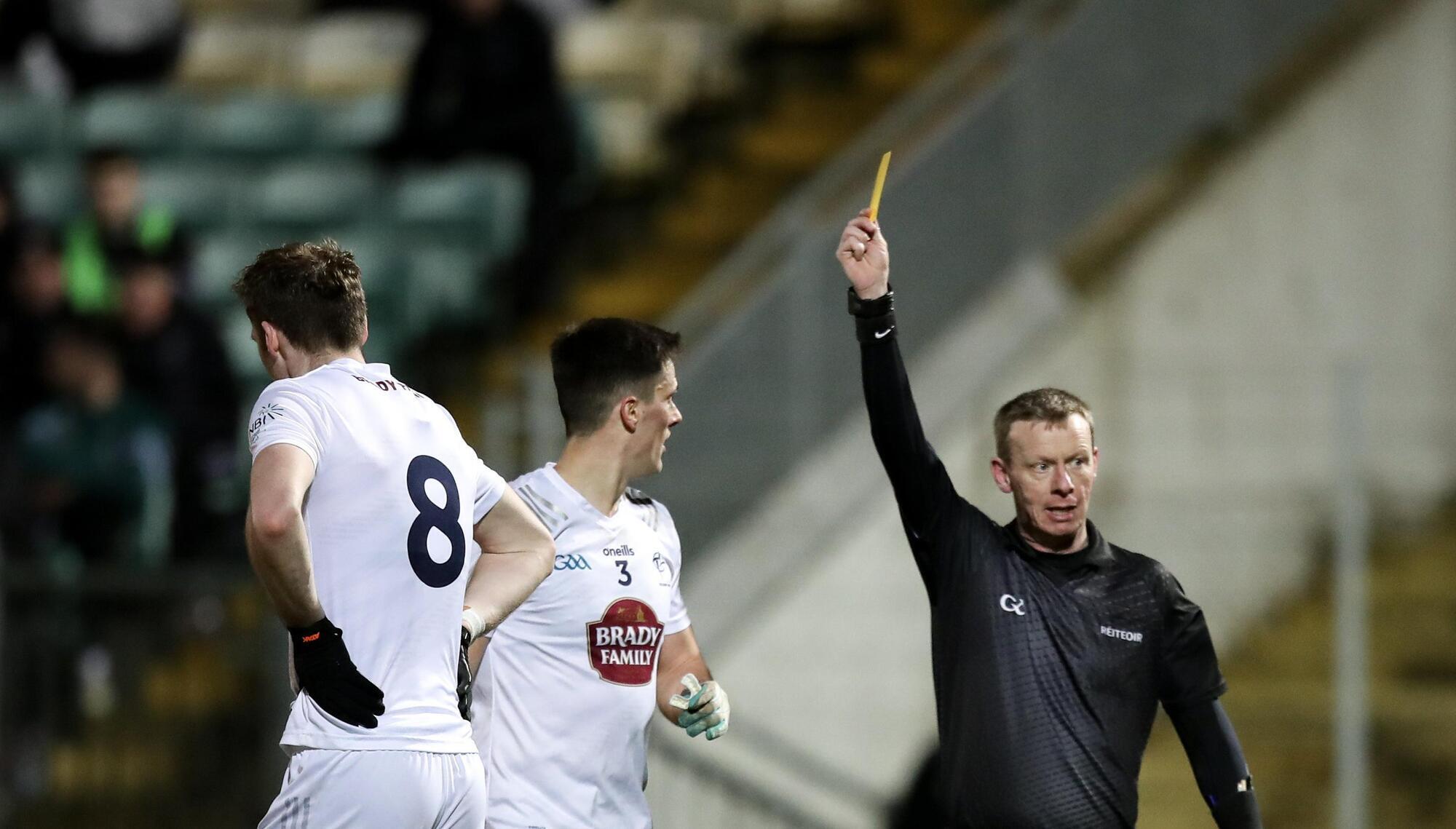
Mick O'Grady of Kildare is shown a yellow card by referee Joe McQuillan.
Cards will carry into extra-time in Gaelic football for the first time in this weekend’s Allianz League finals.
Operational since last weekend’s hurling divisional semi-finals, the new rule comes into force for the four matches in Croke Park across Saturday and Sunday.
It means yellow, black and red cards that have been recorded in normal time will remain active if they are two additional periods of 10 minutes. Unlike previously, a team that incurs a dismissal or more will not be able to return to their full complement of 15 players for extra-time.
Likewise, a footballer who has been booked in normal time can be shown a red card for receiving a second yellow or a black card in extra-time. A player can also be issued a red card in extra-time if they have added a black in that period to a previous yellow.
A team member who has been shown a black card with less than 10 minutes remaining in normal time must be listed in the side starting extra-time and serve out their remaining time in the sin bin in extra-time. The rule applies at all levels in both codes.
Armagh face Donegal in Sunday’s Division 2 final and their last two knock-out games – last year’s All-Ireland quarter-final against Monaghan and Ulster final against Derry – were decided after extra-time on penalties.
In another change applicable across the board, players who are not deemed seriously injured and require treatment have to leave the field for medical attention. They can only return to the field at the halfway line, at a break in play and with the consent of the referee.
The rule is aimed at cutting down time-wasting and cynically slowing down the game, although players who have shipped serious injuries can continue to be treated on the pitch.
Last weekend, hurlers who removed their helmets for attention were directed to leave the field of play. In last Saturday’s Division semi-final against Kilkenny in Cork, Limerick’s Cathal O’Neill and William O’Donoghue suffered head injuries and were ordered to go off the pitch by referee James Owens and had to wait for him to permit them to come back on.
In Sunday’s other last four game between Clare and Tipperary in Portlaoise, Banner midfielder Darragh Lohan came off having picked up a head injury but as he required further treatment was temporarily replaced by Seadna Morey.
The helmet rule has also been introduced to curb cynicism but is only relevant to club and county level above minor grade.


CONNECT WITH US TODAY



Be the first to know the latest news and updates