The key link: How the half-forward is more important than ever
70% of the points in that Kerry vs Mayo clash were created or scored by a player who started in the half-forward line.
The key link: How the half-forward is more important than ever

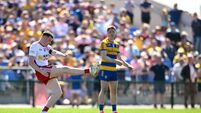
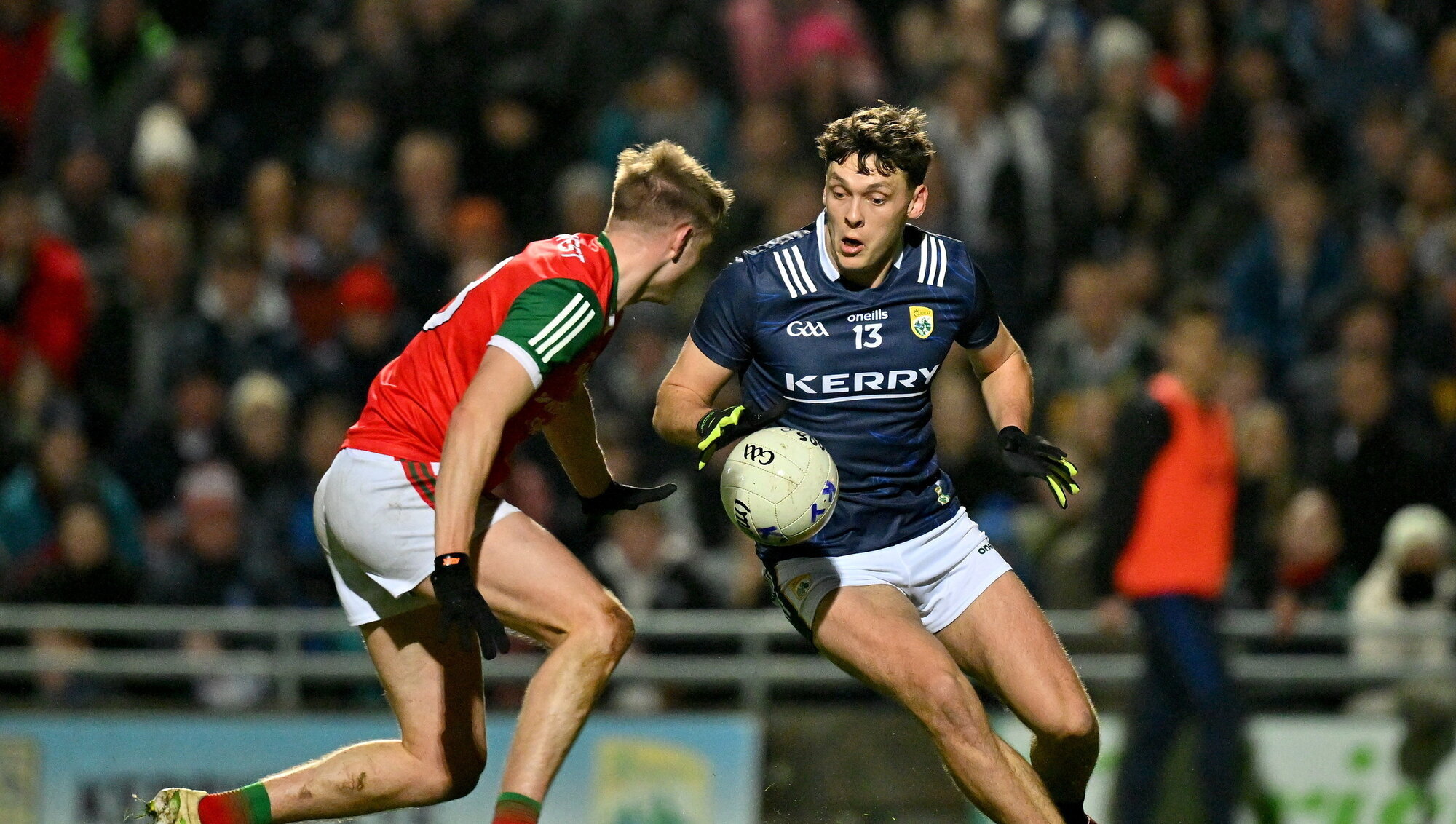
MORE IMPORTANT THAN EVER: Kerry's David Clifford in action against Rory Brickenden of Mayo during the Allianz Football League Division 1 match at Austin Stack Park in Tralee, Kerry. Pic: Brendan Moran/Sportsfile

A frantic finale concluded with the last sensational kick of the game. Writer Tony Hillerman once said in the middle of the storm, the rain always feels random. It’s only when we stand somewhere else that we see the order in it.

That is Gaelic football now. At first glance, a mix of inaction, then chaos and randomness. In reality, there are patterns all over. How did Kerry engineer the winner against Mayo last weekend? Watch closely and look at how history repeats itself. Kevin McStay’s outfit had clawed their way back with consecutive points. The first was a Fergal Boland wonder score. They pressed the subsequent kick-out, Jordan Flynn won a free and Ryan O’Donoghue converted the equaliser.


Boland’s point was a beauty. He collected possession in a central zone outside of the 45-metre line, took no play and unleashed a right-foot effort. Thirty seconds earlier, the centre forward ran out the field for a Mayo kickout and took a couple of plays inside his own half. David Clifford would later get on the ball first in his own half before delivering his extraordinary moment.

The reason attackers, especially half-forwards, drop deep like that is tied to how the opposition are hardwired to defend now. A magnetic field extends from their own posts to the edge of the scoring zone, drawing defenders back to occupy that space. Against a set defence, a well-timed rush can find a hole and do damage.

Reflect on what happened elsewhere. Paudie Clifford had 25 possessions last Saturday. He would have had an assist if Jason Foley did not miss a straightforward shot late on. Sean O’Shea also pulled a free wide after his captain was fouled. All four Clifford possessions closest to goal ended in a point. Every venture into this area was maximised.

This is the task of a half-forward now. These are the patterns they must execute. 70% of the points in that Kerry vs Mayo clash were created or scored by a player who started in the half-forward line.

In the long list of trends established by All-Ireland winners, Brian Dooher’s template endures. He was critical to every Tyrone All-Ireland title ever, three as a player and one as a co-manager. This current iteration has to be even more defensively minded while still kickstarting every attack. The demands on both sides of the ball have never been greater.

Jack O’Connor’s delight at the performance of his captain and upcoming prospect Cillian Burke post-match fits this mould. He knows what he is looking for. In his autobiography, the Kerry boss recalled the moment he elected to pick Declan O’Sullivan over Eoin Brosnan for the 2006 decider.

“At one stage we have a half-forward line of Sean O’Sullivan, Eoin and Darren O’Sullivan playing on the ‘A’ backs,” O’Connor explained.

“The thing isn’t working. We stand watching and there in front of us we can see. It’s not fucking working. Bryan Sheehan and Paddy Kelly are tearing into our ‘A’ midfield and the half-forward line aren’t able to rescue them. It’s an important scenario for us to see.

“Eoin Brosnan is a tremendous player when you are on top in midfield. He’s not a man to go back and link. If you win primary ball, he’ll come on to it like a train when you pop it in front of him. Declan O’Sullivan is a great man to link the play, to know when to slap pass and keep it going.” 

In last year’s All-Ireland final, Dara Moynihan was tied at the top for Kerry in secondary assists, assists or scores with 1-3 in total. Dublin started with six outright forwards, ensuring no Kerry defender could afford to retreat and sweep. Their wing-forward became the mark asked to double up and drop back. It is a thankless task. Later Moynihan was criticised in places for affording Brian Howard so much space. This was undoubtedly a move defined by commands rather than by choice.

Attacking strategy was always going to evolve in line with prevalent defensive principles. Bodies behind the ball and zonal arches are a threat to front-foot football. They are also an opportunity. Coaches are coming to realise that. Boland and Clifford are part of the same trend that has seen a host of forwards converted into wing-backs, the sort of adjustment that led to Conor McCarthy’s recent All-Star.

The basic concept is age-old. Give-and-go. Run the V. Intercounty football layers on top of it, advances it with formulated athleticism and training-pitch honed precision.

No current side are greater exponents of that than Derry. They scored 2-9 in three games where a player was both creator and finisher in the same score. A perfect example was Conor McCluskey’s opening goal against Monaghan in Round 3. A classic give-and-go involving assist king Ethan Doherty.

The same thing happened for Padraig McGrogan’s second-half goal. Doherty has directly assisted 2-4 in three games. He scored 0-4 and has 0-6 in secondary assists. For their sixth and seventh point in Celtic Park last Saturday, the sequence was a carbon copy. Shane McGuigan wins the ball deep, Ethan Doherty cuts in to feed off him, Ciaran McFaul puts it over the bar first-time.

There are whole sequences that seem like a glitch in the match. At one point in the second half, Derry mustered back-to-back attacks that were identical to each other. A host of team-mates stroll in the centre, the ball is worked wide to the left sideline where McCluskey attacks and a forward cuts in on the perpendicular. They both ended in a left-footed shot, for a wide and a Niall Toner point. None of this is a coincidence.

Derry’s opening point vs Tyrone. Shane McGuigan (yellow) drops into his own half and passes to Cormac Murphy.

Murphy (yellow) drives forward and attracts defenders. McGuigan (black) continues his run and kicks their opening score

Look around. Former Galway captain Gary O’Donnell has long maintained that Johnny Heaney is the most important player in the current panel. Heaney has played the most minutes of any player under Padraic Joyce. The wing-forward scored two vital second-half points as Galway dug out their first victory of the league in O’Neills Healy Park.

His desire was indivisible from that quality as he pounced repeatedly on breaking ball. The energy defensively was endless. Post-match Heaney was awarded Man of the Match. “We were disappointed with our opportunities in the first half and not taking them,” he told Spórt TG4. “We regrouped at half-time and knew the opportunities would come. When they did, we had to take them.” 

Meanwhile, Ciarán Kilkenny notched 0-2 in Croke Park. He is Dessie Farrell’s second-most-used player. The six-time All Star was back on his own 13m when Dublin turned over a long Enda Smith punt. Kilkenny’s composure and sidestep helped beat the press. 30 seconds later Niall Scully scored their only goal.

All of this goes some way towards explaining why the best proponents are so valued internally. Once that link was confined to the start of the attacking third, running the 45-metre line persistently. Now the brief is broader even if the fundamental requirement is still the same: defend, create, score. Do more.

x

More in this section

Cookie Policy Privacy Policy Brand Safety FAQ Help Contact Us Terms and Conditions

© Examiner Echo Group Limited