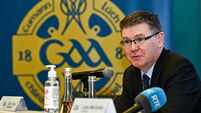
Ryan calls for hardline approach to protect GAA amateur ethos

GAA Director General Tom Ryan. Picture: INPHO/Tom Maher
A hardline approach towards protecting the GAA’s amateur status is one of the few solutions remaining to the association, director general Tom Ryan has admitted.
In his annual report, Ryan claimed “club management is now largely a paid undertaking” and inter-county set-ups are “increasingly professional in all but name”.
He believes the GAA will be thanked for adopting a more stringent adherence of its ethos. Concerned the organisation’s values are at “risk of erosion” and units are guilty of “espousing one thing and doing the opposite”, Ryan acknowledged previous attempts to enshrine the volunteer status have failed.
“We’re not good at that. In general, it’s not in our make-up really… we cajole, we try to influence, we try to convince, we incentivise, we extol the virtues to try and scare people, all of those things. They haven’t really worked.
“You look at the travails of some teams in other sports at the moment because there are defined regimes that have to apply. I don’t know off the top of my head how we would go down that route but it’s something that we should consider.”
In his report, Ryan touched on the €40 million that is now being spent on preparing inter-county teams and believes the rising costs are largely "borne out by either buying services which were previously made available to us voluntarily or enlisting new expertise”.
He continued: "Of course this presents a financial challenge but it also represents an erosion of the volunteer ethos.” He warned about what he considers the widespread practice of paying managers at club level. “There are risks here for clubs, for the individuals concerned and for the entire Association in terms of financial resources, taxation and reputation.
“The responsibility doesn’t really lie with the manager who is being paid, or the juvenile mentor who only picks the strongest players. The failure on the part of the Association in espousing tone thing and doing the opposite.
“You might well argue that none of these are new issues, and you would be right. But a process of gradual but constant erosion has taken us quite a distance from where we would like to see ourselves, and we need to take corrective action.” In the wake of recent Munster and Ulster rugby games in SuperValu Páirc Uí Chaoimh and Kingspan Breffni, Ryan called for a debate on loosening the rules regarding the renting of GAA property.
“Treoir Oifigiúl (GAA Official Guide) and Central Council policy currently prescribe that GAA grounds may only be used by other sports in the case of ‘events of national significance’.
Recent months have seen permission granted for a small number of games which possibly stretch that definition and have given me pause for thought.
“It’s not a question of finance, or at least not a short term income stream. We are in an era where the construction of new grounds, the refurbishment of existing ones, and even the running costs of either pose an even greater challenge. Our future lies with new models of ownership, municipal facilities and shared grounds. These could well present our best opportunities for expansion. In that context perhaps it is time to adopt a more liberal attitude to opening existing county grounds and trusting local county committees to make those decision based on practicalities and opportunities.
“I won’t prejudge where that particular debate might take us, but I would certainly welcome the discussion.”
It's Ryan’s assertion that the GAA playing calendar, that is the split season, has “largely been resolved”.
He commented: “By and large the response to the new season and new inter-county competition structures has been positive. It delivers fixtures certainty to for players so that they can plan their lives beyond GAA commitments and it creates a defined period for devoting attention and playing time to club championships.
“I think the momentum and sentiment is such that we will not be reverting to the old arrangement any time soon.”
Ryan accepted Gaelic football requires rule changes to improve it as a spectacle.
“We cannot simply ignore the prevailing commentary around the attractiveness of Gaelic football. Many games are characterised by slow, deliberate and cautious play and are dominated by mass defences.
“We’ve arrived at a place where the game is devoid of risk-taking and individual instances of skills are at a premium. Yet these things are the very things that foster in us all our initial love of the game.”
Ryan also expressed concern about the Department of Sport’s plans to extend free-to-air sports events to the All-Ireland senior quarter-finals. Currently, only two of the football last-eight games are not on RTÉ but premium streaming service GAAGO.
“But it would remove our right to negotiate and would have a seriously detrimental impact on our finances and our operations. We will be making a submission on the matter.”
He also voices his support for the campaign seeking justice for Bellaghy GAA clubman Seán Brown, who was murdered while closing the grounds 27 years ago.
Condemning the British government’s Legacy Bill which guarantees immunity from prosecution after May 1, Ryan wrote: “It (the decision of the British government) is a blunt instrument inflicted on people who deserve so much better.”
GAA president Larry McCarthy is expected to address the matter in his final speech as Uachtarán at Congress in Newry later this month.
CONNECT WITH US TODAY



Be the first to know the latest news and updates