‘What colour is a hi-vis jacket?' - Yellow sliotar to become hurling's official ball from January
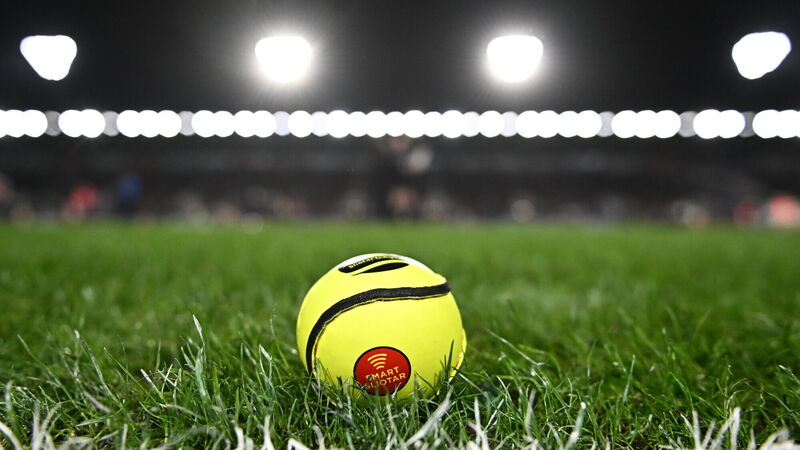
CHANGING TIMES: A view of a smart sliotar before the Allianz Hurling League Division 1 Group A match between Cork and Limerick at Páirc Ui Chaoimh. Pic: Eóin Noonan/Sportsfile
The white sliotar has just 47 days before it becomes a thing of hurling’s past.
It will be the veritable whole new ball game from January 1 when the yellow sliotar becomes the official ball across all levels of the sport, although the smart variation of it will only apply to the inter-county game for the time being.
Introduced at the start of 2021 at inter-county level, it was agreed that the yellow ball would come into play among clubs and all grades two years later.
“That was to give suppliers ample opportunity to divest themselves of the white ball,” explained Ned Quinn, chairman of the GAA’s sliotar and hurley advisory workgroup.
“We didn’t dream this up – it was the science that told us. I received a very good answer when I asked a lady ‘why the colour yellow?’ She asked me, ‘What colour is a hi-vis jacket?’” Quinn doesn’t rule out the smart yellow sliotar, that which is microchipped to ensure the ethical provenance of the product, being used for significant club games in the future.
The number of licensed smart sliotars manufacturers, who like all of the GAA’s ball providers have signed up to the World Federation of the Sports Goods Industry, currently stands at five. It had been two in 2022 when the ball was trialled in the U20 All-Ireland championship. At present, there are 14 club sliotar producers.
“The Association had previously been very exposed,” said Quinn about the duvious origins of some sliotars that had been used. “There were no drawbacks about the smart sliotar in last year’s championship and I don’t anticipate any in the coming year.
“I don’t see it coming in at club level across the country but some counties could opt to use it for say semi-final and final stages. There is no discernible difference between the smart sliotar and the regular sliotar. It has the same touch, feel and strike.”
Quinn’s group are continuing to work with DCU to analyse sliotars and hurleys. He would dearly love if technology could detect a legitimate hand-pass but knows it’s difficult.
“The biggest situation that has to addressed is the hand-pass, not necessarily by our group but it has be dealt with. If you want to check a hand-pass, you’re likely to need a battery in the ball and that’s not going to last too long being belted. There is obviously a trial going on at the moment in freshers’ hurling (curbing the hand-pass from the holding hand) and I think we should wait for the outcome of that.”
During the summer, Central Council signed off on the committee’s new minimum and maximum hurley lengths and bas sizes. A senior adult’s stick can run from 30 to 36 inches with a maximum bas of 17cm while the goalkeeper’s biggest bas can be 21 centimetres.
Quinn said it is not a matter for his committee who if anyone polices the dimensions, stressing the numbers they put forward are those they received during the consultation process.
“We spoke with as many hurley manufacturers as we could and they’ve all agreed that they are the sizes they will produce. We only proposed those sizes to reflect what was actually happening. The 36 inch size was the norm for a maximum length.”


CONNECT WITH US TODAY



Be the first to know the latest news and updates