Gaelic football matches now taking two minutes longer than hurling
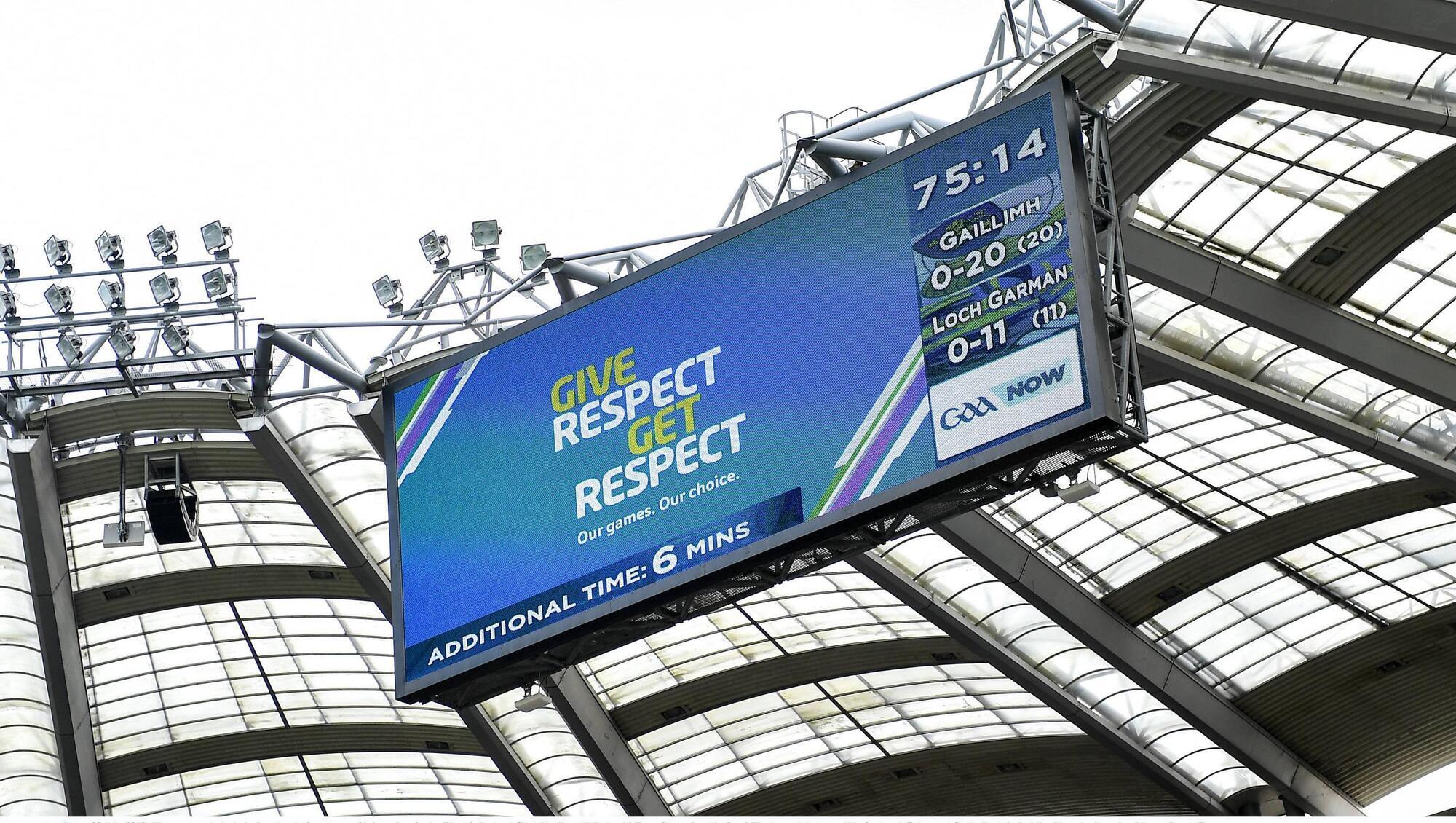
The scoreboard clock at Croke Park Photo by Brendan Moran/Sportsfile
Major inter-county Gaelic football games are running longer in duration than their hurling equivalents.
The Irish Examiner’s study of the 11 matches in this year’s championships reveal football games were averaging over 77 minutes in total, additional time representing in excess of 10% of the regulation minutes.
This year’s All-Ireland SFC final and semi-finals lasted an average of almost 78 and a half minutes whereas the hurling games’ average was over two minutes less. The trend extends to the previous four sets of All-Ireland senior finals.
The growth in game-time at the higher end of Gaelic games is in line with a new report that has found the percentage of soccer fixtures lasting 100 minutes or more in Europe’s top 20 leagues has more than doubled this season as officials allow for more stoppages.
In 2016, GAA inter-county referees were directed to allow for at least 20 seconds per single substitution as well as the delay in players travelling to take frees and other stoppages such as HawkEye. Last year, GaelicStats revealed the average time taken to complete a substitution in the senior inter-county hurling games it studied was 36 seconds, with 49 seconds for double replacements.
Since 2016, referees have been advised about further time-wasting practices. However, there is no rule preventing a team running down the time a black carded player spends in the sin bin as the 10-minute period starts and doesn’t stop from the moment he leaves the field.
Gaelic Stats’ analysis of last year’s Kerry-Galway SFC final found that the ball was in play for 43 minutes and 53 seconds of the 79 minutes plus between the first and final whistles, which represented 55.3%. That is considerably larger than the 1992 Donegal-Dublin final where the game was over eight minutes less in duration and the ball was only in play for just over 25 minutes, the equivalent of 35.18%.
Negative possession is considered a primary contributory factor to the added amount of in-play time. Interestingly, that was cited as one of the reasons for the GAA’s central authorities not recommending the clock/hooter 10 years ago. A report of the clock/hooter trial games read: “There was a temptation – almost exclusively in football – to play ‘keep ball’ over and back in defence while protecting a lead.
“This did not make for entertaining viewing and led, in some of the games, to games literally petering out, even when on occasion there was very little between the teams on the scoreboard. This type of negative possession also led to a lot of passing backwards in order to retain the possession.”
Twelve months ago, Gaelic Stats revealed that for an inter-county hurling game lasting 79 minutes, the ball was in play for 33 minutes, almost 42%. Earlier this year, the company, commissioned by the GAA, established that the amount of time the ball was in play during the Allianz League had dropped to 38%, a decrease of 5% from 2016, owing to the volume of shots players were taking.


CONNECT WITH US TODAY



Be the first to know the latest news and updates