Hurling has seen nothing like Limerick's long-range masters
When it comes to scoring from range on the biggest stage, hurling has seen nothing like this Limerick team
Hurling has seen nothing like Limerick's long-range masters

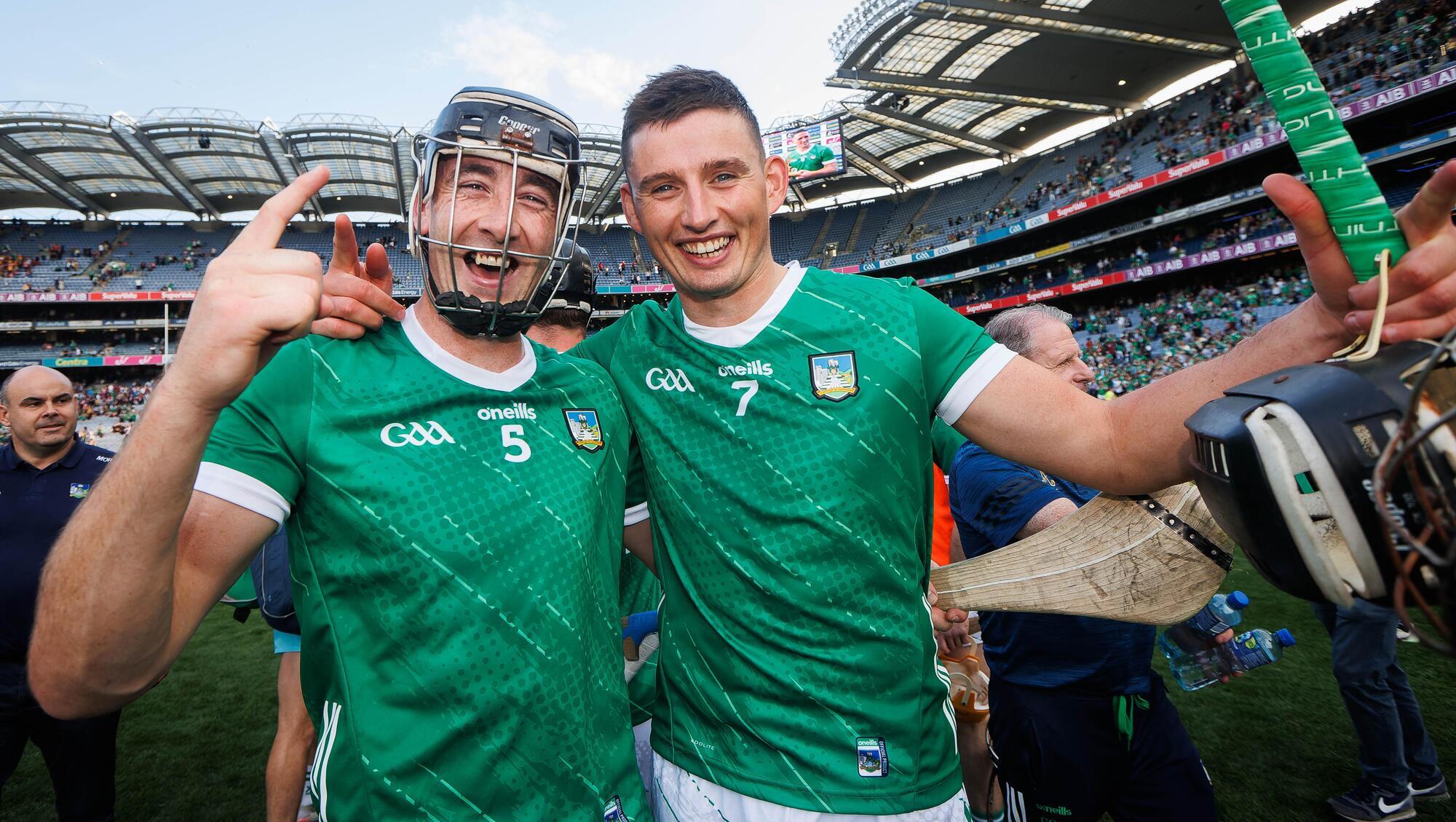
LONG-RANGE THREATS: Limerick’s Diarmaid Byrnes and Gearoid Hegarty celebrate after the game. Pic: INPHO/Ryan Byrne

When Kilkenny won the first All Ireland of this century, racking up as many goals (five) as any team had in an All Ireland final in 30 years, their scoring spread was indicative of how hurling – or more particularly, scoring – operated back then.

Of the 5-15 they put up against Offaly that day, not a single score came from their backs.

Just one point, courtesy of Andy Comerford, was from midfield.

The starting half-forward line chipped in with a then respectable 0-5 from play, thanks in main to Denis Byrne’s 0-4, yet that represented just a sixth of the team’s overall return. The bulk of their scoring came from their inside forward line, rock stars all, All-Stars all.

DJ Carey, after contending with chatter all through the lead-up that he had yet to really deliver a standout performance in an All-Ireland final, delivered 1-4. Charlie Carter shot 1-3. Henry Shefflin registered a game-high 2-2. Between them they’d combined for 4-9, 4-6 from play. To compound Offaly’s misery, a rookie called Eddie Brennan, who had just come off the bench, banged in another goal in injury time. It suggested that, as their manager would often contend in the years after that first All Ireland win of his on the line, Kilkenny didn’t do tactics, or at least overly-complex ones. Just get the ball to the lads inside and let them do the scoring.

Last July in the last of 19 All-Ireland finals that same Kilkenny manager viewed from the sideline, the opposition’s half-back line, for their fourth consecutive time in an All-Ireland final, combined for three points from play. More astonishing though was the return from Limerick’s three-man unit on the other ’65.

Both Kyle Hayes and Tom Morrissey equalled Byrne’s 2000 return of 0-4 from play yet those contributions were dwarfed by the return of the team’s other half-forward. For the second straight All Ireland final Gearóid Hegarty had registered a tally from play worth eight points; after pummelling Cork for 2-2 in the 2021 decider, he had taken Kilkenny for 1-5.

All in all Limerick’s starting half-forward line had posted 1-13 from play in the 2022 final; their full-forward line, though featuring three reigning or former All-Stars, had combined for ‘just’ 0-5 from play. Furthermore, two subs, Cathal O’Neill and Conor Boylan, had chipped in with a point apiece when introduced into the half-forward line, meaning that 1-15, or 53 percent, of Limerick’s scores came from their half-forward line.

Clearly such high scoring from such sources is exceptional – only hardly exceptional for this Limerick team.

In the previous year’s All-Ireland final, their starting half-forward scored even more: Messrs Hegarty (2-2), Lynch (0-6) and Morrissey (0-3) combined for 2-11 in the demolition of Cork, with a further two points coming from Hegarty’s and Morrissey’s replacements, David Reidy and Pat Ryan. In contrast, the inside line of Gillane, Flanagan and Peter Casey ‘only’ scored 1-9 from play to go with Graeme Mulcahy’s point upon coming on for Casey.

In fact in each of their four All-Ireland appearances Limerick’s half-forward line has outscored their inside line from play. As much of their game plan hinges on getting ball in to Aaron Gillane, it is not necessarily a final destination. Feed that inside line and they can always chuck it back outside for a half-forward to put it over.

Actually there’s plenty of other fascinating trends we’ve noticed when breaking down where and who scores have come from on the biggest stage of the lot in what we might term the era of Cody (1999-2022).

BACKS: LEADING FROM THE REAR 

When it comes to scoring in All-Ireland finals, there simply hasn’t been anything like these Limerick backs.

In four All-Ireland final appearances, both Declan Hannon and Diarmaid Byrnes have scored from play in each of them. Only other back in the Cody era or indeed any other has scored in as many All-Ireland finals from play. And no, it’s not Tommy Walsh; after storming onto the scene in 2003 and scoring three points from wing forward in the final, he was redeployed back the field and scored in just two further All-Irelands. It’s his brother Padraig who has scored in four All-Irelands from the half-back line, to go with the 0-2 he got from the half-forward line last year.

In fact Limerick are the only team to have all three members of their halfback line score from play in at least two All-Ireland finals. In 2020 Kyle Hayes from the No 7 spot joined both Hannon and Byrnes on the scoresheet while last year Dan Morrissey operating on the same line also chipped in with a point. The Kilkenny half-back line of Paddy Deegan (twice), Mikey Carey, and Richie Reid also all scored; throw in Thomas Walsh’s point from corner back and no backline scored more from play in an All-Ireland in the Cody era than the 0-5 his own group did in his last game with them.

In all the Limerick backs have by a distance scored more than any other defence of the Cody or any other era. As Table 1 below shows, their backline has scored 0-13 from play in their last four All-Irelands; in contrast the great Cork triumvirate of Gardiner, Curran and Ó hAilpín only managed 0-2 between them over the course of their four final appearances from 2003 to 2006. No Kilkenny back scored in their first six final appearances under Cody, and none would again in their four finals after completing the four-in-a-row.

MIDFIELD: LYNG - MR DEPENDABLE 

When it came to the crucial business of deciding on who should succeed Brian Cody, the kingmakers in Kilkenny rightly put huge store on the reliability of their eventual choice. How reliable is Derek Lyng? Well, no midfielder has scored in more All-Ireland finals from play than Urlingford’s finest.

Lyng played in eight All Ireland finals from 2002 to 2010 and failed to score in just one of them (2007). In the other seven he prompted the umpires to reach at least once for the white flag. His highest return in a single All-Ireland final was the 2008 demolition of Waterford in which he fired over 0-3. In each of the other six finals he scored ‘only’ the one point, yet the fact he was able to register a score at all in each of those finals is a measure of his consistency and dependability.

UPFRONT: BIG DOGS ON THE BIG DAY

The bigger the stage, the bigger the big man seems to play. Even in the unlikely event Gearoid Hegarty was to fail to score in this weekend’s final – as he did in the 2018 decider – he will still remain the player who has averaged most from play in All-Ireland finals in this millennium (having played a minimum of three finals that is).

To just appreciate just how outrageous it is that he has racked up 3-14 from play in All-Ireland finals, consider the fact that TJ Reid has played in eight finals more and still scored five points less with ‘just’ 2-15 from his 12 appearances. Eoin Kelly only scored 0-4 from play over his four All-Ireland final appearances and brief cameo in the drawn 2014 final. Joe Deane only scored two points from play over five finals – as Table 2 shows below, Ben O’Connor was Cork’s most consistent threat from play during that time – though Seamus Harnedy would subsequently average even more.

Tom Morrissey is also right up there, in third place; only John ‘Bubbles’ Dwyer, a possibly surprising candidate in second, separates them, with another Tipp assassin, Seamus Callanan, then completing the top four.

As for scores in any possible way though, the Limerick lads, even including their freetaker Gillane, still have a bit to do to catch up on the Ballyhale duo of Shefflin and TJ (see Table 3). Then again this will only be their fifth All-Ireland final. This will be Reid’s 13th. Shefflin played in 14, including two as a sub in ’14.

Even if and when you beat Kilkenny, you still have Kilkenny to chase.

More in this section

Cookie Policy Privacy Policy Brand Safety FAQ Help Contact Us Terms and Conditions

© Examiner Echo Group Limited