Talking points: Limerick find the missing piece of the jigsaw
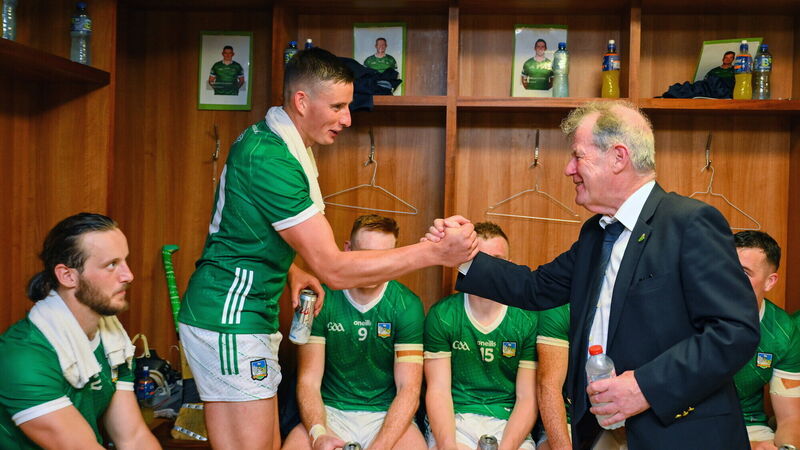
KIGSAW PIECES: Businessman JP McManus and Gearoid Hegarty of Limerick celebrate. Pic: Ray McManus/Sportsfile
When Caroline Currid was the keynote speaker at a Shannon Chamber event a few years back, she described Limerick’s breakthrough 2018 All-Ireland success as a jigsaw. In that analogy, Currid said it only takes one missing piece to make it incomplete.
Limerick have solved many puzzles in the meantime. They have constructed the most glorious jigsaw imaginable but earlier on in this championship, Limerick appeared to be looking for a piece that had gone missing.
Pushed hard by Waterford in the opening game, they lost to Clare in round 2, which was Limerick’s first championship defeat since the 2019 All-Ireland semi-final. If Limerick were missing a piece of that jigsaw, the biggest indication was provided late on in that game when the match was in the melting pot and Clare looked Limerick in the eye and stared them down, flooring them with a volley of late points.
Limerick took that as a serious slight on their identity, not that they had finally lost a match, but primarily because Limerick just don’t lose tight matches. Outside of that Clare defeat in April, and the draws with Clare in last year’s round robin, and against Tipperary this year, Limerick have won six of their last nine matches by just one score. Their three wins in this year’s provincial championship have been by margins of 0-2 and 0-1 (twice).
Clare should have had a late free to try and draw the match to take it to extra-time, but they will still have huge regrets that it came down to that late missed refereeing call. Clare’s overall conversion rate was just 48%, with that number plummeting as low as 42% in the second half when Limerick’s was 65% in the same period. Clare’s frees were form harder positions but Clare’s conversion rate from placed balls was a paltry 45% compared to Limerick’s 89%.
Clare dropped six shots short but they’ll also be disappointed with how they struggled to shut down Aaron Gillane; from 12 possessions, Gillane scored 1-3 and was fouled for three frees. Gillane also nearly had another goal. Limerick also did most of their damage in that second half off puckouts, mining 1-7 out of 1-12 from that source.
Limerick are still not operating at the levels they have been in recent seasons, but they are still experts at winning tight games. If that was the main piece of the jigsaw they were missing in late April, Limerick have certainly found it again.
When it comes to late match-winning (or equalising) goals, in the cruellest manner possible for the opposition, nobody drives that knife into the ribcage and gut harder and with more force than Kilkenny.
There has been a litany of those devasting rapier thrusts; Matt Ruth against Offaly in 1982, DJ Carey against Wexford in 1991, Denis Byrne against Laois in 1995, Walter Walsh in the drawn 2016 All-Ireland semi-final against Waterford.
Ruth’s goal in the 1982 Leinster final was a lot earlier in the game than the last puck, but it carried similar undertones to Cillian Buckley’s goal here. Offaly were reigning All-Ireland champions and were leading by 0-12 to 0-09 with six minutes remaining when a ball that Offaly goalkeeper Damien Martin was adamant had gone wide was cut back across the goal by Liam Fennelly. Ruth finished it to the net and Kilkenny went on to snatch two late points and the match on the scoreline 1-11 to 0-12.
Subsequent evidence strongly indicated that the goal should have been disallowed. Martin is still adamant that the ball was wide but the biggest regret Martin and Offaly had on the day was that he didn’t clear the ball when he had the chance.
Galway will harbour those same bitter feelings now when they had the ball in the corner in the dying moments, with the chance to clear it, or put it dead over the sideline and give themselves a chance to reset and shut any defensive avenues down.
When they didn’t, TJ Reid and John Donnelly kept the sliotar alive before it eventually fell to Buckley, from a Padraic Mannion kicked clearance. Buckley’s finish was similar to Rodri’s for Man City in Saturday night’s Champions League final in how he placed the ball in the corner (albeit not the same power or connection as Rodri) outside the defenders and beyond the reach of the ‘keeper inside the post.
Galway will be sick at the manner of this defeat, especially when they had done so much to drag themselves back into the match and take control of it at apparently the right time. Much of that credit is due to the outstanding Conor Whelan who scored 1-6 from play and had assists for 1-2.
In the end though, it all amounted to nothing as Kilkenny won a first Leinster title since 1998 without Brian Cody at the helm. Sitting beside Cody in the stand yesterday was Matt Ruth.
Considering how the match ended, Kilkenny would have seen that image as almost fitting.
Recently, the archivist and private collector Pádraig Ferguson donated his archive to the GAA, which the Association are in the process of digitalising to make it a precious data collection resource.
The GAA are lucky that someone like Ferguson, who crunched and collated all the numbers, has done so much heavy lifting for the Association. But they’re also blessed that many other dedicated and brilliant statisticians, archivists and historians like Seamus O’Doherty and Leo McGough have continued to educate the GAA public through their own outstanding work.
In yesterday’s Munster final programme, O’Doherty outlined how Declan Hannon has now become the joint most successful Munster final winning captain, alongside Johnny Leahy from Tipperary, who captained his county to five Munster titles, in 1916, 1917, 1922, 1924 and 1925.
Prior to Sunday, Hannon had been the joint-second most successful Munster captain alongside Christy Ring, who captained Cork to four Munster titles in 1946, 1953, 1954 and 1956. Cork’s Seán Óg Murphy, Tom Semple and Mickey Maher from Tipperary and Clare’s Anthony Daly had all captained their county to three Munster titles.
Hannon, along with Nickie Quaid and Graeme Mulcahy, also became the first Limerick hurlers to win six Munster medals. Between 1933 and 1940 (inclusive), Mick and John Mackey, Paddy Scanlan, Timmy Ryan and Paddy Clohessy won five Munster titles. The majority of this Limerick squad have now joined them, but Hannon, Quaid and Mulcahy are out on their own with six medals.
McGough’s genius also unearthed some recent gems. Against Cork, Tony Kelly scored his 300th championship point (white flags) and also his 300th from play in all competitions (113 games). Kelly’s four points from play in the Munster final moved him onto 163 points from play, alongside Patrick Horgan, who has also hit 163.
John Conlon’s brilliance and longevity was underlined with the Munster final being his 160th competitive match for Clare. In Croke Park, TJ Reid played his 141st game for Kilkenny, finally surpassing Henry Shefflin for all competitive games played for his county.
In those 140 games, Shefflin finished on 1,035 points. After the Leinster final, Reid finally moved past Shefflin with a combined total of 1,040 points from all of his competitive games with Kilkenny.
Like great players, hurling supporters everywhere are lucky to have great historians and statisticians like McGough and O’Doherty.
CONNECT WITH US TODAY



Be the first to know the latest news and updates