Talking points: Reunited in summer and for once the heat is on Kerry
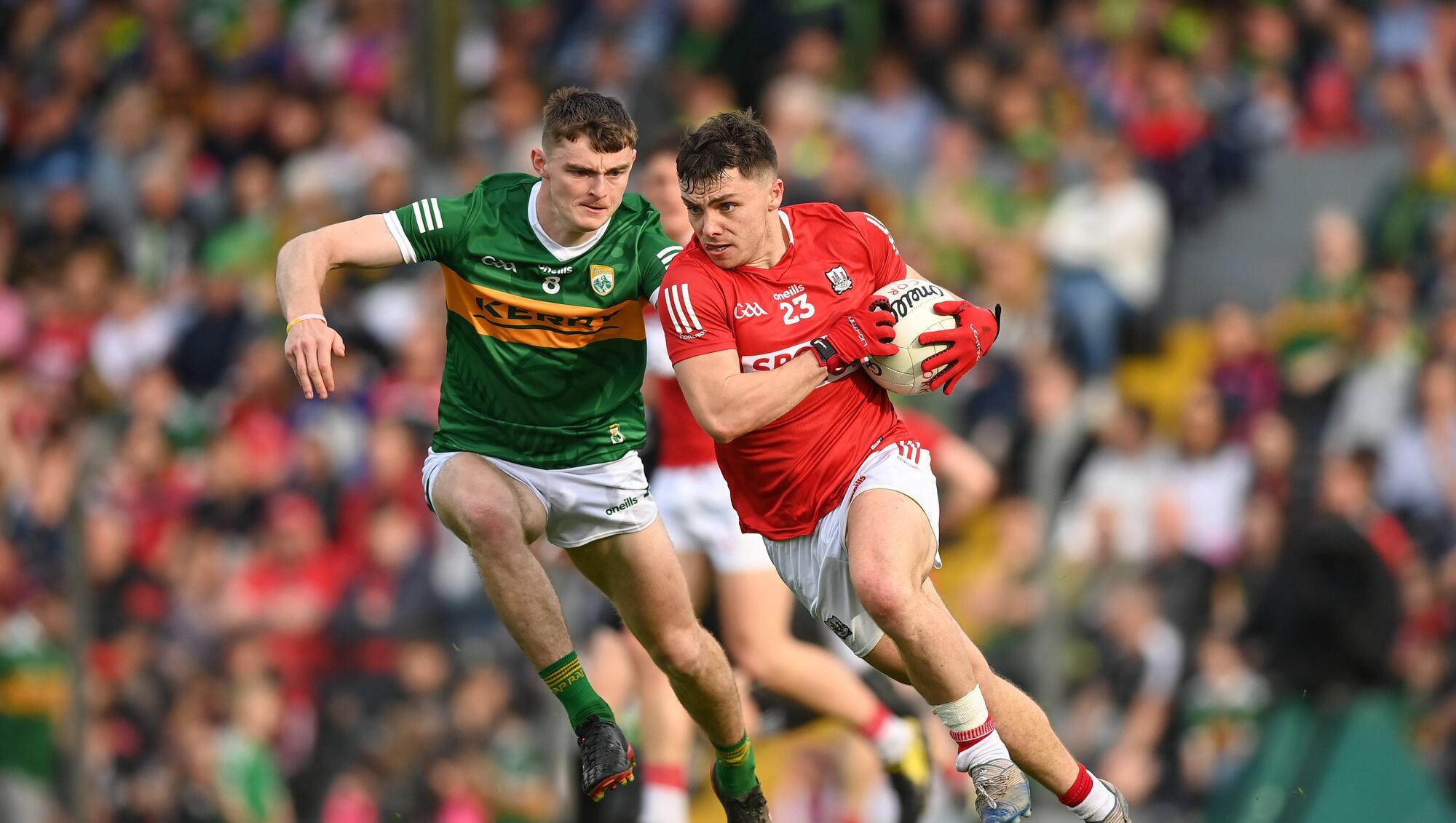
RUNNING GAME: Sean Powter of Cork in action against Diarmuid O'Connor of Kerry. Pic: Stephen McCarthy/Sportsfile
When the All-Ireland football qualifiers were introduced for the first time in 2001, Cork football carried such a status that the new system didn’t provide the kind of emancipation that it did for other counties imprisoned in their own province for so long that they’d never known anything else only perennial frustration and disappointment.
Cork had been in the All-Ireland final in 1999. They’d won more Munster titles (five) than any other county in the 1990s. Cork had beaten Kerry in eight of their previous 13 championship meetings between 1987-2000.
And yet, a new system still gave Cork a renewed sense of freedom and liberation, ensuring that they would never again have to suffer anything like the long, dark periods of impotence that they endured in the past, particularly during Kerry’s most glorious era of all in the 1970s and the first half of the 1980s.
At least when Cork couldn’t beat Kerry in Munster anymore, they had a second chance, something they were always denied when Cork legitimately had the second-best team in the country but they just couldn’t crack Kerry during their golden years between 1975-’86.
Once the qualifier era was introduced, the biggest Cork-Kerry games took place on the All-Ireland stage, and not just in Munster as they historically always had; the 2002, 2005, 2006 and 2008 All-Ireland semi-finals, and the 2007 and 2009 All-Ireland finals.
Cork and Kerry could have met again in the 2010 All-Ireland final except Down beat Kerry in that year’s All-Ireland quarter-final. The closest they really ever came to meeting again on the All-Ireland stage was in 2012, when both sides were slated to meet in the All-Ireland semi-final but Donegal took out Kerry in the All-Ireland quarter-final.
That was Cork’s last All-Ireland semi-final appearance. Once they slipped from the high standards they had continually reached during the previous decade, failing to make the last four of the championship also denied Cork the opportunity of meeting Kerry again later in the summer, as they had done on seven occasions in Croke Park (including the 2008 All-Ireland semi-final replay) during the 2000s.
There was the potential for them to meet in the 2013 semi-final but Cork lost to Dublin in that year’s quarter-final. Technically, they could have also met in the 2016 and 2017 semi-finals given how the draws panned out in those years, but that would have still required Cork winning two more games along that pathway, with Cork losing a round 4 qualifier to Donegal and Mayo in both of those seasons.
There was also the scope for them to meet in an All-Ireland semi-final in 2019 after Cork qualified for the Super 8s but they finished bottom of their group when they’d have needed to finish second to get a crack off Kerry, who topped their group.
When Cork finally beat Kerry in Munster in 2020 for the first time in close to a decade, a knockout championship denied Kerry any shot at redemption later on in that winter campaign. The following year was also knockout while Cork and Kerry would have met again in last year’s semi-final if Cork had beaten Dublin in the quarter-final – which was always going to be a big if.
The old system demanded that both teams keep winning to reach the last four together if they wanted to have another joust outside of Munster. The new system though, has pitched them together in early June before the championship has even warmed up.
In their six previous championship meetings on the All-Ireland stage, Kerry were favourites in five of those meetings. Despite what was at stake, Kerry were always expected to win, which they always did. Cork always accepted that slight underdog status in those matches but it still never alleviated the strain or the pressure on them to get the job done against Kerry, which they never did.
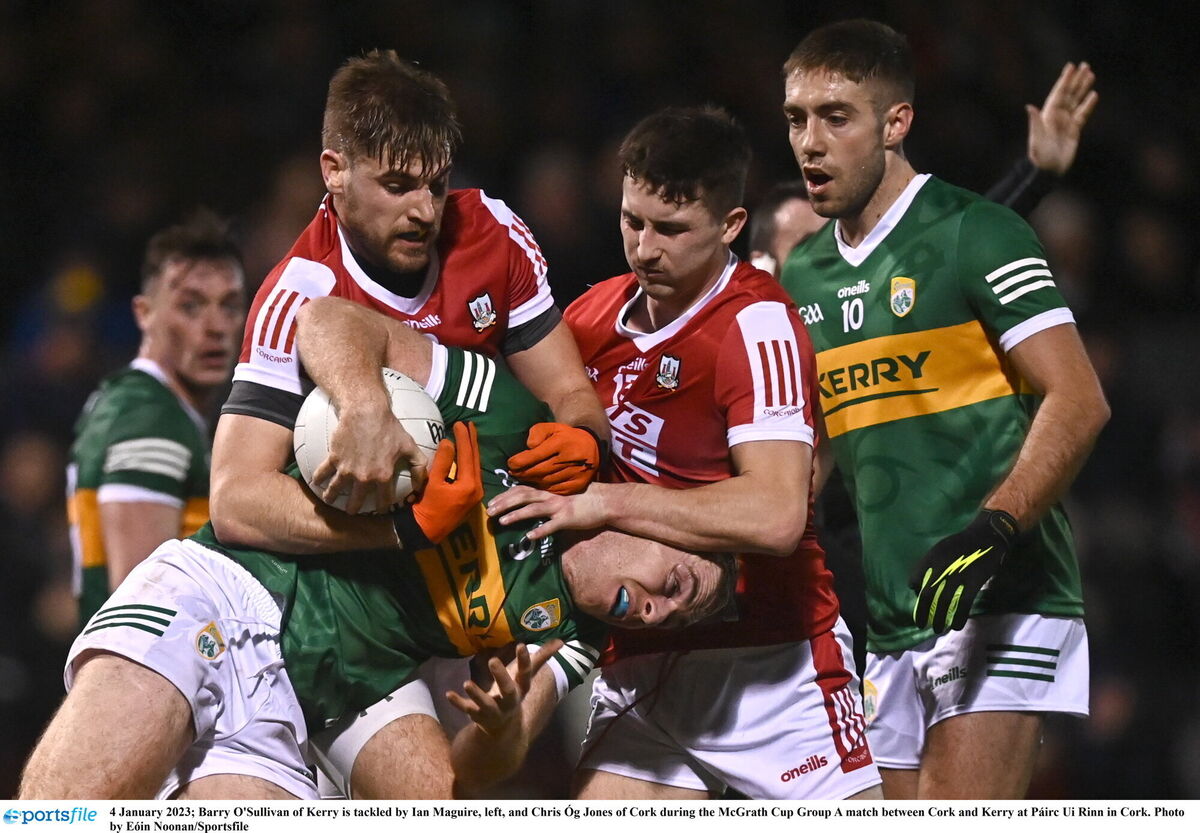
The context is vastly different now because of the makeup of the new system, and the lack of jeopardy attached to it at this stage of the season. Kerry are raging favourites again but Cork’s win against Louth last weekend has taken the pressure off, while the heat has intensified on Kerry after such a poor result and showing against Mayo.
There is always pressure in a Cork-Kerry game. Cork need to show that they can deliver against Kerry in the summer. They need to prove that they are heading in the right direction under this management. If they perform, Cork know that they can heap even more strain on Kerry here.
That brings pressure, but Cork can still enter a Cork-Kerry game on the All-Ireland stage for the first time with a much less to lose than their opponents.
The TG4 slow-motion camera captured the moment perfectly. At the final whistle of the Leinster U20 final, Adam Screeney and Dan Ravenhill jumped into each other’s arms, the emotional release and elation vividly etched in highly descriptive detail through their eyes and smiles.
The last time Screeney and Ravenhill had played a major final saw their emotions at the complete opposite end of the scale when Offaly lost the 2022 All-Ireland minor final to Tipperary in heart-breaking circumstances to an injury-time goal with almost the last play.
Full atonement may only come with an All-Ireland U20 title but at least Offaly and the handful of players who featured in that minor final now have a chance to exorcise those demons and experience more of the euphoria which coursed through their veins in Carlow over two weeks ago.
Offaly hope that day will come on Sunday against Cork in the All-Ireland U20 final, but they probably didn’t expect that opportunity to come as early as it has. On the other hand, maybe they did; Offaly reached the 2020 Leinster minor final, which they lost to Kilkenny by six points. And the influx of so many of last year’s minor team has helped take Offaly to the brink of success at U20 level.
In the history of the All-Ireland U21/U20 hurling championship, 12 beaten All-Ireland minor finalists have atoned for that disappointment three years later; Cork (1969, 1971, 1997), Kilkenny (1974, 1977, 2022), Galway (1993, 2011), Tipperary (1964, 2018), Clare (2013) and Limerick (2017).
However, a number of players also atoned for the disappointment of losing a minor final by winning an U21/U20 final the following year; Cork (1969, 1973, 1976), Kilkenny (1975, 1977, 1999), Limerick (2015 and 2017) and Galway (1982).
That Limerick minor team that lost the 2014 All-Ireland minor final has effectively provided the bedrock of the current senior team. The quality and talent of that side was fully apparent when five of the players which lost that minor final – Cian Lynch, Tom Morrissey, Barry Nash, Seán Finn and Peter Casey – played in the U21 final win against Wexford just 12 months later.
When those five played on the 2017 All-Ireland winning U21 side, they were joined by Kyle Hayes and Conor Boylan, who had played on the Limerick team which lost the All-Ireland minor final to Tipperary the previous year.
For Offaly now, Screeney, Ravenhill, Brecon Kavanagh, Cillian Martin, Ter Guinan, James Mahon, Conor Doyle, Niall Furlong and Donal Shirley will be hoping to get that coveted medal. Their best chance may come down the line but Offaly won’t be thinking that way, especially those players which lost last year’s minor final.
They will know better than anyone that when the chance comes, you have to take it.
When Seán Kelly established the All-Ireland club Junior and Intermediate championships during his GAA Presidency, the real beauty and attraction of those competitions was how they reached out to the GAA proletariat everywhere.
Just as importantly though, Kelly’s Hurling Development Committee was responsible for the establishment of the Christy Ring and Nicky Rackard Cups. Those competitions (which was later extended to include the Lory Meagher Cup) gave hurlers from the lower tier counties a season of games along with an outlet and pathway to Croke Park, something they were previously denied.
In the near two-decade history of the three competitions, every Christy Ring, Nicky Rackard and Lory Meagher final, bar one Ring final, have been played in Croke Park. The 2008 Ring final between Carlow and Westmeath was played in Tullamore on a Sunday evening, but that never happened again.
The numbers are also revealing around final participation amongst the counties; 12 different counties have featured in the Ring final, including London; 11 different counties have played in the Rackard final, including London, Warwickshire and Fingal; 11 different counties have featured in the Lory Meagher final, including Lancashire and Warwickshire.
Mayo, Derry and London have played in both the Ring and Rackard finals, while Tyrone, Donegal, Sligo, Louth and Warwickshire have played in both the Rackard and Meagher finals. On Saturday, Wicklow will also join that list of counties playing in two different finals, contesting the Rackard final over a decade after losing successive Christy Ring finals in 2011 and 2012.
Prior to this season, the only county in the country which hadn’t appeared in Croke Park for a hurling final was Monaghan. Yet the Monaghan hurlers will finally get that chance in Saturday’s Lory Meagher final.


CONNECT WITH US TODAY



Be the first to know the latest news and updates