Peter Fitzpatrick: the Wee County supremo with big ideas
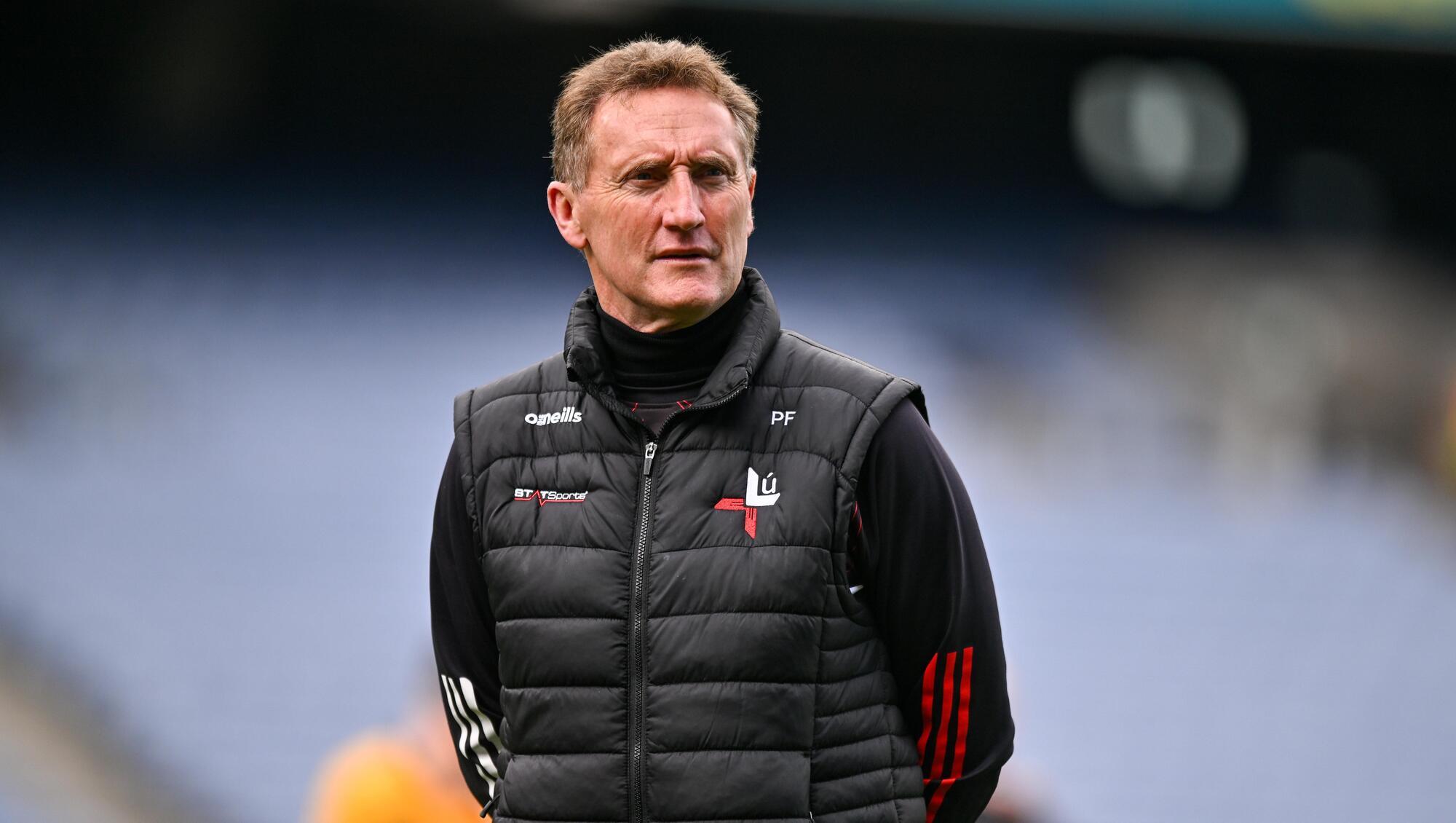
LOUTH AND PROUD: Louth GAA Chairman Peter Fitzpatrick. Picture: Ben McShane/Sportsfile
He’ll always be one of the faces of that day.
By his own admission he’s forever scarred by that day.
And in recent years he’s again dedicated himself to his county to help it finally move on from that day.
When the 2010 Leinster football final finished in absolute chaos, Peter Fitzpatrick was simultaneously a model of protest and restraint. Martin Sludden, without consulting his umpires, had deemed that Joe Sheridan’s last-gasp try more so than a goal was worthy of three points, prompting several Louth players and supporters, enraged that their county had been denied their first Leinster title in 50 years, to engulf him. That’s when an unlikely security alliance was formed for the beleaguered Tyrone official: as well as being patrolled off the field by several Gardaí, Sludden was ushered to the sanctuary of the referee’s dressing room by Fitzpatrick, his lips clearly questioning Sludden’s decision but his arms outstretched to keep the maddening crowd at bay.
Although Croke Park stadium director Peter McKenna disapprovingly questioned why the Louth manager had entered Sludden’s orbit, the Irish Independent at the time viewed his intervention as “a remarkable display of composure from the Dundalk man who had every right to be spitting feathers”.
Fitzpatrick was indeed seething over the decision and the result. In his first post-match interview he described Sludden as “Dick Turpin without a mask” for presiding over “pure daylight robbery”. But either side of that comment Fitzpatrick also felt and expressed a degree of sympathy for Sludden. That he had the grace to allow Fitzpatrick into his dressing room to raise his objections; that he would later accept he had made an “awful mistake”; that ultimately it was the GAA’s fault for not acknowledging the gravity of that mistake and ordering a replay; and for how rattled Sludden was in that immediate aftermath.
“He was really shook up in fairness,” Fitzpatrick would recall 10 years on from that day. “I wouldn’t like that to happen to anybody. What happened after the game [a couple of Louth supporters were later convicted in court for assaulting Sludden] should never happen to any referee.”
Instead of being his most painful day in football, it should have been his most glorious, the culmination of a life highly devoted to Louth GAA. He had won a provincial medal before for the county alright back in 1981 but that was only at U21. For the next 16 years he’d played senior for the county and feature in six provincial semi-finals but each time Louth fell short.
He’d get his hands on some silverware in those years. In 1985 he won a senior county title with his home club of Clan na Gael, a victory he’d credit less to his role at centre back and more to the sweet left foot of a future soccer international by the name of Steve Staunton.
After his playing career he fell into coaching. In 2003 he led St Patrick’s Lordship to their first Louth senior championship; after making that breakthrough the club won a further six titles over the subsequent 12 years. Taking the county team at some point had long been an ambition of his and in the autumn of 2009 the opportunity finally arose.
Louth were at a low ebb. They had just managed to avoid relegation from Division Three on scoring difference and had been knocked out on the first day of that year’s qualifiers. The first week he got the job he went to watch county champions Mattock Rangers in the provincial championship. Portlaoise beat them by 25 points.
Fitzpatrick though knew from personal experience there was no such thing as lost causes. In September 2003, just a couple of weeks before he’d win that maiden county with St Patrick’s and a future collaborator called Mickey Harte won a maiden All-Ireland with Tyrone, Fitzpatrick’s then 16-year-old daughter Daramay had collapsed in their family home. Fitzpatrick raced home, carried her in his arms into the A&E in Louth county hospital where he was informed she had an extreme case of meningitis. She entered a coma, was administered her last rites and Fitzpatrick was told there was no hope for her.
But yet he stayed by her bedside for nine days without leaving her once. He prayed incessantly. And then, one day, she woke up. “It’s an awful shock when someone tells you your daughter isn’t going to make it,” he’d recall to Ewan MacKenna of the old Sunday Tribune in the summer of 2010. “I’ll never forget when she came around. Now every time I see her I feel so lucky.”
That summer of 2010 he’d perform some miracles of his own, masterminding the defeat of Kieran McGeeney’s Kildare en route to the Leinster final, while emerging as one of the most riveting figures of that championship. In a way he was a cross between the evangelism and eloquence of Liam Griffin and the charisma, athletic frame and shorts of John Maughan; like the Crossmolina man, Fitzpatrick spent some time in the military, serving in the 27th Infantry Battalion stated in Dundalk. A couple of weeks out from his team’s 2010 first-round game against Longford, he entered the entire squad into the Dundalk 10k run. The first of them over the line was future All Star Paddy Keenan – four minutes and 30 seconds later than his then 48-year-old manager. “It’s important that I can feel their pain,” Fitzpatrick told the Tribune, “and that I go through what they do.” Unfortunately, with the way the subsequent Leinster final panned out, they’d feel and share a pain that still lingers.
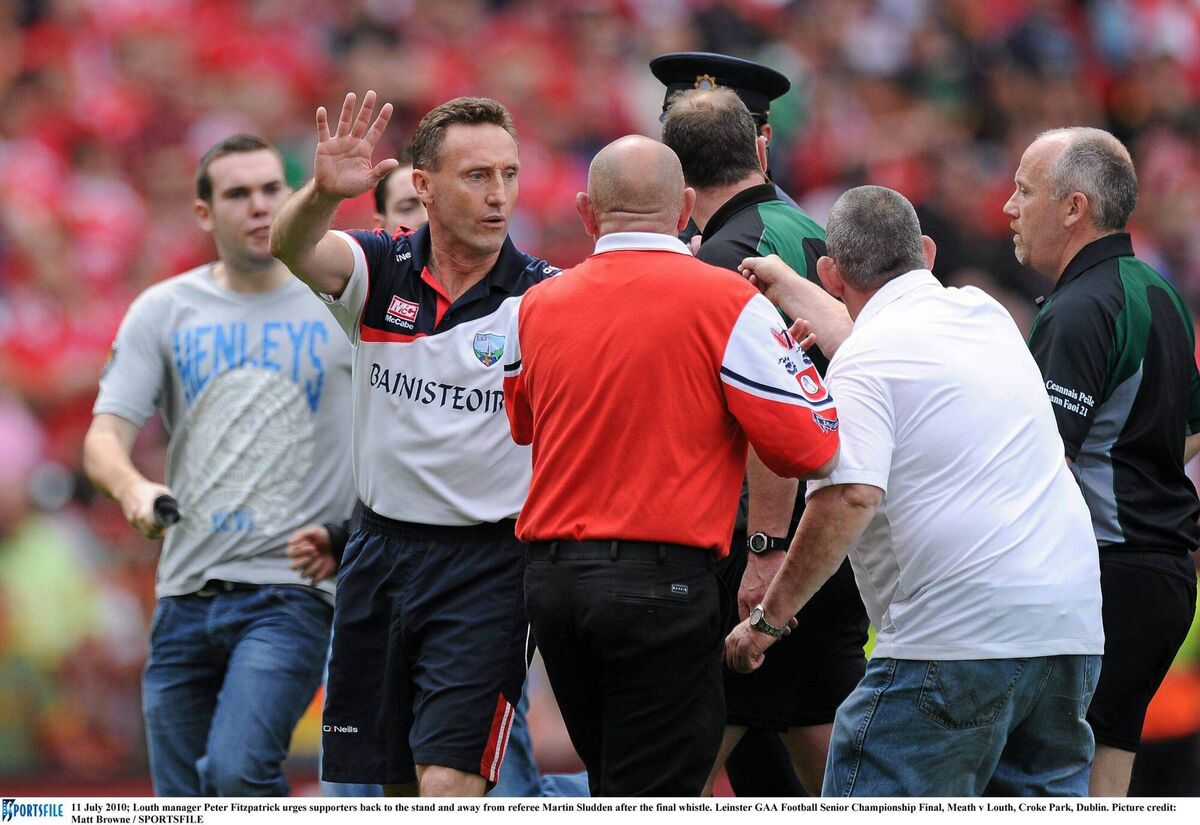
On their way off the Croke Park pitch that day, Sludden invited Fitzpatrick to his dressing room to air his grievances. “He said that if it wasn’t a goal he was going to give a penalty,” Fitzpatrick would claim 10 years later. “So I said, ‘Why didn’t you go ahead and give the penalty?’ He said, ‘I don’t understand you.’ I said, ‘They could have missed the penalty!’ When I asked why he didn’t consult the umpires he asked me to leave. I left then.
“At the time I blamed the Meath players because they were publicly saying that they had no intention of doing a replay. But time is a healer. I think now that it should never have been put back on the Meath players. The GAA let Louth down. And in fairness they let Meath down.
“We had our best team in nearly 50 years on the field that day but that shook the living daylights out of Louth. The following year three or four lads went to Australia, the whole thing kind of broke up. We’re still recovering. There’s not a day that passes that I don’t think of that final.”
Fitzpatrick would finish as county manager after an early-round championship exit in 2012 by which time he was also a local TD, a position he still holds over a decade later. Initially he ran as a Fine Gael TD and sat on the health committee and another for transport, sport and tourism. In 2018 though he resigned from the party, in no small part because of his opposition to the legalisation of abortion in Ireland, and ran as an independent when re-elected to the Dáil in 2020.
The same year he was also voted in as chair of Louth GAA and in typical fashion was immediately ambitious, outlining a vision for both a county ground and county team Louth could be proud in. For decades Louth have had the smallest county ground in the country but by autumn next year a new €20 million stadium with a 14,000 capacity on the Dundalk Inner Relief Road should be completed.
He’s also played his part in building a fine team in the wee county. Within days of identifying and appointing Mickey Harte as the new county manager, Fitzpatrick gave an interview to local radio reiterating his belief in supposed lost causes. Louth may at the time have been in Division Four but Fitzpatrick was already looking beyond promotion to Division Three.
“People say ‘What’s the goal?’ Our goal over the next two or three years is to get back into Division Two, hopefully get back into a Leinster final.” Now here they are just two and a half years later, in a Leinster final, having finished just a spot off winning promotion to Division One.
In Harte he’s found a kindred spirit, someone with similar religious and personal beliefs – the value of prayer, the sanctity of the life of the unborn – and who believes in the power of positive thinking, especially in football. “When I [first] met Mickey Harte,” Fitzpatrick told the local media recently, “he asked me one question: ‘Peter, is there talent in Louth?’ I said there was but that we just needed somebody to harness it. To this day Mickey recalls that conversation and me telling him that the players were there.”
In the lead up to this Leinster final Harte has referenced the last time the county appeared in one. How the players of 2010 “are to be respected, [making] their way to that final and to all intents and purposes won it but didn’t get any cup for it”.
But how now the final of 2023 “is a new starting baseline for the future of Louth football”. How being back in a final again “is good for the people who follow Gaelic games here and good to know that it [2010] isn’t the one that will always be talked about now”.
Thirteen years on they dream again. In no small part because Fitzpatrick went away and came back and dreamed it all back up again.

CONNECT WITH US TODAY



Be the first to know the latest news and updates