Declan O'Keeffe interview: 'It's a lonely spot, making a mistake in front of 60,000. You have to take a couple of deep breaths'
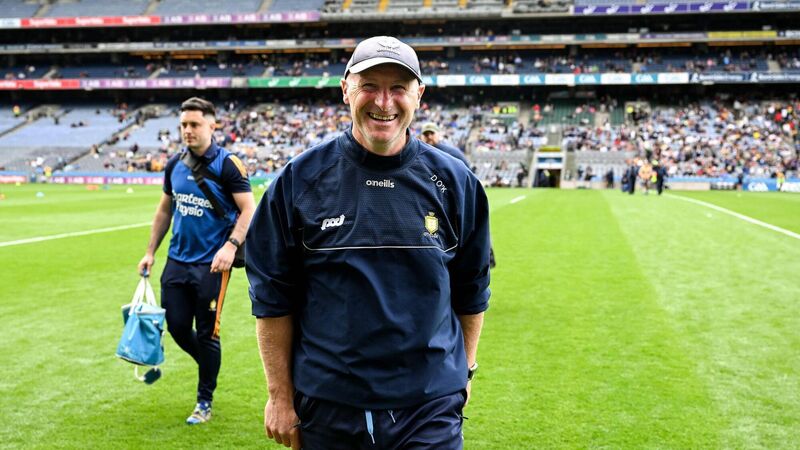
SAFFRON SMILE: Former Clare goalkeeping coach Declan O'Keeffe at Croke Park.
Sunday morning, only days after he and almost every other Garda in Clare ensured the safe passage of Donald Trump, and a few hours before he’ll head into Limerick to watch his adopted county play his native one in a Munster final, Declan O’Keeffe will look over a group of U11s playing a game of football in Clarecastle.
For the past 18 years he has lived in another hurling stronghold, that of Clooney-Quin who his children play for. Sometimes he finds it frustrating as to where football can lie in the Banner hierarchy – “Coming from Kerry it’s been the biggest difference to have to get used to” – and how swathes of the county could be producing more footballers. Yet he has also seen from his four years inside the senior Clare setup a demographic shift, symptomatic of the quiet revolution Colm Collins has presided over as much as the depopulation of west Clare.
Éire Óg in Ennis, just like Collins’ own Cratloe before them, are now heavily represented on the county panel; seven of their players have made the matchday 26 for Sunday. Traditionally such clubs were more partial to the small ball. So who knows: a couple of the kids from Clooney-Quin or Clarecastle playing Sunday morning could someday be Clare footballers.
And life has taught him that it could be any of them. Even the weakest of them. Back in Rathmore in the 1980s, he was that kid.
“If someone had told you back when I was 14 or so, ‘That fella in goal there is going to play minor and U21 with Kerry, win two senior All-Irelands, a couple of All Stars and play for Ireland’, you’d have told him, ‘Jesus, would you go away!’ I remember conceding 11 goals in a Community Games match in Killorglin. At U14 our corner back would have to kick the ball out for me. I had no kickout. I went from that to later kicking the ball 80 yards.
“That’s why I never judge young fellas on a first day or a second day or what they look like at U15 or whatever. We can be very dismissive of kids. I’d be totally against that. Don’t get hung up on winning or losing. It’s all about learning. Reserve your judgement. There’s so much that can be worked upon.”
When he was 16 or so a selector in the club persuaded Charlie Nelligan to come out and take him through how to get distance on his kickout. O’Keeffe made a captive audience: he was a child of the golden years and now in the local club field was one of its gods.
Nelligan’s tutorial only lasted about 40 minutes – like how to place the ball with the O’Neill’s print facing out at you, make contact with the valve point, driving through – but its legacy has lasted a lifetime: Sunday in Limerick's Gaelic Grounds, Stephen Ryan, the Clare goalkeeper that O’Keeffe mentored for the four seasons previous to this one, moulding him into one of the finest in the country, will carry out an almost identical routine.
For the most part though O’Keeffe had to work on things and work out things on his own. “I coached Stephen Ryan. I had no goalkeeping coach. I’d no performance coach. I’d to coach myself, manage myself.
“Did I manage it all well? I would say I didn’t. But just through bull-mindedness and persistence or I don’t know what term in performance coaching they’d call it these days but I’d eventually come up with some way to cope and drive on.”
In 1996 he broke onto the senior Kerry team, having played in and endured losing a minor All-Ireland in 1990 and a string of U21 All-Ireland semi-final and final defeats. His breakthrough coincided with Kerry beating Cork in a Munster final for the first time in a decade but in the subsequent All-Ireland semi-final they were ambushed by Mayo and a stranded O’Keeffe was lobbed by James Horan. The immediate aftermath was hellish, the following winter purgatory: in Kerry’s first seven league games he was rooted to the bench.
“I was at a crossroads. A lot of players find themselves there at some point. Where you’re out in the cold and you’re saying to yourself ‘Am I going to stick with this or what?’ It’s probably worse as a goalkeeper. It’s not like you can be brought on as a sub and kick a few points: either you’re playing the full game or you’re not playing at all.
“That day against Mayo, I was trying to find Éamonn Breen on the wing from a kick out. But Horan intercepted it and it was like time froze. I was just stuck there on the 21 when God, if I had scrambled back I could possibly have got to it. We all had a bit of a stinker that day but if you make a mistake in goals, number one you don’t forget it and number two, a lot of other people don’t forget it either.
“But the simple truth of it there isn’t a goalkeeper that has been born into the world that doesn’t make a mistake. So you learn that no matter what has happened you have to hold your head. ’Tis a lonely spot, being out there, making a mistake like that in front of 60,000 but you just have to take a couple of deep breaths, almost like you’re pressing a reset button, and just get on with it. There is no other way.”
His break came in a league quarter-final up in the old Croke Park against Down; though he was wearing the No 22 jersey like all Kerry sub goalkeepers did back then, he was handed with the responsibility of being their number one for that day at least.
“There’s something about that time of year: the new leather is brought out, like they bring out the new balls at Wimbledon. And any dead ball kicker will tell you: new leather will travel a bit faster. Even training teams now, l love to see the new balls coming out for championship. And that day and any other day we played in Dublin I felt like I could break deadball records up there.”
By that September he was back up there, winning an All-Ireland to go with his league and Munster medals, and by November he was returning again to collect an All-Star. Some difference from how bleak things were looking for him the previous winter.
“That’s why I always say to lads now, ‘You never know what’s ahead of you. Keep at it and often there’s a reward there at the end of it.’”
The journey though, the quest for self-improvement, was never-ending. “I remember in 1999 in the Munster final on a wet day down in Cork I left a ball through my hands for a Fachtna Collins goal. After that I became feckin’ paranoid about the high ball. It was like a daily diet where there’d have to be 30 footballs at training every night and I had to be the first out and the last off, seeing how many of them I could catch overhead.”
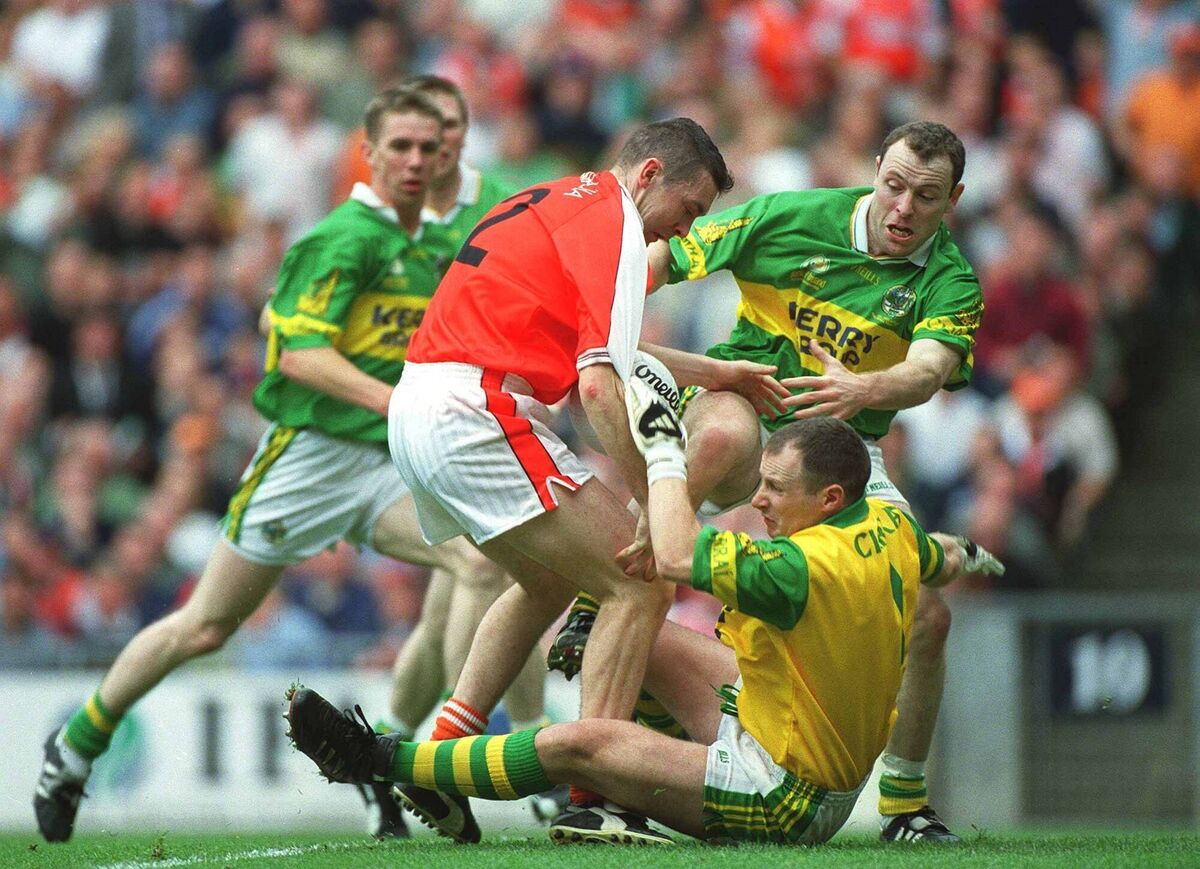
That was his nature but also the environment. In those years he was also winning county medals with East Kerry and Seamus Moynihan, a friend from his minor days whose house he’d often crash in after a night out in Killarney. In his eyes, Moynihan was “both the best I ever played with – and the best I ever played against because with Rathmore we often played Glenflesk”.
His eyes also saw what ours didn’t: the work he did away from the lights.
“Seamus was another who’d always stay back after training. I remember when he was switched from the wing to full-back in 2000 and how he’d get Donal Daly to stay back with him and kick the ball into so he’d get used to the change of how to attack the ball. Páidí would have to come out and tell us, ‘Jesus Christ, will ye come in, ye’ve enough done for tonight.’ That was something Páidí was brilliant at actually: judging when a fella needed to put the work in by himself and when he’d done enough.”
That said, while Páidí was far more sophisticated than he’d let on, he was also decidedly old-school. Jack O’Connor, in his 2007 book Keys to the Kingdom, wrote about how before the 2000 All-Ireland semi-final replay against Armagh, he and another selector approached O’Keeffe. In the drawn game he had just bombed the ball up for Darragh Ó Sé to fight for, not adequately factoring in that Aidan O’Rourke was sliding in from wing back to cut in front of Darragh and take his run away. But in the replay if O’Keeffe looked to hit Mike Hassett on the wing, it would make O’Rourke have to stay put.
“Páidí would never yield to that,” O’Connor wrote. “In west Kerry they have the tradition of the fear laidir, and Darragh was our fear laidir.” O’Keeffe will vouch that for that game there was a deviation from the usual game plan without seeking the approval of the bainisteoir, but that its genesis was as much rooted in the East Kerry brains trust as that from the south of the county.
“Páidí, God be good to him, would often say to me, ‘Pike it out as long as you can!’ but a problem the first day was that it was often landing around [Kieran] McGeeney territory where they had O’Rourke and Tony McEntee floating around. But something I used to do quite a bit with East Kerry with my cousin Denis Moynihan and Seamus as well and Donal Daly was go short, so for the replay we went with something like that. I won’t say Páidí wasn’t tactically aware, he had a great football brain, but he was a traditionalist and just didn’t like the idea of the short one.
“And to be fair, he was hardly alone. When I look back at some of the old games I cringe at how we used to just belt the ball out. But that was how the game was back then, and with us having the likes of Darragh out there to hit, a lot of the time it worked.”
In 2002 it nearly delivered another All-Ireland, only for Armagh to avenge the semi-final replay defeat of two years earlier. Everyone remembers how everything changed after Oisín McConville missed a penalty just before half-time and Joe Kernan threw a runners-up medal against a dressing room wall. What’s often forgotten is that O’Keeffe saved that penalty as much as McConville missed it – and in hindsight he is the one with regrets about that moment.
“It was definitely the best penalty save I ever made but it means nothing now. If I had it over again, feck it, I would nearly let it in. Because if it had there’d only have been a point or so in at going in at half-time and it would have given us the jolt we needed as a team. Whereas we went into the dressing room four points up, probably thinking deep down it was going to be just like Galway in the quarter-final and Cork in the semi-final who we swept away.
“But look, it happened. No sour grapes. Oisín actually came down here to Scarriff [where O’Keeffe is the local sergeant] as a guest of honour for the local festival the year before covid. I got to meet him with his young lad and he got to meet my young lads and it was lovely. That’s the beauty of the GAA. We’ll scrap all around us for the medals at the time but actually, they don’t matter in the end.”
O’Keeffe doesn’t even talk about his two All-Irelands. “Sure why would I?” he says. In Kerry it’s nothing special while here in Clare to the kids he coaches sure he’s just another old guy. But what he will talk about is some of the people he met along his journey. Like Moynihan. Maurice. Mike Frank. Gooch.
“You just didn’t know with Maurice Fitzgerald where he was going to put the ball. Most fellas coming in at an angle, you’d tempt them, maybe open the goals a bit: Go on, try to beat me there.’ But Maurice could read you like a book. He had an uncanny knack of looking at one side and next thing the ball would go to the other side. Like the goal he got against Armagh and [Benny] Tierney in the 2000 replay. Genius.
“Mike Frank then. Pure assassin. Gooch, I only played with for a couple of years but his balance made up for whatever physicality he lacked then. Lethal.”
Then there was the car. Often coming from Cork with Tom O’Sullivan and Aidan O’Mahony – O’Keeffe started a bit of a tradition of Rathmore county men becoming gardaí – and Johnny Crowley and Paul Galvin. Galvin, as you can imagine, made for fascinating company but Galvin in his book would say it went both ways.
“I learned a lot from Deco,” he’d write. “He was good to talk and good craic too. One night on the way home he drove through Macroom hanging out of the driver’s window singing ‘Billie Jean’ at the top of his voice. That in itself was funny but throw in Deco’s accent and his singing voice and it became funnier still. He was showing his age too, knowing all the words to it.”
By 2004 though O’Keeffe was coming from Killaloe, near where his fiancée was from, and a few months after being left off the starting 15 following Jack O’Connor’s first game – and defeat – up in Longford, decided he hadn’t the fire of ’97 to stick with it. Instead, he’d embark on other journeys and adventures. He’d link up with Doora-Barefield and play in a couple of senior county finals with them after getting a phone call from James Hanrahan, his opposite number in the 1997 Munster final. He’d coach and manage UL, linking up with coaches like Cian O’Neill and current Clare coach Brian Carson, as the Sigerson calendar was friendly for someone starting a family.
In 2017 then Kevin McStay brought him in as a goalkeeping coach to help Roscommon win a sweet Connacht title. Then Colm Collins made the inevitable enquiry of someone living in the county and O’Keeffe was both a goalkeeping coach and selector with Clare, beginning in 2019 where they’d come within a point of getting to the Super 8s all the way to 2022 when a Jamie Malone point in Croke Park against Roscommon won them a spot in the last eight of the All- Ireland. He finished up after the Derry defeat, feeling four years is enough, but he’s still immersed in the game, taking the club U11s, managing the St Breckan’s Lisdoonvarna seniors, following closely the fortunes of the county team.
“People would say we were punching above our weight but I don’t think so. Clare are well able to punch at the weight they’re at so that has to be their weight now. It’s just a case now of moving up another weight, getting up to that next step. Being beaten so heavily by Derry up in Croke Park [at the All-Ireland quarter-final stage] was very disappointing. If that happened to a Kerry team there’d be dead bodies all over the place for months. In Clare the public sentiment seemed to be, ‘Oh well, ye did well to go as far as you got.’ That didn’t sit well with me and I know as a group the Clare setup wouldn’t be happy with that.
“The same now with this Munster final. Nobody gives them a chance but I think the lads will be backing themselves. They’re a competitive bunch and they’ll be seeing it as a real opportunity coming off winning two hard championship games whereas Kerry walked over Tipperary after an indifferent league. I know Clare people were hoping it’d be on in Ennis but the big thing is it’s out of Killarney. Playing Kerry in Kerry, it’s a different animal.”
However it goes, he can’t lose. He’s played his part for both causes.


CONNECT WITH US TODAY



Be the first to know the latest news and updates