Christy O'Connor: Family affair for Kevin McStay against Roscommon
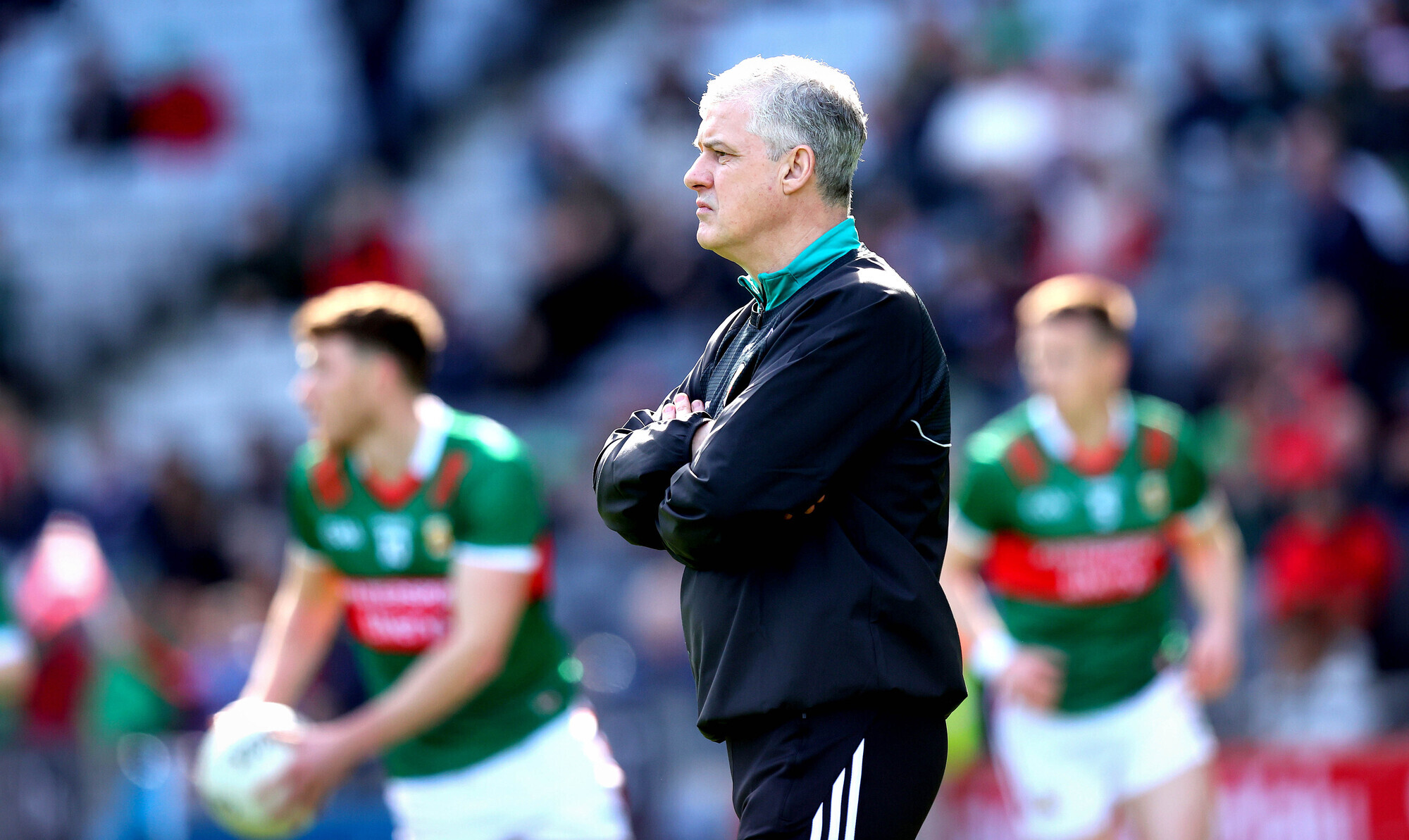
FAMILY AFFAIR: Mayo manager Kevin McStay. Pic: INPHO/Ryan Byrne
In ‘Behind the Gates’, the four-part series on Roscommon’s 2017 championship, a highlights reel of half-time scenes from the Connacht final neatly encapsulates where Roscommon found themselves, and where they intended to go at that time.
Seven points ahead of Galway the players desired, and demanded, more. “I want to kick on and win this, well,” said Diarmuid Murtagh. Then Conor Devaney issued a firm diktat: “They’re not coming back here.”
Manager Kevin McStay expanded on Devaney’s point, as if to surmise what everyone else outside the Roscommon dressing room was expecting to happen.
“They (Galway) think that we’re going to back off, that we’re going to be frightened, that we’re 22 and 23, and that we haven’t done this shit before,” McStay says. “Well I f***ing have, and those boys [pointing to his management] have. We f***ing take it to them.”
Before they went back out on to the field, McStay reminded the group of how they were going to go about that task.
“We’re Roscommon people, and I know ye will not stop,” said McStay. “Because it’s yer nature. Whatever it takes, we’re going to survive. And we’re going to fight.”
Roscommon did. A nine-point win, against all the odds, was a huge breakthrough success for a young side but a fairytale story doesn’t always have the perfect ending. Roscommon were subsequently hammered by Mayo in the 2017 All-Ireland quarter-final replay. Apart from the epic 2018 Round 4 qualifier win against Armagh, that 2017 drawn All-Ireland quarter-final against Mayo was McStay’s last great championship act with Roscommon.
When he stepped down at the end of the 2018 season, McStay said that his three seasons in charge were the “greatest years of my life but I look forward to a less stressful period now”.
The 2017 season had emptied McStay. Initially appointed alongside Fergal O’Donnell as joint-managers, O’Donnell and two of his Roscommon backroom team stepped away at the end of the 2016 season.
The fall-out was huge. It was never stated but some players loyal to O’Donnell left the squad. O’Donnell was a legend in Roscommon and McStay felt the pressure go through the roof.
It reached boiling point after Roscommon were beaten by Mayo in a league game in Dr Hyde Park in February 2017, Roscommon’s third successive defeat. Former Roscommon player and manager Gay Sheerin questioned McStay’s loyalty to Roscommon when he had “hated” Roscommon as a Mayo player.
“I knew that I could never become a Roscommon man, but I had lived in the county for 30 years,” McStay later wrote in his excellent book ‘The Pressure Game’.
“My daughters were born and reared as Roscommon girls. My wife (Verona) and daughters were upset for me. I was angry that they were so upset.
"I felt that on the street, people who might never have looked at me twice were staring. That was wrong. I kept reminding myself of my father’s advice to me when I first moved to Roscommon. He told me to make the new town my ‘home’. That was his word.”
McStay tried to live and manage Roscommon by that creed but the stress was unbearable at times during that season. The heat rose even further after Roscommon were relegated from Division 1.
“Every day in 2017,” wrote McStay “was a pressure I had never known before.”
It wasn’t all emotional stress either because of the difficult financial position Roscommon found themselves in at that time. After Roscommon played Tyrone in their opening league game in 2017, and after the squad stayed in Fota Island in Cork for a training weekend, McStay covered part of the costs out of his own pocket.
On a number of other occasions, McStay bought year-long gym membership for some of the players when the county board didn’t have access to money on a particular week. Purchasing extra tickets for players was another recurring theme during his three years in charge.
“Being manager of Roscommon,” wrote McStay, “meant that that the county team was family.”
Roscommon has always been family to McStay because it is the county where he reared his own family, and where he has lived more than half his life. On Sunday, nobody will have a greater insight into that footballing family than McStay. He knows exactly how Roscommon think. And McStay knows for sure how they will survive and fight.
In his seminal book, ‘Legacy’, James Kerr outlines how the All-Blacks starting point in redesigning the world’s most successful sporting culture was developing the character of the players off the pitch, so that they could perform better on it. The challenge then was to work out how to make it real. "There was no blueprint,” said Graham Henry. “You couldn't just look it up on the internet."
The plan revolved around a number of critical pillars ranging from individual personal development to a philosophy of continual improvement. The All-Blacks had always been successful but once the culture changed, results went to another level.
Winning cultures start from the bottom up, beginning with parents, guardians, clubs and coaches. But a philosophy of continual improvement in a team environment is largely structured around key principles and stable pillars. Limerick are now operating at the level that Kilkenny set in their pomp under Brian Cody, when it was always about more than just another win, another title.
That Kilkenny team achieved everything possible but their most important legacy lay not simply in the medals won or the glory gained – it was about the attitude instilled in the group, the standards demanded, the example set by the Kilkenny squad as an entity.
Limerick are the standard now but no other county has a better modern history of espousing or championing the importance of culture and legacy than Kilkenny. Cody had created the template but when he finally stepped away last July after 24 glorious years, Derek Lyng was Cody’s natural successor because he was always the ultimate exemplar of Cody’s philosophy and values.
With Kilkenny’s culture and way having always been guided and governed by understated pragmatism, Lyng was the ideal fit. Lyng’s arrival also blended freshness with a fundamental grasp of that Kilkenny way, and how it worked so well for so long.
On the other hand, it hasn’t always worked as well as Kilkenny would have liked in recent seasons. Last year’s All-Ireland final showed how much ground Kilkenny still had to make up on Limerick. Their approach and style had to tactically evolve after Limerick completely exploited Kilkenny conceding too much space; Gearóid Hegarty, Kyle Hayes and Tom Morrissey won a colossal 17 puckouts.
Kilkenny’s aim to be more tactically fluid and adaptable has been largely recalibrated around trying to play a shorter game, to work the ball through the lines more. That’s not new to Kilkenny but making that transition to the required execution levels set by Limerick has been a struggle during stages of this league.
In any case, Sunday's Allianz League final at Páirc Uí Chaoimh is the ideal test for Kilkenny to see where they are at tactically. In terms of modern culture and legacy though, no county is closer to Limerick than Kilkenny.
It may have only been for one season but it wasn’t surprising either when Dublin were relegated to Division 2 last year. For the first time in as long as anyone could remember, Leinster had no team in Division 1 in 2023.
The last time Dublin were relegated to Division 2 in 2007, it wasn’t straight relegation either as Dublin finished 5th in Division 1A but they went down after the league was restructured. Kildare meanwhile, finished second in Division 1B which meant they took Dublin’s place in Division 1 in 2008. When Kildare were relegated again at the end of that season, Dublin seamlessly popped back up to continue Leinster’s presence in the top division.
Dublin’s dominance of the province ever since hasn’t been healthy for Leinster football but the state of so many of those counties in the province has contributed to that malaise.
Despite what some counties may have otherwise thought of the Tailteann Cup, Leinster counties had to be realistic about the competition at the outset of this season. Seven of the 11 counties in the Leinster championship were in Divisions 3 and 4 of the league this spring.
With two Ulster teams securing promotion from Division 3 to Division 2 next year, and Down finishing third in Division 3, six Leinster teams were ranked outside the top 20 counties in this year’s league, with Westmeath just edging in at number 20, having finished fourth in Division 3. That’s a chronic level of underachievement from some counties who should be doing better.
As the Leinster championship kicks off this weekend, everyone knows who is going to win it. The prospect of winning a Leinster championship in the next decade is zero for the vast majority of counties outside of Dublin. The ongoing imbalance is sucking the life of out of the Leinster championship, but counties still have a massive loyalty to the competition.
Tradition is a binding factor. Derby games are another huge life-source. Carlow-Wicklow may not be a high-profile rivalry like Dublin-Meath or Kildare-Laois but it still carries huge meaning in those counties, especially in that strip along the north-east Carlow and south-west Wicklow borders.
For the time being at least, especially early in the competition, that is all that the Leinster championship has to sustain itself as a viable competition.
CONNECT WITH US TODAY



Be the first to know the latest news and updates