GAA talking points: A snapshot of success in TJ Reid’s grasp and grip
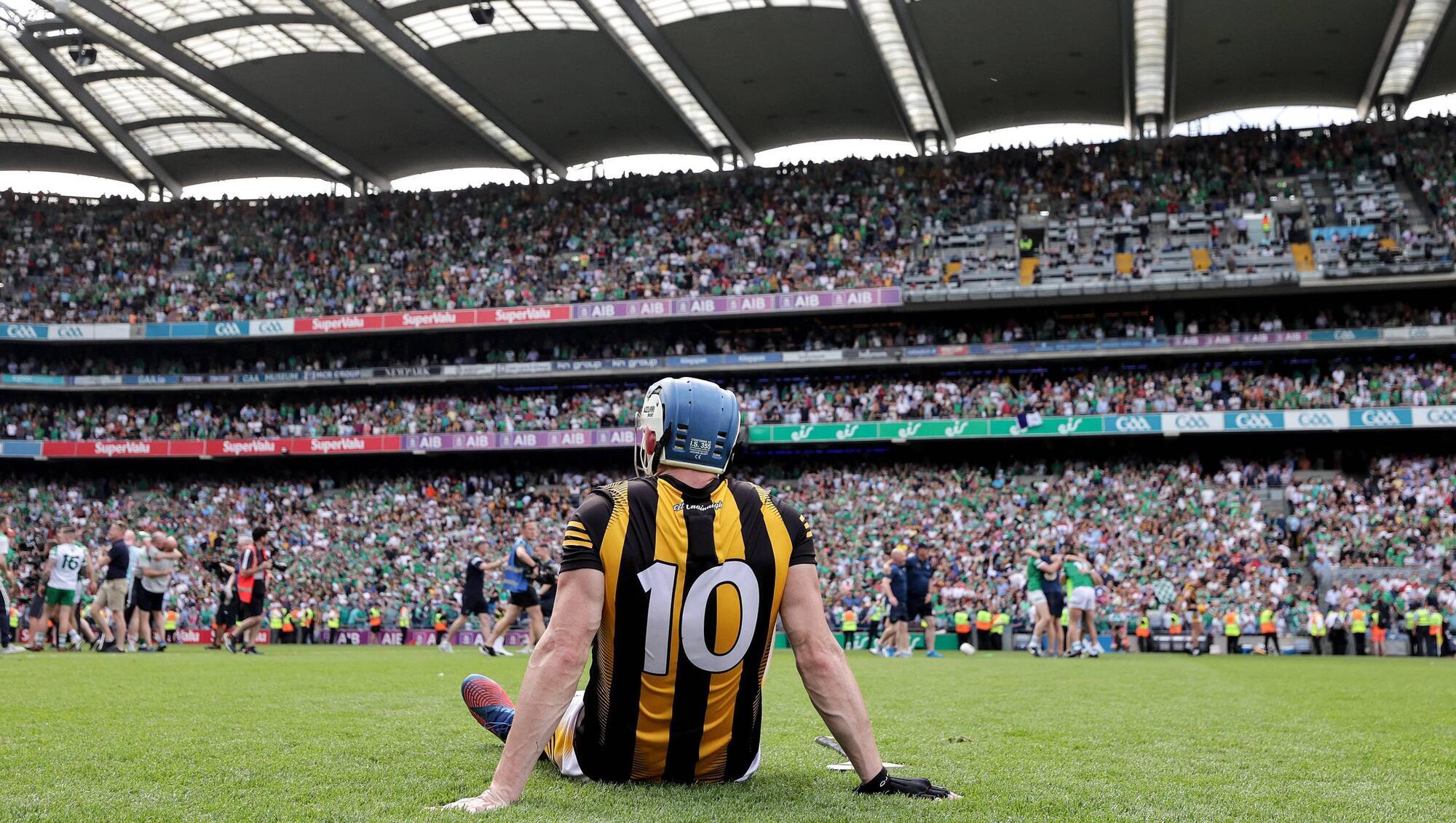
DEJECTED: Kilkenny's TJ Reid dejected after the game. Pic: INPHO/Laszlo Geczo
A few weeks back, Inpho Photography showcased some of their best sports photos of 2022 on social media under the heading ‘TwelvePicsofChristmas’. The series included iconic images taken across all sports but one of the standout pictures was Laszlo Geczo’s snap of TJ Reid just seconds after the final whistle of the All-Ireland final in July.
Taken from ground level, Geczo was directly behind Reid, who was sitting on the Croke Park turf, legs outstretched, with his arms planted firmly into the ground. Reid had his back to the camera but the panoramic shot perfectly captured his dejection and disappointment when it was juxtaposed with the elation of the Limerick players celebrating in the background.
It was the second time in six months that Reid found himself sprawled on the ground in Croke Park after losing an All-Ireland final. Yet there was no comparison between Reid’s reaction after the All-Ireland final last July and his devastation in the aftermath of the All-Ireland club final defeat in February. As soon as the referee blew the final whistle, Reid collapsed in a heap and it took him an age to get back up.
The nature of the defeat, when Ballyhale were beaten by a last-second goal, made it more concussive and traumatic in the moment. Moreover, it was another big day defeat in Croke Park, which was a pattern completely at odds with so much of Reid’s early career, when he had known nothing only success.
He had won successive All-Ireland clubs in 2019 and 2020 but Reid had also lost the 2019 All-Ireland final (when he was captain), and the 2020 and 2021 All-Ireland semi-finals with Kilkenny, along with that club final. “No way was that happening today,” said Reid when interviewed for his man-of-the-match award when Kilkenny beat Clare in last year’s semi-final.
Another final defeat, to Limerick, made Reid hungrier than ever for atonement but as he continues to chase greatness, the spiralling numbers continue to provide more testimony to that greatness.
His tally of 1-8 against Ballygunner in the semi-final took his championship total for Ballyhale – in 96 championship games in Kilkenny, Leinster and the All-Ireland series since his debut in 2004 – to a whopping 33-552. When that number is added to his total taken from 131 games for Kilkenny in league and championship, Reid has now scored an astonishing 78-1,333.
Now that he’s within touching distance of Cork’s Patrick Horgan, Reid should become the championship’s all-time highest scorer by the Leinster round robin stages of the 2023 inter-county season.
Milestones and immense accolades just keep stacking up at a relentless rate; if Ballyhale win on Sunday, Reid will become the first club hurler to win six All-Irelands as a starter.
Incredible.
Every team has to start somewhere. Corofin have earned the right to be considered the greatest club team of all time because they are the only side – in both codes – to win three All-Irelands in a row. The club’s five All-Irelands were spread across 22 years but, before Corofin ever won anything, they struggled to cross that glorious threshold.
They lost two All-Ireland semi-finals in 1992 and 1996, but, when they reached a first All-Ireland final, in 1998, they got the job done, defeating Erin’s Isle in that final.
Corofin’s first success was also a significant victory for Connacht because they were the first side from the province to win an All-Ireland club football title. Yet their success also came after a decade of breakthroughs, where they were the eighth team over the previous ten seasons to win an All-Ireland after appearing in their first final.
The first three decades of the competition was bound to be defined by first-time winners, but a trend of the club championship is how the big clubs keep, and have kept, coming back. A year before Corofin won their first All-Ireland, Crossmaglen Rangers also won a first title in their first final. They were newcomers too, but Cross went on to win five more, and appear in seven All-Ireland finals in the space of just 15 years.
Since Corofin’s breakthrough 25 years ago, 14 clubs have attempted to win an All-Ireland in their maiden final – Ballina Stephenites, Na Fianna, Crossmolina Deel Rovers, Ballinderry Shamrocks, Caltra, An Ghaeltacht, St Gall’s, Kilmurry-Ibrickane, St Brigid’s, Garrycastle, Ballymun Kickhams, Slaughtneil, Ballyboden St Enda’s and Kilcoo. Yet only four managed it – Crossmolina, Ballinderry, Caltra and Ballyboden. And Ballyboden are the only side to do it in the last 19 years.
A handful of those sides put that experience to good use by coming back to win after losing a final – Ballina, St Gall’s, St Brigid’s and Kilcoo. The numbers show how the odds are stacked against newcomers, from both angles; nine of those clubs beaten at their first final attempt over the last 25 years were taken down by a previous champion, or a side which had already appeared in a final.
Watty Grahams Glen have a serious chance of winning a first title in their first final on Sunday. But recent history has shown that it will be a big ask - especially when they’re coming up against a Kilmacud side which appeared so recently in a final.
In the aftermath of the All-Ireland semi-final, Ryan Elliott was photographed celebrating with his father Shane, alongside two other supporters. An All-Ireland semi-final win is bound to trigger huge emotion but the image had a special connection to the past - Ryan will line out on Sunday as a goalkeeper in an All-Ireland final, just like his dad Shane did for Dunloy Cúchullains in 1995 and 1996.
Ryan’s uncle Nigel - father of Nigel and Sean who also play on Sunday - played in all four of Dunloy’s previous All-Ireland finals alongside Alistair Elliott, while Jarlath Elliott also played in the 1995 and 1996 finals. The Elliott name is synonymous with Dunloy as Ryan’s grandfather Seamus is the former great Dunloy manager.
A handful of decades on from when Dunloy’s great crusade to win an All-Ireland came up short, the next generation have taken up that torch to continue the quest. That was first evident when this current Dunloy side started making waves again at the end of the last decade.
“Yes, there was a belief that Dunloy would deliver again, because if you trace it back, a lot of their fathers played,” said Gregory O’Kane, the current Dunloy manager, back in 2019. “You might have six or seven sons, their dads would have been in the ‘90s team. Some of them have uncles involved too from back then. As the saying goes ‘They didn't pick it off the ditch’.”
There are connections everywhere to the past. When Dunloy reached their first All-Ireland final in 1995, the late winning goal against Athenry was scored by substitute Jarlath Cunning, who is an uncle of current player Conal Cunning.
After Dunloy’s All-Ireland semi-final win against Portumna in 2004, there was a photograph taken of Malachy Molloy hugging a team-mate with his son Ronan in the grasp of his right arm. Two decades on, Ronan Molloy also lines out in an All-Ireland final like his Dad did.
The generation game just keeps on rolling.
When Kilmacud found themselves in a tricky position late on in the semi-final against Kerins O’Rahillys, when David Moran had a late half-goal chance to take the match to extra-time, there was devil in the detail of the data.
For a start, the 0-14 they conceded was the joint highest score Crokes had shipped all year. Crokes hadn’t helped themselves by continuing to foul when O’Rahillys got a run on them. But another interpretation of that policy was that Crokes – at all costs – just refused to concede a goal.
There is a harder and more cynical edge to Crokes this year after the late goal – and the manner of how it was conceded – against Kilcoo last February cost them the All-Ireland. Crokes have only coughed up three goals in ten games since the start of the Dublin championship last autumn. Their average concession rate in those ten games is just 0-9.
The team they are facing now aren’t too far off them in that mean defensive context as Glen have only shipped an average of 0-10.5 points in their ten games since the start of the Derry championship. They have only conceded 5 goals in the same timespan.
This is bound to be a cagey and tactical game defined by tight margins. But if Crokes are to be on the right side of those margins, they need to marry their defensive parsimony with smarter game management.
With the exception of the Dublin county final dogfight against Na Fianna, a pattern and trend of Kilmacud’s play all season has been to press their foot hard to the accelerator early on, get the job effectively done, before controlling the game in the second half on their terms.
It has worked but taking their foot off the gas has still put them in some sticky positions that they didn’t need to be in. Their game management has been questionable at times, which was particularly evident late on against O’Rahillys, especially around their own kickout.
Crokes know that if they don’t concede a goal on Sunday, 12 or 13 scores may be enough to win this game. But managing the game smartly late on against a good side will be just as important as another targeted clean sheet.


CONNECT WITH US TODAY



Be the first to know the latest news and updates