Talking Points: Is Tipp's north division set to become a bearpit again?
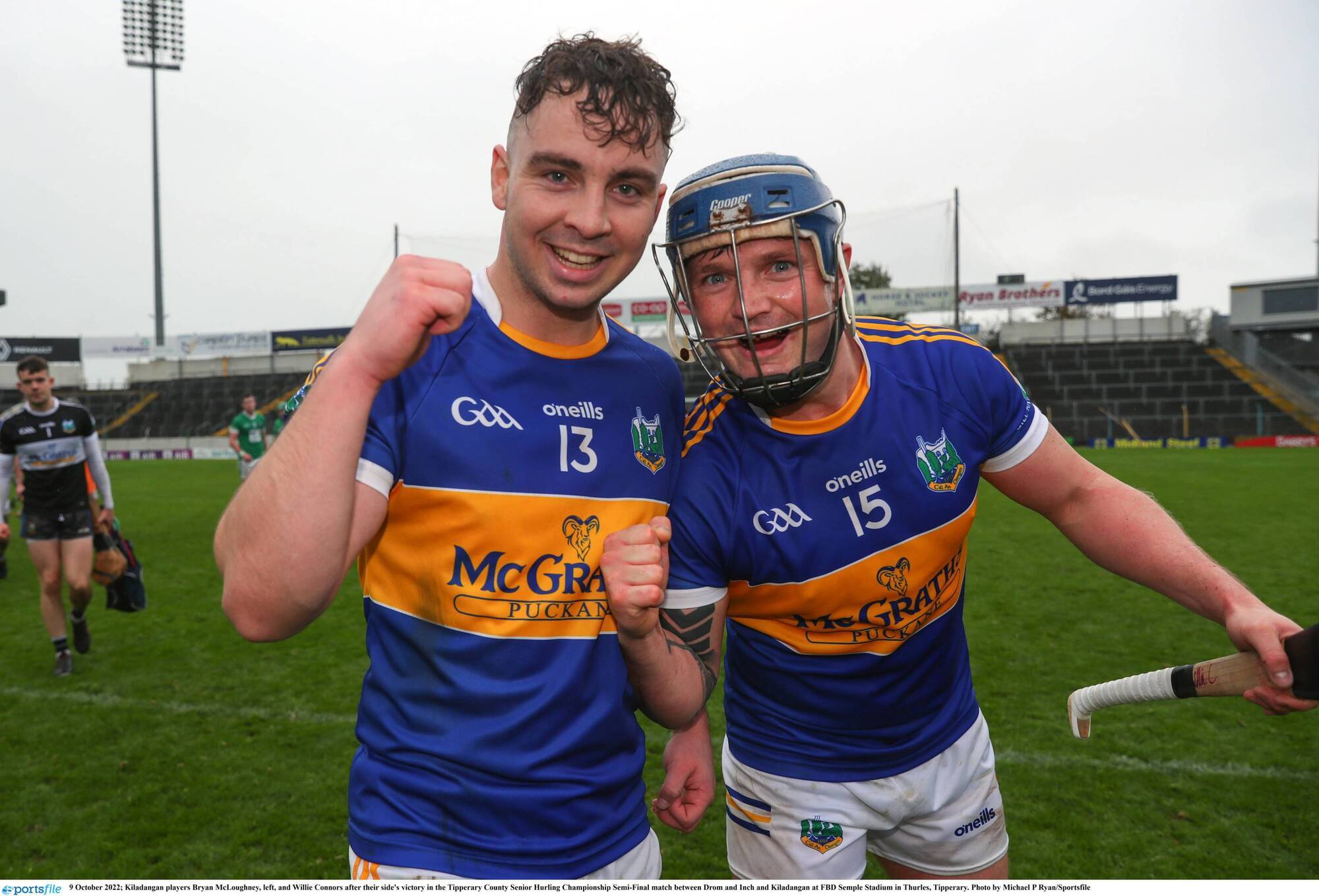
FATE: Kiladangan players Bryan McLoughney, left, and Willie Connors celebrate the semi-final win. When Kilruane MacDonaghs defeated Upperchurch-Drombane in the Tipperary semi-final two weeks ago, fate almost decreed that they would meet Kiladangan in the final. Pic: Michael P Ryan/Sportsfile
When Kilruane MacDonaghs defeated Upperchurch-Drombane in the Tipperary semi-final two weeks ago, fate almost decreed that they would meet Kiladangan – who were playing Drom & Inch afterwards –in the final. Fate may have no place in the modern and cutthroat world of competitive sport but Kilruane MacDonaghs and county finals have a habit of rhyming with history and their neighbours from the north division.
When Kilruane won their first county title under their own name (De Wets had won their only previous one in 1901), it was almost fitting that they would beat a side from the north division in that final – Borris-Ileigh. Thurles Sarsfields and Moyne Templetuohy did win county titles in the 1970s but that period emphatically belonged to the north division, with Kilruane, Roscrea and Moneygall sharing every other title during that decade.
At the end of the 1960s, Roscrea finally sparked a prolonged period of dominance for the north division for the first time in the history of the Tipperary championship. Thurles Sarsfields had won ten of the previous 13 titles but that was a brilliant Roscrea team, which went on to win the first All-Ireland club title.
Prior to Roscrea winning three in a row and five titles in six years between 1968-1973, clubs from the north division had only won 12 titles during the previous 80 years. The most sustained period of dominance in that time was in the early 1910s when Toomevara won four titles in five years. Even at that, the 1910 title against Racecourse was won on an objection.
Yet between 1968 and 1986, clubs from the north division won 15 of the 19 championships on offer. And Kilruane were at the heart of that northern renaissance. After having lost finals in 1973 and 1975 to Roscrea and Moneygall, their breakthrough win two years later heralded a whole new beginning for the club. Between 1977-’79, Kilruane won three in a row. They almost made it four in a row but they lost the 1980 final to Roscrea by one point.
During that time, the north division was a bearpit. There had been an open draw in Tipperary between 1969-76, but the format went back to two qualifiers from each division from 1977, which meant the strong northern teams were mostly meeting twice in the same season.
In 1977 Kilruane beat Borris-Ileigh in the north final before beating them again in the county final. In 1978, Kilruane defeated Roscrea in both the north and county finals. In 1980, Roscrea turned the tables in both games.
North clubs won five of the first seven county titles in the 1980s but a club from the north contested every county final in that period. Yet Kilruane went to a different level again after defeating Roscrea in the 1985 county final, going on to win the 1986 All-Ireland title, with Len Gaynor as manager and another future Tipp manager, Eamon O’Shea, leading the charge up front. After Borris-Ileigh beat Kilruane in the 1986 county final, Borris-Ileigh went on to win the All-Ireland.
Kilruane fell on hard times afterwards. They were Intermediate for a period, but now they’re finally back in a county final again for the first time in 36 years. And it’s fitting that they’re meeting their neighbours from over the road.
In the history of the Ulster club football championship, one of the most remarkable stories was Loup’s success when winning the provincial title in 2003. Fourteen years earlier, they were only a Junior team in Derry before getting promoted from Intermediate in 1994.
Around the same time Loup were oiling a brilliant underage production line, which culminated in Ulster minor club titles in 1993 and 1995, which ultimately fed into their Ulster senior glory in 2003.
Ulster (the St Paul’s tournament as it is known) is the only province to run a provincial minor (U18) championship and, while minor success never guarantees a repeat at senior level, it’s a dominant theme of tomorrow’s Derry county final between Slaughtneil and Glen.
In the history of the Ulster minor championship, Glen (along with Ballinderry) top the roll of honour with four titles. Yet those titles were all won in succession, between 2011-14, with the majority of those players on the current Glen squad which won the county title last year for the first time.
Glen are only focussed on Derry for now but, at the back of their minds, they are hoping to translate that Ulster minor success into provincial senior silverware, which is what Ballinderry did in 2001 when winning the Ulster title before going on to bag the All-Ireland. Three of Ballinderry’s four Ulster minor titles were a precursor to that senior success, coming in 1996, 1997 and 2001.
When Slaughtneil won their first Derry senior football title in 2004, the bedrock of that side had come from the three county minor winning teams of 1998, 1999 and 2000. Slaughtneil won the Ulster minor title in 1998 before narrowly losing the final to Cavan Gaels a year later.
The Ulster minor championship hasn’t taken place now since 2019 but the list of recent winners and finalists since Glen’s domination is interesting. Crossmaglen Rangers (who play Granemore in tomorrow’s Armagh final) were champions in 2015 and finalists in 2018. Enniskillen Gaels (who play Erne Gaels Belleek in tomorrow’s Fermanagh final) were Ulster minor champions in 2017.
Does provincial minor success make a difference at senior level? “We had underage success at the highest level,” once recalled Johnny McBride, who captained that Loup team in 2003. “It breeds a belief and you get to a stage where you sort of expect to win.” For Ulster minor winners involved with Glen, Crossmaglen and Enniskillen Gaels tomorrow, they’ll all be looking to tap into that belief system once more.
At the final whistle of the Galway-Dublin Leinster qualifier in Pearse Stadium in May, the Galway supporters invaded the field, not in the manic sense of celebrating their passage through to a Leinster final, but more in the vein of kids hunting autographs and selfies. Galway just moved on while Dublin shifted in a completely different direction after tamely limping out of the championship.
The only bright spark from their evening was provided by the excellent Donal Burke, who ended with 0-14, five from play. In Dublin’s biggest win of the campaign, away to Wexford, Burke scored 12 from 17 shots, along with having three assists.
Burke was Dublin’s only All-Star nominee but the Na Fianna club-man has been one of the best forwards in the country for the past couple of years, during which time his scoring stats have gone stratospheric, where he has averaged 12 points per game. Burke was the top scorer in the 2021 league.
His status as one of the game’s elite free-takers is even more impressive again considering that it was never a role Burke naturally assumed for his club. It’s only been since he got involved with Dublin that Burke has established himself as a placed-ball specialist, which he is clearly suited to with his icy temperament.
Burke has benefited from both nature and nurture. His father is a native of Banagher in Offaly and was a noted Dublin club hurler himself with Faughs. His eldest brother Seán also plays for Na Fianna tomorrow while younger brother Kevin was centre-back on the Dublin U-20 team that lost the 2020 All-Ireland final to Cork.
Burke is part of a remarkable generation of Na Fianna hurlers who won five Dublin minor titles in six years from 2012 to 2017. It looked like he and many of those players were going to follow up that success with a first senior title for the club last year but they blew a nine-point lead with ten minutes remaining before Kilmacud Crokes won in extra-time, a game in which Burke hit 2-7.
Now that they’re facing Crokes again in tomorrow’s final, Burke will be a central figure in trying to drive Na Fianna to that elusive first county hurling title.
A few days back, Michael Regan drove a teleporter into Strokestown late in the evening and a group of people from the club – termed the Masters - spent a handful of hours in the dark, lit up by all the streetlamps, decking the town out in black and amber flags and bunting. Long before a ball was even kicked ahead of tomorrow’s county final, the evening was such a big hit that they made a video of the event to the backing track of the U2 song ‘City of Blinding Lights’.
A county final is always a big event but it’s taken on even more significance for Strokestown, who are contesting their first final in 20 years. Yet the buzz is at near fever pitch because they are taking on Boyle from just up the road, who have reached a first county final for 95 years.
Since Strokestown were last champions in 2002, 16 of the following 19 championships were won by clubs from the south of the county. This is the first county final between clubs from the north of the county since 2009. And it has all the makings of an epic occasion.