GPA want accountability for inter-county training breaches
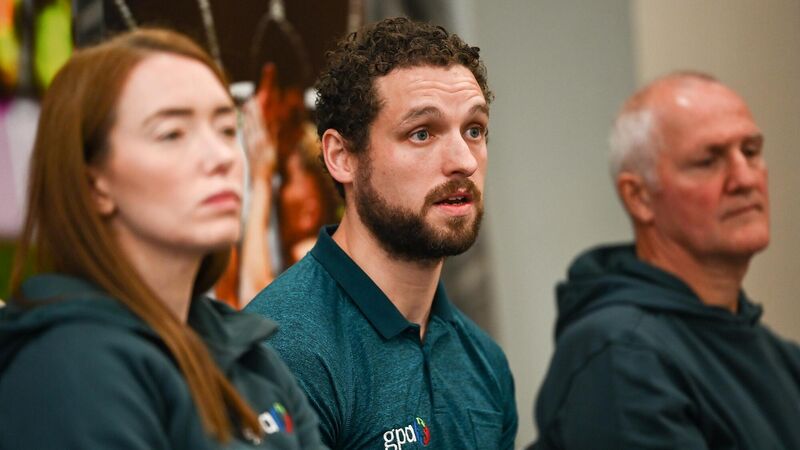
ACCOUNTABILITY: GPA chief executive officer Tom Parsons, centre, alongside GPA national executive committee co-chairperson Maria Kinsella and GPA head of finance and operations Ciarán Barr during a media briefing of the association's AGM and 2021 Annual Report Highlights at the Radisson Blu Hotel at Dublin Airport in Dublin. Pic: David Fitzgerald/Sportsfile
The Gaelic Players Association (GPA) want inter-county managers and county boards as well as players to be answerable for inter-county training breaches.
The official inter-county players body succeeded in convincing the GAA to bring forward the collective training return date to November 24. They would have proposed a December one but unsuccessfully lobbied for the disbandment of pre-season competitions.
In return, the GAA’s Central Competitions Control Committee (CCCC) chairman Derek Kent last month called on the GPA to assist them in policing that date.
Asked if they are prepared to do that GPA chief executive Tom Parsons said: “So, in previous years the only party that there was a consequence to in policing sessions before the return to training date was players, because training was happening, players were travelling, they couldn’t claim expenses. We weren’t getting the data on our centralised web expenses system, so we’re blind to the data, and they were suffering the consequences.
“So now there needs to be consequences on management, county board and players, if it’s a breach in rule there needs to be consequences – whether it be home advantage, points deduction in the league, but there needs to be consequences on all parties.
“Yes, the GPA will play our position but it can’t be the sole responsibility of players and that’s a very strong point. The contact hours policy, there will be joint responsibility for sure. But I would always use the term joint responsibility. It does need to be led by the county board and management, of course. They are the guys that are setting the fixtures, setting out the collective sessions and the return to training date is set by the county committee and Central Council management.”
Parsons said the GAA are keen to speak to managers before the start of what is set to be the most intense inter-county season in 2023.
“We have communicated with the GAA through our negotiation process that we would like a joint communication with managers and what is best practice. Even to circulate with managers why November 24 is an adequate period to return to collective training.”
As 46% of male players who suffered injuries in 2022 reported setbacks lasting five-plus weeks and 15% experienced 12-plus week lay-offs, Parsons explained the rationale behind the November 24 date, two weeks earlier than last year’s return.
“For player welfare and the player to be prepared for the inter-county season, they need a minimum of six weeks of phased loading. Go into an inter-county training session and you’re getting about 10 kilometres per session. Two or three thousand metres of high intensity running. And you have a sequence of twisting and turning – it goes back to the frequency of hip and groin pain among players.
“40% of our players (in a study across the 2017 and ‘18 male senior inter-county seasons) in the here and now have hip and groin pain. Over time, that becomes chronic. That’s why you have players down the line getting hips replaced, having surgery intervention. If there is not a building up in pre-season, you’re going to have significant injuries in the on-season.”
At Saturday’s AGM, the GPA mentioned there were “red flags” raised by players about the make-up of the new split season, in particular the load from inter-county to club and the load across the year.
Looking ahead to 2023 where there will be additional championship games in the senior football championships, Parsons is worried about the lack of gap weekends.
“We have increased games with very little room for preparation so for me personally I think there are unknowns in can we deliver the football structure in this window.
“My opinion is we need to remove pre-season competitions. If we could remove them and start the leagues a week earlier it would give another week's break. We have very few break periods in the season next year to deliver this new structure.”
The appointment of a chief medical officer (CMO) was a motion passed at the GPA’s AGM in Portlaoise on Saturday and is likely to become their motion at GAA Annual Congress in February. GPA head of finance Ciarán Barr said the GAA’s current medical, scientific and welfare committee is not sufficient to deal with the prevalence of injuries such as hip and groin occurring.
“It's a committee so they're meeting and they're volunteers, they're meeting once a month, once every two months, it's not enough. Look at the amount of players that play Gaelic games, there's like 300,000 or 400,000 members of the association.”
Barr envisages a CMO being given the power to make playing rule changes based on injury data.


CONNECT WITH US TODAY



Be the first to know the latest news and updates