Interview: Jack O'Connor and the inside story of Kerry’s 38th All-Ireland title
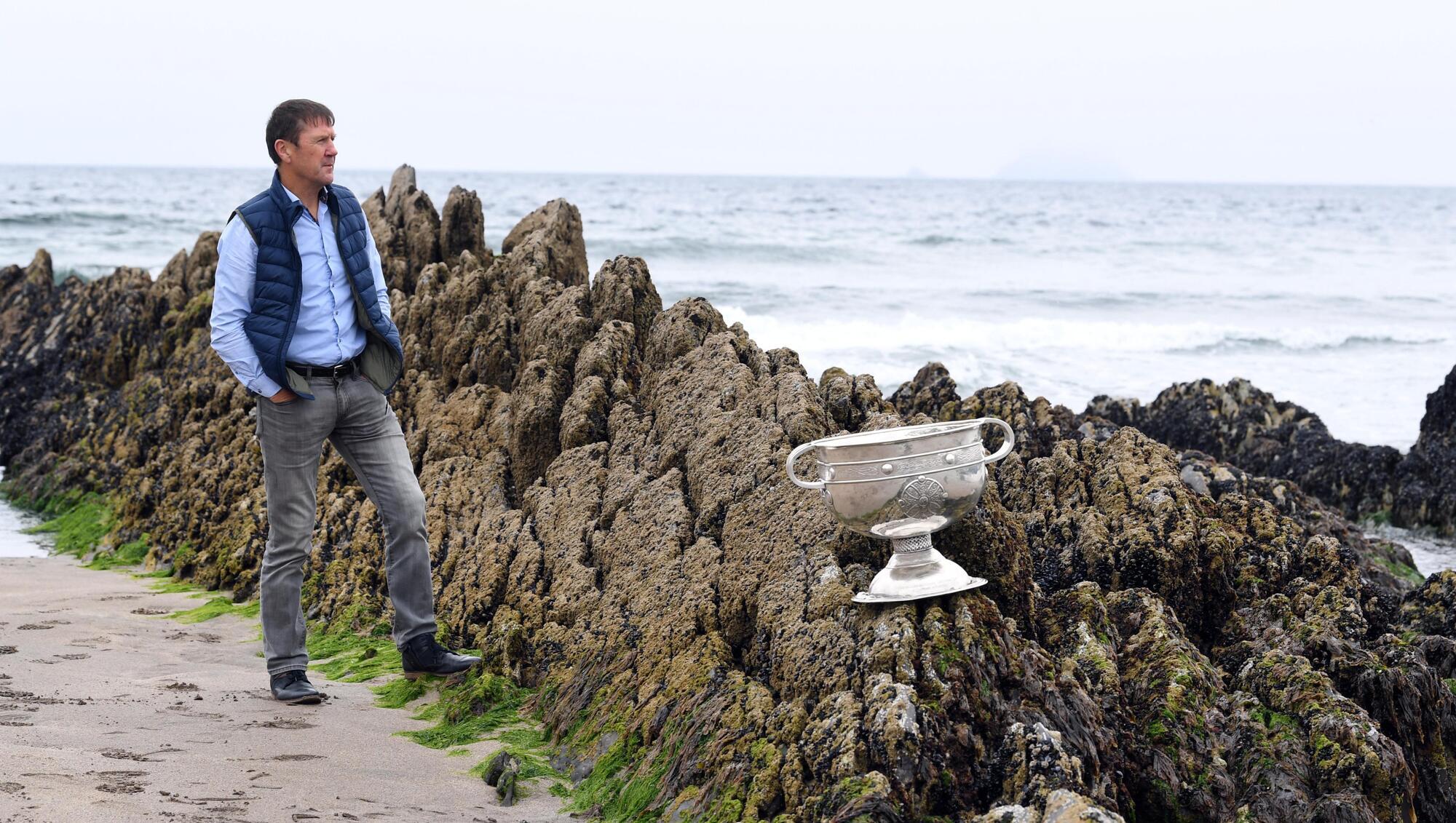
HOLY GRAIL: Kerry team manager Jack O'Connor, with the Kingdom's Holy Grail that is the Sam Maguire Cup pictured on St. Finan's Beach in South Kerry on Friday.
We are looking out from a well-set corner table with a check, cotton cloth in Killorglin’s Bianconi Inn, and getting out of his car across the street, outside Jack’s artisan bakery, is Jack himself.
Just Jack. Páidi. Micko. Now Jack.
The All-Ireland-winning Kerry manager is the greater part of an hour late but he doesn’t sweat himself into lathers now. He would once talk sharp and walk fast everywhere but age and experiences quietened that. The growler’s gone.
“I’m a very different person to what I was in 2004. People think I am still cranky and abrupt, but I’m not really, or I don’t think I am anyway.
"People evolve. For example, the Jack that appeared in the ( , 2007) book is a very different Jack to the one these days. That was almost like a former life. All I was doing that time was expressing something, I don’t know what, like I had to write it to exorcise stuff in me. The frustration, the chip on the shoulder, things like that.
“I concentrate now on trying to be as positive as possible, within reason. I think that’s encapsulated by the fact that we had great fun this year. Really and truly, we had some fun.”
That they did. On Wednesday evening, the sun still high, the air still but light, they walked behind Sean O’Shea and Stephen O’Brien from the golf club into Kenmare town. Jack and Paddy Tally together.
“I am able to enjoy the reaction of people. To see Tralee on Monday… I was with Páidi in 1997 when we turned the corner onto Denny Street and we thought we would never see the likes of it again. But Monday night it was actually magnified. To be involved in some small way in bringing that much joy to people, to a whole county. We walked last night in Kenmare, Paddy was beside me and he just whispering, ‘This is incredible’.
“One of the mistakes I made in 2004 was I was way too obsessive. The adrenaline was running for weeks and months and I didn’t savour it enough. I never got off the rollercoaster. By the start of 2005, I was burned out. Downtime is key. You can’t stay on the adrenaline rush. If you do, you’ll hit the wall somewhere.”
He’ll have that time now. Aside from July’s end to the campaign, the hips have finally given out. Surgery is scheduled. Golf parked.
“We will probably sit down as a management in a few weeks to review things. What we got right, what we can improve. But it will be casual, a few lads chatting. I think that’s the way I am now at this stage of my life. I don’t feel like anything under the same pressure I did when I took over the job in 2004. Not even close.”
Is that four All-Irelands or the fact that he’s 61 now?
“A bit of both. It does help if you win a couple of All-Irelands. You look at Dwyer, when he had won his eight All-Irelands, and he was above in Laois, Kildare or Wicklow, sure the man had nothing to lose. He could breathe and enjoy it. I am the same now. When you win a few, they can’t take them off you, can they?
“I didn’t find this season too taxing. There was a good crew. We were enjoying it - I know I’m repeating that, but there was a lovely vibe around the place. The journeys up the country to Armagh, Monaghan and those places, we actually never stopped laughing at each other on the coach. And mostly, they were laughing at me.
"I’m 61. Some of those lads are barely 20. But people forget I was a secondary teacher up to a few years ago, so in terms of communicating with young fellas, it’s not like it’s something I’ve never done in my life. I am so aware of the importance of having fun at this. Back in the old days, I was too tense, the fists were clenched, the teeth were gritted. Over the years I’ve learned that you don’t need to be like that all the time. We’ve all learned a lot about ourselves, which is great.”
In Fitzgerald Stadium in Killarney on the Thursday before the All-Ireland semi-final against Dublin, O’Connor took the players over to the far corner of the ground on the terrace side, underneath the old psychiatric hospital. It had relevance for him.
“It was a place Páidi used to take the team when I was a selector with him. When it’s getting serious in Kerry, you move the boys over to that side of the ground. They sat down on the wall and one of the last things I said was how we couldn’t contemplate not being back here the following Wednesday night, because it had been so much craic.
"And that’s a fact. I wasn’t making that up. There would have been a huge void in their lives, believe me, if we came down from the Dublin game, and there was no training the following week. That’s a great place to be. Take everything else away. If it’s that enjoyable and that much fun, they are having the time of their young lives. They mightn’t see that yet, but they are.”
A lot of the management’s ground floor planning was about identifying characters, leaders and eradicating possible flaws in the set-up.
“Tadhg Morley was very important to that group this year. One of the things I did early on was to go around and speak to virtually every player in their own area. I didn’t want them taking time out of work to come to me, I had the time to do these things.
"I would have asked players about the group - I don’t think they even realised I was looking to gather information to make the best judgements possible. One of the key things was leadership in the dressing room and Tadhg Morley’s name kept coming up in that regard.
“That was one of the things I did in Kildare too because I feel the centre half-back is a fierce important player, and we had a good lad in David Hyland from Athy. I wanted someone of that ilk.
"I wouldn’t have known Tadhg that well before, maybe just on a casual basis, but it came across early that when Morley talked, fellas listened. I watched him in a club championship game in Tralee between Templenoe and Austin Stacks, he was playing that sweeper role and he was really good to read the game. I drove home intrigued.”
His tight management group, well-chosen, set about building from the inside, layer by layer. Jason McGahan and Arthur Fitzgerald drove the S&C superbly. Everyone mucked in on the coaching. As someone once said, it’s amazing what you can achieve when nobody cares who gets the credit.
“I picked up a phrase from a great man called Brian Cody a long time ago. He always talked about ‘panel spirit’, not team spirit. It’s very easy have spirit when you are on the team. The biggest trick of all is whether you can keep No’s 21-35 invested in it.
"I remember seeing an piece from Ronan O’Gara saying the same thing. If you can’t keep those lads invested, you can’t keep them competitive. And if they’re not competitive, the lads from 1-15 won’t be tested. Everybody has a role.
“Look at (Austin Stacks’) Jack O’Shea, who came in this year. Did he get even a minute of action all year? I’m not sure he did because he was away with Stacks in the early part of the season. But every night we went out training he was tearing into Tony Brosnan or Paul Geaney.
"I was able to say to him, ‘you mightn’t make it this year, but you are on a development path and maybe 2023 is your year to give it a cut’. You have to give them some carrot, some incentive to have an agenda in there.
“To win an All-Ireland, a group has to grow incredibly close, maybe even closer than a club team. Tony Griffin has a gift for that, for getting people into a room and opening up to each other. To tell each other things that, even in the height of drink, they wouldn’t say. The players had some powerful meetings where they’d come out and would be practically exhausted because they were so emotionally drained.
"That’s what you had to do to get close as a group. I don’t want to get into detail because it’s a sacred dressing room thing, but you have to get that group to bond. There can’t be ego and there can’t be cliques. And it was very obvious to us as management that lads mixed very well and there weren’t players from the same clubs having the grub together.”
In a collection of reasons why Kerry are All-Ireland champions for a record 38th time, among the most pre-eminent would be their remarkable capacity to keep clean sheets and the ability this year to grind it over the line where necessary. When I say to O’Connor that it can hardly be that simple, he gets animated for the first time.
“I hate complication. If someone is explaining something to me, and I can’t get it, I just say ‘Nah, that’s no good to me’. Maybe I am dim, but if I don’t get it, the players won’t get it.
"Even on video analysis when lads are coming up with issues and problems, I am saying ‘that’s no good, show me a solution’. I have a very clear idea that if you present a scenario to players, you have to provide a solution to it. If I’ve matured any small bit, it’s around being able to see the wood for the trees, to see the stuff that’s relevant and the stuff that isn’t.
“We had a thing in the dressing room after each game, five minutes of a chat as a group, nothing complicated. I was very frustrated after the opening League game against Kildare in Newbridge. I asked could someone tell me why, 15 minutes into the second half, we stopped doing what we said we would do, which was to move the ball with purpose, forward if possible?
"We were four points up, we started messing with the ball, going east and west. My point is you can have all the theories in the world. Sometimes you need to simplify it down to ‘Lads, what the hell happened there?’ There has to be a reason you stopped doing something that was working.
“Players like structure. When a game is going against you and things aren’t working out, if you’ve structure and a way of playing that you can fall back on, then players have security. I felt Kerry were working very hard in other years, including last year, but out of possession, they weren’t exactly sure of what they were supposed to be doing.
"There are options in that scenario – you can go looking for your man, you can go and tackle the nearest man or you can get back to a certain spot and start your defensive line there. We worked really hard on giving players certainty about what to do out of possession. That’s a big thing. If we lose the ball, this is what we are supposed to do. Then there is no blind panic.
“Let’s not make this any more complicated than it is. There has to be a meeting of minds with management. This is how we will play – and it is up to the coaches to implement that. That is what Paddy, Mike and Diarmuid are good at. You can have all the theories, but you have to do it in training - review it, tweak it, refine it. Their input on all that was critical.
“I learned a bit in Kildare as well. They talk about Kildare conceding five goals this year against Dublin… in my first year there, we conceded five goals in one half against Meath in a Leinster semi-final. I came away from that game swearing never again would I be in charge of a team that’s not going to give themselves a chance.
"We had a very good coach, Emmett McDonnell, a Westmeath man who was school principal in Edenderry. He did a lot of good work on that out-of-possession shape and Kildare were very good on that in the second year. You have to stop conceding goals to be competitive. They will kill you.”
The appointment process last winter was more public and grubby than anyone in Kerry would like it to have been. Everyone seemed to have a moan. I wondered how much pride-swallowing O’Connor had to digest to apply this time around for the Kerry gig. It’s easily forgotten that with three All-Irelands in his jeans pocket, he had interviewed for the gig in 2019 and been told thanks, but no. Plus this time, many in the county and some in the County Board were picking up Paddy Tally’s CV with a tongs and a clothes peg on their noses.
“There was a bit of a chicken and egg situation with Paddy. I couldn’t get Paddy until I had the job. I made it fairly obvious at the interview that unless Paddy was acceptable to them, I wouldn’t be doing the job. Simple as that. Because Kerry needed that and you can’t keep throwing the same stuff at players. I am not saying Mike, Diarmuid, or myself couldn’t have done it but sometimes you need an outside voice, someone very different. I felt myself Paddy was exactly what Kerry needed.
“I know the perception was out there, and it might have come up in the discussions at the interview, that this guy would destroy Kerry football. But the people who interviewed me would have known that any time I had managed in the county we would have played good football, so I wasn’t suddenly, at the age of 61, going to do a 360 degree and go all men behind the ball. It was a case of reassuring them that we would get the balance right.
“I was very disappointed the last time (in 2019) because I felt the job would have suited me as I was just after retiring from teaching. I went to Kildare and learned some more about myself. But a nine-hour round trip journey takes a lot out of you. I was thinking if I could put that nine hours into a team, I could do the job better.
“When I finished with Kerry the last time in 2012, I went back and did something I am not sure many others have, which is coach the Kerry minors. I saw a fantastic challenge in that, because Kerry hadn’t won a minor All-Ireland in 20 years which is extraordinary – imagine Kilkenny not winning a minor hurling title for 20 years? When we won it then and again in 2015, my dream would have been to maybe take those guys through to senior at some stage down the line. It was always there.”
Last night, they brought the cup back to Dromid and south Kerry. For Jack and for rookie defender, Graham O’Sullivan. He’s seen about as much of his front gate as he has of the All-Ireland final, both in the small hours between power naps.
“If I looked at it properly, I’d have to be slowing it down and rewinding things, so I haven’t done that yet. But even the bits I’ve seen, you’d pick up those little nuances. Stephen O’Brien had an absolutely epic game, I didn’t realise it in live time actually how hard he was working. Gavin White made a couple of massive plays later in the day. Shane Ryan had a couple of fantastic stingers late on that hit their target, with next to no hang time.
“Micheál Burns would have been bitterly disappointed not to come on in the semi-final. But he bottled it up and was really going well in training. He was exactly what we needed in that last quarter. Energy, working into space. Good decisions.
"Jack Barry really developed as the year went on. And on Sunday, as the final went on. I'm talking about his kicking. He put a crucial ball under pressure down the line to Gavin White in the latter stages.
“We pay a pile of store to what’s happening in training. In all my years I have yet to see a fella going badly in training and playing well. With Killian Spillane, I am on record as saying he was the best minor forward I coached. He has no idea himself how much ability he has. He just has a brain for the game. He’s a bit laid back now, and if you don’t know him gives the impression he doesn’t want it enough, but if he does he can be a serious player for Kerry for a long time.”
O’Connor’s coaching team was tight, but everyone had a role, from S&C and dieticians to management. Quirke and Paddy Tally have already managed senior inter-county sides and others wonder how Diarmuid Murphy hasn’t.
“They all took segments of the training. There’s no point in giving someone a job and then looking over their shoulder at them. It’s also worth pointing out that taking off two of their club men at half-time was a non-issue. These lads are in this set-up for the right reasons. They were ruthless decisions (to remove Paul Geaney and David Moran). I worked with a selector one time who said to me when we were replacing a lad from his neck of the woods, ‘Why don’t you take off your own man…?’”
The tale of the tape confirmed Graham O’Sullivan’s stellar final debut.
“Even better than I thought he was on the day,” O’Connor nods. “Halfway through the second half, he was actually – a young fella playing in his first Al-Ireland – demanding the ball, playing like a lad out in the back garden. Amazing how he rose to the occasion, how it never seemed to faze him.
"In total, he was involved in five of our points – from corner-back. That is incredible stuff. The transformation in that man has been startling. How does a fella do that? It’s in his nature, I think. The family are from Moulcore, a townland in Dromid. His grandfather, he was Paddy Moulcore, was our postman. He was a divil-may-care character, and Graham is the same. That freedom and abandon? It’s just his nature.”
His appointment term was for two years but the idea of Kerry football, right now, without the Dromid man’s guiding hand, is a sobering one for anyone with the county’s football wellbeing at heart. Who would take the reins next? Right now, Kerry don’t even have an Under 20 manager, and the minor grade is up in the air. The necessity for a continuous production line is self-evident.
“We had been in six senior finals in a row from 2004-2009, and there was a sense a new group was needed when I left in 2012. That Kerry needed to develop a new side – and it wasn’t very evident where the next team was coming from. Éamonn and the lads pulled a massive All-Ireland out of the bag in 2014. There’s a great buzz coaching young fellas. They can be moulded. Shane Ryan was minor goalie in 2014, and the one thing he has always had is nerve. And you can’t teach a fella that.
"One of the things you find out in the heat of battle at Croke Park is that players are on their own. Outside of half-time, they literally can’t hear a fella on the sideline. Which, by the way, is a bugbear of mine. This thing of not having a maor foirne to be able to go on the pitch is a joke. Yes, some were abusing it, but each team should allow three entries per half. That’s the first thing,” he says in a manner that suggests he isn’t done.
“Secondly, medical people should not be allowed on the field until the referee calls them in. This craic of medical lads darting on willy-nilly for no reason half the time is bonkers. They allow that but they won’t allow a maor foirne?
"The third one, this craic of fellas being able to throw themselves down for three or four minutes when a colleague is off with a black card period is an absolute joke.”
There was broad agreement on that one around the table in Killorglin.
“Well, you better agree with me on the first two as well….”

CONNECT WITH US TODAY



Be the first to know the latest news and updates