PM O'Sullivan: Brian Cody's name will arise whenever the most beautiful game is discussed
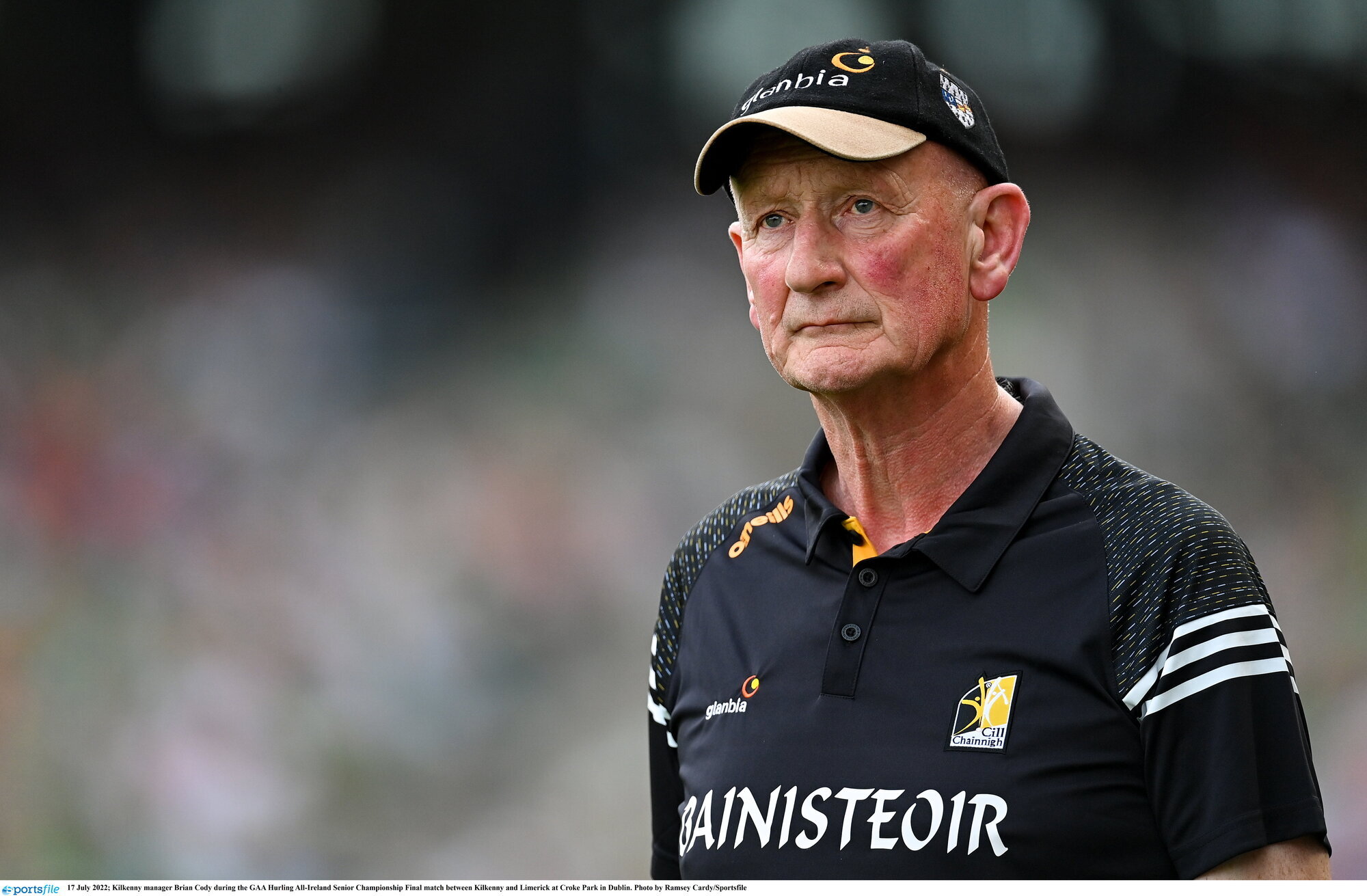
Brian Cody became part of hurling’s Mount Rushmore over a 24-year stint in one of the code’s most demanding jobs
PM O'Sullivan: Brian Cody's name will arise whenever the most beautiful game is discussed

LEGEND: Former Kilkenny manager Brian Cody. Pic: Ramsey Cardy/Sportsfile

News of the Kilkenny Senior manager’s retirement landed flecked with irony, given its arrival during Gaelic football’s premier week.

Quite simply, Brian Cody became part of hurling’s Mount Rushmore over a 24-year stint in one of the code’s most demanding jobs. His height and distinctive countenance granted an instantly recognisable profile. This week’s development represents not just a bracket for Noreside hurling but likewise a bracket for hurling per se. His name will arise whenever the most beautiful game is discussed.

Cody began managing Kilkenny in 1999, as the 20th century ebbed. He departs following unprecedented attainments, with nearly a quarter of the 21st century gone. Those co-ordinates alone inspire a kind of awe.

The attendant haul of silverware still astonishes. Between 1999 and 2022, 11 Senior titles, 18 Leinster titles and ten NHL titles were assembled. Terrible luck with injuries undermined 2010’s attempt to oversee five Senior All Irelands in a row. This manager built what most observers acclaim as hurling’s finest ever combination, the teams that went right to that brink.

Then the same manager brought off perhaps his most impressive feat. He constructed a fresh team, winning four of the next five Senior titles. This spell involved the magical All Ireland Finals of 2014, when a terrific Tipperary side got edged out in the replay. The sweep and sheer majesty of the drawn day’s exchanges enthralled watchers. Even so, Cody stayed composed enough to understand that a cooler approach might thrive. He changed two thirds of his half back line and spun home, second time of asking, by three points.

The 2015 decider ended up a grace note, an 11th trip to the summit. Kilkenny returned in 2016 and 2019, when disappointment perched. Substantial defeat and heavy defeat ensued. Yet last Sunday’s two point loss to Limerick reiterated his core values of determination and spiritual stamina. That selection kept going against a superior force, receiving more plaudits for this showing than accompanied some past wins.

Pat Daly was not surprised by the display. The GAA’s Director of Games Development & Research, he knew the young Brian Cody when they were contemporaries at St Patrick’s College, Drumcondra during the early to mid 1970s. “Brian was very impressive from the start,” Daly stresses. “I think we all knew he would go places, at whatever he took on. I think Brian just had, more than anything, the right values. He knew whatever you achieve in sport ultimately comes far more from spirit than from anything else. Also, at St Pat’s, I think Brian was majorly influenced by Stiofán Ó hAnnracháin, another wonderful GAA man.” 

Daly continues: “It was always a treat when Brian would come and speak at our annual Coaching Conference. There he would be, standing up on stage without even a single note to hand. And he would talk about leadership and about hurling for 30 minutes or 40 minutes, without pausing, no humming or hawing, and he would have everyone in the palm of his hand. He just loves hurling to an amazing degree, and he knows hurling, and sport, to an amazing degree.” 

Certain comment, especially within Cody’s native place, mainly attributed his progress to the extraordinary flush of playing talent that unfolded over the 2000s. I never agreed with that deflationary note. The only experience harder to manage than failure is success ― and Kilkenny quickly stepped into a position of vertiginous success, when the initial five seasons yielded three triumphs.

Within this context, some panellists become easier to handle but some of them end up much harder propositions. All the while, Cody accrued immense authority through his eschewal of media fripperies and material reward. He forever remained a quintessential GAA volunteer. Sovereign reality? That he has given 50 years and more to hurling.

Kilkenny manager Brian Cody on the sidelines of the All-Ireland Senior Championship Final match between Kilkenny and Limerick at Croke Park. Picture: Piaras Ó Mídheach/Sportsfile

Remember also his adeptness during this decade with player development. Taking on Waterford in 2008, Kilkenny produced a performance of transfixing brilliance. Yet around half of that team, I often said to people bent on deflation, might never have hurled for Kilkenny but for Cody’s interventions.

Jackie Tyrrell opened up in The Warrior’s Code: My Autobiography(2017) about chronic self doubt as a young player. Would Martin Comerford have proved such an influential figure in any other set up? Aidan ‘Taggy’ Fogarty, Brian Hogan and Derek Lyng? Cody did not care about parish of origin, whether your local team hurled Senior or Junior. Nor did he permit club rivalries to enter Kilkenny’s dressingroom. These emphases could never be overpraised.

Ditto for his handling of the tragedy that befell James McGarry and family during the summer of 2007. I thought the manner in which Brian Cody steered the people and the players involved over those awful weeks his finest moment. He effortlessly struck all the right notes, all the requisite tones. The hurling seen between Galway and Kilkenny in that All-Ireland quarter-final unspooled into a sensational standard.

There are essentially three ages of Brian Cody. First came, naturally, the player. Born in 1954, the James Stephens clubman was marked out from boyhood as a likely intercounty candidate. A willowy graceful stickman, he captained St Kieran’s College to a Schools All-Ireland (1971) and Kilkenny to a Minor All-Ireland (1972). Then he starred for two U21 All-Irelands (1974-75).

Cody’s reputation soared early in his career. So much so that he was picked to play, at 19, as left half back against Limerick in 1973’s Senior Final defeat. A sub for 1974’s ascendancy, he hurled superbly at left corner back when Galway were overcome in 1975. By the age of 21, he possessed an All-Ireland on the field of play in the three main grades, plus an All-Star.

Something of a lull ensued on the intercountry scene. By 1978, Cody had been recast as a full forward. He initially did well in the role but suffered an unproductive time against Cork in that autumn’s Senior Final. Some of the reaction to this setback during the team’s homecoming counts as reprehensible but seems merely to have increased the iron content of his soul.

For 1982, Cody slotted in as Kilkenny’s full back and captain for victory against Cork. A second All-Star recognised the tremendous job done as Jimmy Barry Murphy’s marker. A similarly imperious full back re-emerged in 1983 and the county revisited success against the same opponents. Leg injuries thereafter restricted playing opportunities and he bowed out, now a sub, in 1986.

The second age involved immersion on the sideline with his much loved James Stephens. Cody had been a potent club operator as well, landing three Senior County Finals (1975-76, 1981) and two Senior Club All-Irelands (1976, 1982). The player acted, unusually enough, as a selector for the second Club All Ireland. Cody embarked on a sustained period overseeing James Stephens’ Senior panel. Along this path lay searing frustrations, with loss to Young Irelands in 1996’s replayed County Final a particular scald.

All the while, experience grew into readiness. Brian Cody was preparing for his third age, those 11 treks to Croke Park summit. The Kilkenny County Board appointed him, succeeding Kevin Fennelly, in November 1998. The former hurler, so imposing in demeanour, set about turning into the greatest supremo.

“I wasn’t one bit surprised,” Pat Daly notes. “But you still need to remember how much Kilkenny had fallen during the mid 1990s. Brian wasn’t coming in off a massively strong base. There was a lot of work to do, and he went about doing it. A lot of stuff needed changing. But he had no fear of this challenge, because above all he is a person of clear convictions. Once you know what you’re looking for, you have some chance of finding it.

“Otherwise you have no chance of finding it in yourself, of finding it in others.”  

More in this section

Cookie Policy Privacy Policy Brand Safety FAQ Help Contact Us Terms and Conditions

© Examiner Echo Group Limited