Big Pitch: How a Tipperary man is helping grow Gaelic Games across America
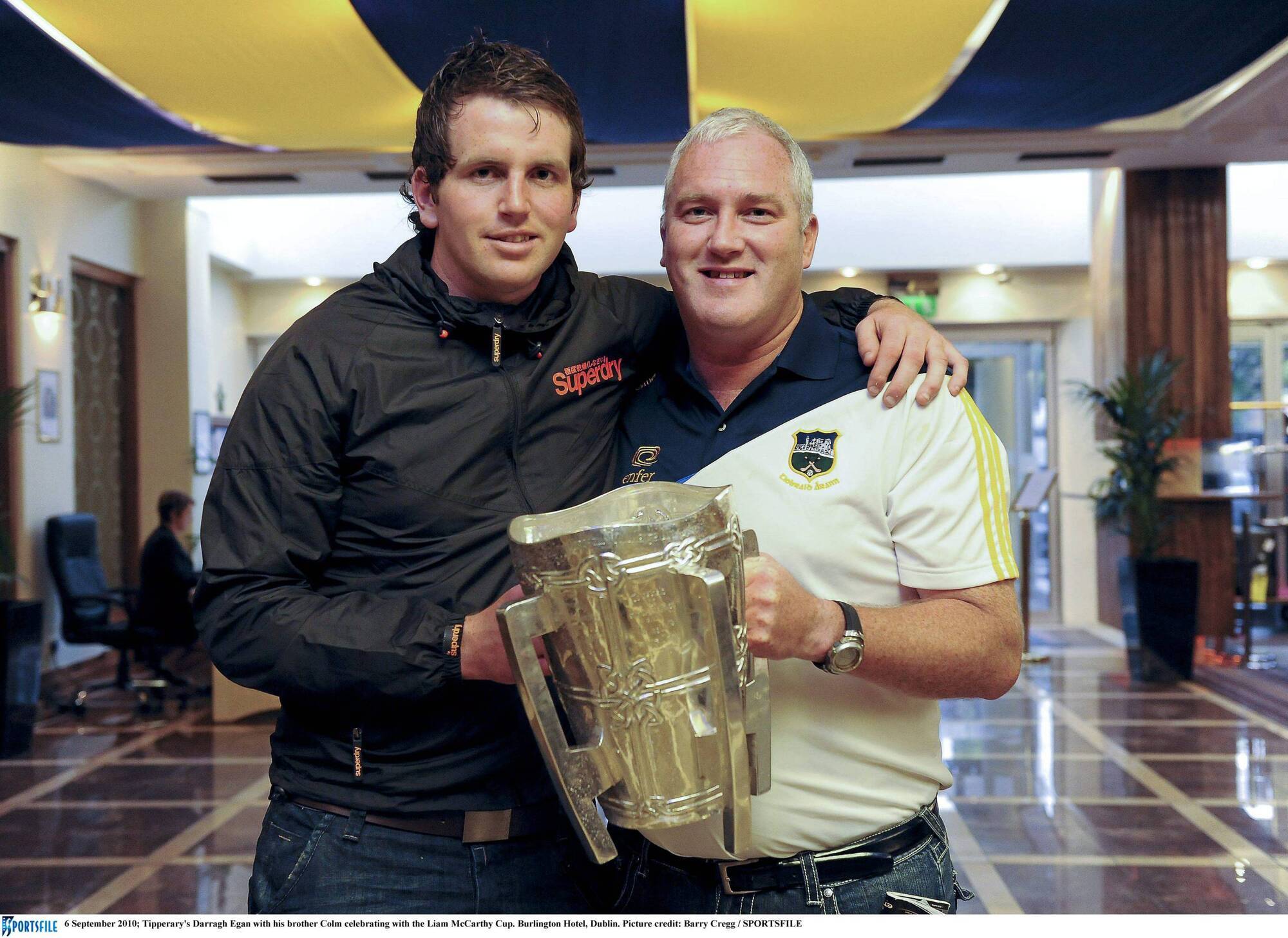
BROTHER IN ARMS: Tipperary's Darragh Egan with his brother Colm celebrating with the Liam MacCarthy Cup after the 2010 All-Ireland final
Mere weeks before the pandemic halted world travel in early 2020, Colm Egan was back on home soil for the GAA National Games Development Conference taking place at Croke Park.
He was looking forward to bringing some cutting edge coaching advice back to Chicago and the USGAA, which has jurisdiction over the Association across all states except for New York.
He still thinks about the learnings gleaned that weekend, in particular the talk given by Kris Van Der Hage, the Director of Coach Education for the Belgian FA whose revolutionary approach to coaching coaches is right up Egan’s alley.
Once it was safe to play again, Egan’s network of coaches utilised seven-aside and nine-aside games that were based around a Belgian philosophy which began with a clean slate in 2000 and produced world class players who could end up challenging for a World Cup this year.
The Kiladangan club man starred as a minor and U21 forward for a famous Tipperary unit that won championships in the late 80s and simultaneously served as a prolific assembly line for Babs Keating’s senior successes in 1989 and 1991.
This was a cluster of talented players that was on the road together since the first Tony Forristal tournament was hosted in Waterford in 1982. Two years later, on Centenary Munster Final day, Egan, Liam Sheedy and many other instantly recognisable names lined out for the midday throw-in of the Under 16 decider at Semple Stadium. About four hours later, Sheedy's brother John knocked the ball down to Seánie O'Leary who famously whipped it to the back of the net to postpone the end of the famine.
So many future Tipp managers and selectors travelled that journey with Egan: Declan Ryan, John Madden and Michael Ryan. a who’s who of the Premier County. None of them could get a word out of future selector John Leahy who inconspicuously lined out in goals that Tony Forristal year before becoming a different player and a different character as a senior player in the 1990s.
Egan never made it all the way to senior championship hurling although he did play senior football for Tipp. Remarkably, he was a minor footballer before he was ever a minor hurler.
“At one time in my life, I was Colm Egan. Now I'm Darragh Egan's brother," the Wexford manager’s older sibling laughed the other day when we spoke by phone.
When I tentatively asked about the age gap, he told me he was a Tipp minor when Darragh was born. But he didn’t want to elaborate on past glories too much. All the focus for him and for the Chicago GAA is next week’s triumphant return of the Continental Youth Championship, officially the largest gathering of underage football, hurling and camogie players outside of Ireland and arguably the largest when you consider the logistics involved. Part Two of this column next Friday will delve a little deeper into that incredible event.
By the time I was enjoying my third call with the busy CYC-mode Egan this week, I was finally able to convince him that maybe a little bit of reminiscence about his playing days would help shine a light on the incredible work he does as Games Development Administrator for Chicago and the Central Division while also developing best practices in hurling coaching across the entire USGAA.
Over and over, he repeated his core point that having the CYC back after a three-year absence was the only success he wanted to focus on. No matter what happens over the course of the four-day Gaelic games festival played out on 12 fields laid out pristinely, the ability to reunite almost 1,400 young players and 800 coaches and parents from across North America will be an emotional experience.
But let's look back to where Egan's passion and drive was moulded. His overriding reflection on lining out for the blue and gold is pride that a small club like his could muscle its way out of North Tipp obscurity. After a 105-year wait, Kiladangan reached the mountaintop in 2020. Marooned in the US, Egan watched the TG4 broadcast with a mixture of agony and joy.
“The club is now an absolute powerhouse across the board. That was just not the case in the mid 80s.” Before Belgium wiped the slate clean in 2000, Egan’s home club did the same and dropped to junior just after he left for a summer of hurling in the US in 1994. He had accepted he was never going to make the senior breakthrough for the county team so he took up the opportunity to play for Cú Chulainn. As with so many, a summer season became a lifetime. Both he and his club rebooted and reset at the same time, a long term mission that would yield long lasting impact.
“I just loved every time that I took the field of play,” he recalled for me. “And every time you got an opportunity to play on a team, whether it was on a wet February day are a Munster minor final in 1987 before the senior game, it was all about the opportunity to play and show what you were able to do.
“Half the craic was getting picked up by Bertie Fitzpatrick's bus. We evolved as hurlers, but we evolved as people on that bus. He drove probably 25 years of minor teams. Anybody from North Tipp who ever played hurling or football for Tipp will know exactly what that journey was like.
“And coming from Kiladangan, I was delighted to be able to make those county teams. To be fair to Babs, the senior side was very buoyant at that time. There was a full Tipp revival happening and there were very good seniors that went on to be managers managing All-Ireland senior winners.”
Arguably the most stunning year for Tipp hurling was 1989’s treble success at Under 21s, Intermediate and that breakthrough senior win over Antrim. Egan claimed the first two of those medals but even more significantly for his house, the intermediate All-Ireland continued a familial tradition which began with his father Jim in 1971 and rounded out poetically with his brother Darragh who helped Tipp to win the 2013 decider.
“I had a very bad record in finals, I was absolutely shite in the ‘87 minor final. And I was worse in the U21 final in 1989. And that is the truth," he laughs.
“We were able to turn the tables and beat Offaly in ‘89 in front of 42,000 in Portlaoise after they shocked us in ‘87. I didn't score but I got cut in half for a penalty. And those were the days where you had to earn your penalty.
“I had many great days in the Tipperary colours, loved every minute. But I really don't enjoy talking up the career because the main fact is that I didn't play senior championship hurling.”
After a decade or so of playing in Chicago, sage individuals tapped into the talent and vision for development of young players he had learned while being driven around by Bertie Fitzpatrick. Among other things, he started the first youth hurling program in the city and he also took on refereeing duties.
“If there's anybody that ever saw me playing with Kiladangan or even Tipperary they'll know I was the biggest pain in the ass that was ever on the field for a referee,” he chuckles, describing himself as the poacher turned gamekeeper.
His late father had the best response: “You might as well… sure you've been at it since the age of eight. Now they'll give you a whistle.”
Almost a decade ago, he became just the second full-time Games Development Administrator, structuring his year around recruiting and getting coaches in place while also convincing parents that their children will strive more if offered the chance to choose Gaelic games.
The pathways of which lead to the return of the CYC next week, a large scale effort I’ll explore more next week.
“From the get go, the CYC was the first ever real cooperation between the New York Board and the USGAA board,” points out Egan.
“I fully believe this is the future of the games in North America and what it should look like. At the youth level, it is uniquely continental, the US, Canada and New York all collaborating for the greater good.
“Obviously, my vision is much more cooperation all the way up to adult level between New York and USGAA where we should be having proper USGAA finals to include New York teams, all men's teams, ladies teams.
“There is cooperation at the youth level, why not at the adult level?”
He extends the thesis to the growing movement towards integration of the GAA, the Camogie Association and the Ladies Gaelic Football Association.
“At grassroots, definitely in the US, there's interest in being more aligned. If you were starting a club today, you would not split that club into three. You would run it as a Gaelic games club for all.”
It's a simple philosophy but it only makes sense because starting fresh worked such wonders for Egan himself as well as for Kiladangan and Belgium.
CONNECT WITH US TODAY



Be the first to know the latest news and updates