He’s back and he’s Cody. Who he is. What he does. Still
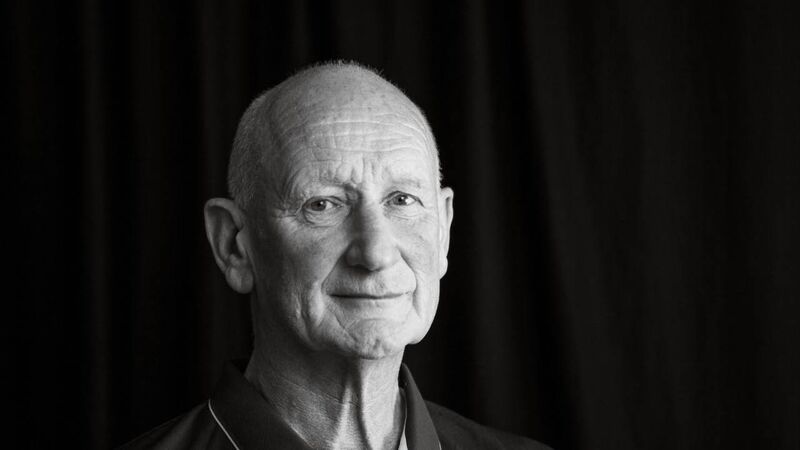
This portrait photograph of Brian Cody was taken by the Dreamtime Studio Hub photography group - Adam Doyle, Brian Manning, Declan Brophy, Lorraine Cashin, Mark Fitzgerald and Oliver O'Neill. Dreamtime Studio Hub is the media centre of SOS Kilkenny, an organisation that supports adults with intellectual disabilities and autism in Kilkenny City, County and Cahir. The photograph was taken as part of the "Faces of Kilkenny" photography exhibition which featured portraits of well-known Kilkenny people. This was the group's first exhibition and highlighted their skills, talent and genuine love of photography.
So here he is, chatting away, at ease with the media and with himself and with the world, out the back in Langton’s garden. One of his places. One of his spaces.
Perhaps because he hasn’t done one of these gigs for three years, and therefore has plenty to say, he is simultaneously contemplative and expansive. Balls are hopped and instead of opting to kill them dead he happily pulls first time.
It’s probably a big surprise for everyone that Kilkenny are there, he agrees, and he “doesn’t have a problem” with that. (“You couldn’t look at it and say, ‘Jeez, this team is definitely going to make the All-Ireland final this year.’)
He’s always positive because that’s the way he is but he’s not foolish-positive. The underdogs are facing “the greatest challenge a Kilkenny team has had in a long long time” in view of where they’re coming from and where Limerick are. Apropos of his own lads, “I’m not saying they’re superstars.” Quite. Enumerating the members of the 2022 edition who would have been there or thereabouts in 2006-09 does not take long. Murphy, Lawlor, Mullen, TJ. The Padraig Walsh of a couple of years back. The Eoin Cody, and possibly the Mikey Butler, of a couple of years hence. That’s all, folks.
No matter. They’re there and they have a puncher’s chance and nothing else matters right now. As for the task of taking down opponents as formidable as the MacCarthy Cup holders, what could electrify the boss more? Better still, this will be his type of contest. Old school, man on man, 15 versus 15. No need to stay up half the night agonising about the opposition’s spare defender and how to go about deconstructing it.
We’ve been making the point here for years, but once more and with more feeling than ever: this is who Brian Cody is and this is what he does. Kipling’s two impostors don’t come into it.
If the days are long gone when he was not only beating every other team but seemed to be beating the game itself, no matter either. He is a couple of days away from his 116th championship fixture as manager and from a 12th All-Ireland triumph in a third decade.
The grand old duke who marched his county up to the top of the hill, marched them down again and now has them within 70 minutes of the summit once more. The subject of a dozen “I’m baaaack!” internet memes after the defeat of Clare.
This man without equal in the history of the GAA when it comes to sending out a team to do a given job on a given day, this pillar of consistency in a universe that has never been more confusing.
War in Ukraine. Chaos in Downing Street. Covid everywhere. Cody still managing Kilkenny. It’s possible to imagine folk even in east Cork or mid-Tipp finding it vaguely, perversely reassuring.
In the Cork dressing room after last year’s All Ireland semi-final, when he spoke with his customary grace in defeat, his listeners were taken aback with how poorly he looked. He does not look poorly now. Had his appetite for the fray in 2022 required any sharpening, the whetstone was furnished by the move to Galway of his former favourite son.
Lose a Leinster final to a team managed by a former Kilkenny player? Unconscionable. That Galway were seen off was not only because they weren’t remotely good enough on the night but also because Cody simply refused to allow any other outcome. His sense of self, his Noreside pride, could not have taken it. Not. On. My. Watch.
Outside of hurling he continues to keep himself to himself. Clipping the hedges at home. Listening, presumably, to his old Springsteen and Neil Young albums. To the public he remains Cody, a man who long ago sloughed off the need for a first name.
When the photography students at SOS Kilkenny, a support service for adults with intellectual disabilities, recently staged an exhibition of portraits entitled ‘Faces of Kilkenny’ he was inevitably a subject, along with other local worthies like Michelin star chef Garrett Byrne, Insomnia coffee guy Bobby Kerr and the Downey sisters.
When the Chief Fire Officers Association held their annual conference in Kilkenny two months ago - 400 delegates, expert speakers from the UK and Belgium and Denmark, lectures on such topics as the Antwerp fire service’s introduction of smart technology and how their Hampshire counterparts coped in the aftermath of a major blaze – there he was again.
He gave his single transferable speech, delivered without notes or Powerpoint, here retitled ‘Leadership in Sport: Lessons for the Fire Service’. The reader will know the topics he touched on.
Spirit. Teamwork. Setting and maintaining high standards. Resilience. Positivity. Bouncebackability.
All very Cody. But the delegates didn’t know this and he had them in the palm of his hand.
“Everything he said really resonated,” reveals John Collins, the fire chief in Kilkenny and originally a Nemo Rangers man who’s looking forward to seeing Colm Lyons on duty on Sunday. “Like a team, any fire service has good and bad days. You have to have standards, be able to cope with setbacks and be positive. Brian was absolutely brilliant. You could have heard a pin drop.”
He has ever been at his best when exuding simplicity. On the field these past few years the problem was that the simple calcified into the simplistic and Cody seemed not so much unable to effect an about turn as bullishly unwilling to. Darkness on the edge of Nowlan Park.
Losing successive All Ireland semi-finals to Waterford and Cork may have been forgivable. Losing them in the same manner – route one stuff at one end, run into the ground in the second half at the other end – was not.
Granted, he used to be a full-back and as a full-back of the 1980s his horizon was necessarily limited. Get the ball and clear it. As Georgie Leahy always emphasised to him in James Stephens, they can’t score when the ball is down the other end of the field.
Thus, for so long, his managerial philosophy of defending. Defenders didn’t do fancy things; they defended. Tommy Walsh didn’t go about hitting every ball he could get his hands on; he held his position and didn’t indulge his instincts.
In the period since Kilkenny’s last All-Ireland triumph defenders have become more than people who defend, however. The job description has widened almost beyond recognition. They are outlets, receivers, ball carriers. They look up. They lay off. They sculpt short balls as well as driving long ones. In sum, they perform as befitting an age where the opponents score when the ball is down the other end of the field.
The Nowlan Park debacle against Wexford two months ago exposed Kilkenny yet again as dull and lumpen, their boss a man out of his time and faintly anti-intellectual, so in thrall to the supremacy of the ancient verities, which have their place and always will, as to be suspicious of the new, which has its place too.
****************************
And then something improbable happened. Kilkenny spent the four weeks between the Leinster final and the All Ireland semi-final being coached up to the eyeballs and beyond.
Rehearsing working the sliotar out of defence. Opting for the jab instead of the haymaker. Doing as instructed by Conor Phelan, with bits and pieces from Martin Comerford and James McGarry. It is amusing to picture the players behind the wheel for the venture and ignoring Cody, whose antipathy to the short ball in defence endures, yelling at them to go long.
On the sideline during games he’ll talk to whichever wing-back or wing-forward is on his side of the field, and he’ll occasionally drop a word into the linesman’s ear, but he is no whirling dervish.
It’s Comerford who does the running and shouting and it’s McGarry, the eye in the sky, who comes down from his seat in the stand every now and then with a note on a piece of paper.
Twenty four years in the job he retains the gift, rare and exalted, of making young men a third of his age want to play for him.
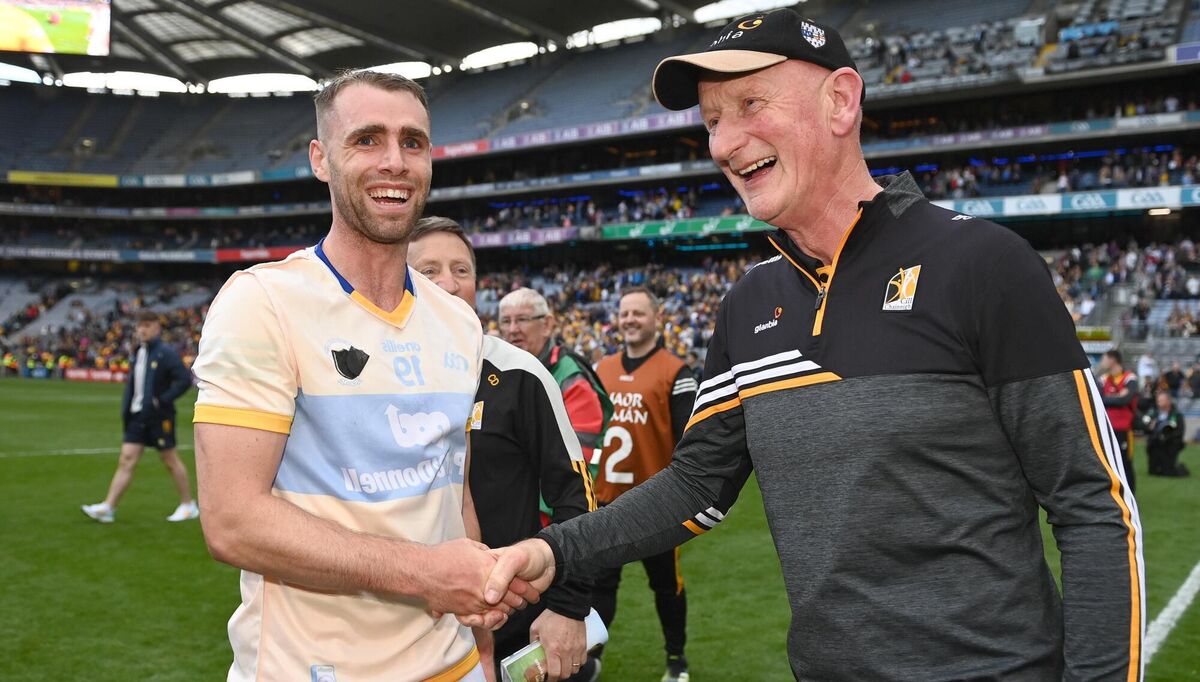
The front of last week’s had a photo of him with a starstruck Mikey Butler and Cian Kenny after the semi-final. That the relationship is a transactional one – he doesn’t want to be their friend, he’d drop them as soon as look at them and doubtless they’d be appalled if he suggested hitting John Street with them of a Saturday night - is the nature of the job. Nor would the older hands still be around were Cody the gulag commander of caricature.
It’s easy, and not just because of his fondness for the Liverpool team of the 1970s, to picture him as a Klopp man more than a Guardiola man. Clean lines, lightning transitions, Liverpool’s current, more considered iteration of heavy-metal football as opposed to endless control, possession for possession’s sake, stitch upon stitch.
Yet the manager he most resembles is of course Alex Ferguson. For too many reasons to list, most of them obvious, not least the mutual lack of ideology.
That neither was doctrinaire constituted a strength rather than a weakness. If a tactic or strategy works it is good; that is the only test. And if taking more care in possession and hurling with their heads up allows Kilkenny to prosper, so be it. Short balls in defence notwithstanding.
He needs a good All-Ireland final nonetheless.
He doesn’t need a third successive defeat. He doesn’t need a sixth defeat in total. He must perform far better than he did in both 2016, when Joey Holden was hung out to dry against Seamus Callanan, and 2019, when Kilkenny were clueless after Richie Hogan’s dismissal. Above all he needs the players to avoid resiling, with fatal consequences, to discredited long-ball habits when the temperature rises.
Victory, given the identity of the opposition, would constitute his greatest triumph. Defeat, given the identity of the opposition, would be easily rationalised.
Had the clubs made a concerted effort last winter, echoing the general disgruntlement around the place, they could have pushed the county board executive into a public conversation, maybe even into holding a vote on the manager’s reappointment. Now he’ll be manager next year if he wants to be. (The last five words of that sentence are superfluous.) Just imagine the energy jolt, the new lease of life, the summer has given him. What’s more, Kilkenny are All-Ireland U20/21 champions for the first time since 2008. Don’t think for a moment that he hasn’t already subjected Derek Lyng’s outfit to extensive microscopic analysis and identified a couple of likely lads to do a job for him sometime down the line.
He’s back and he’s Cody. Who he is. What he does. Still.


CONNECT WITH US TODAY



Be the first to know the latest news and updates