Mike Frank Russell interview: 'Football has to be careful where it’s going'
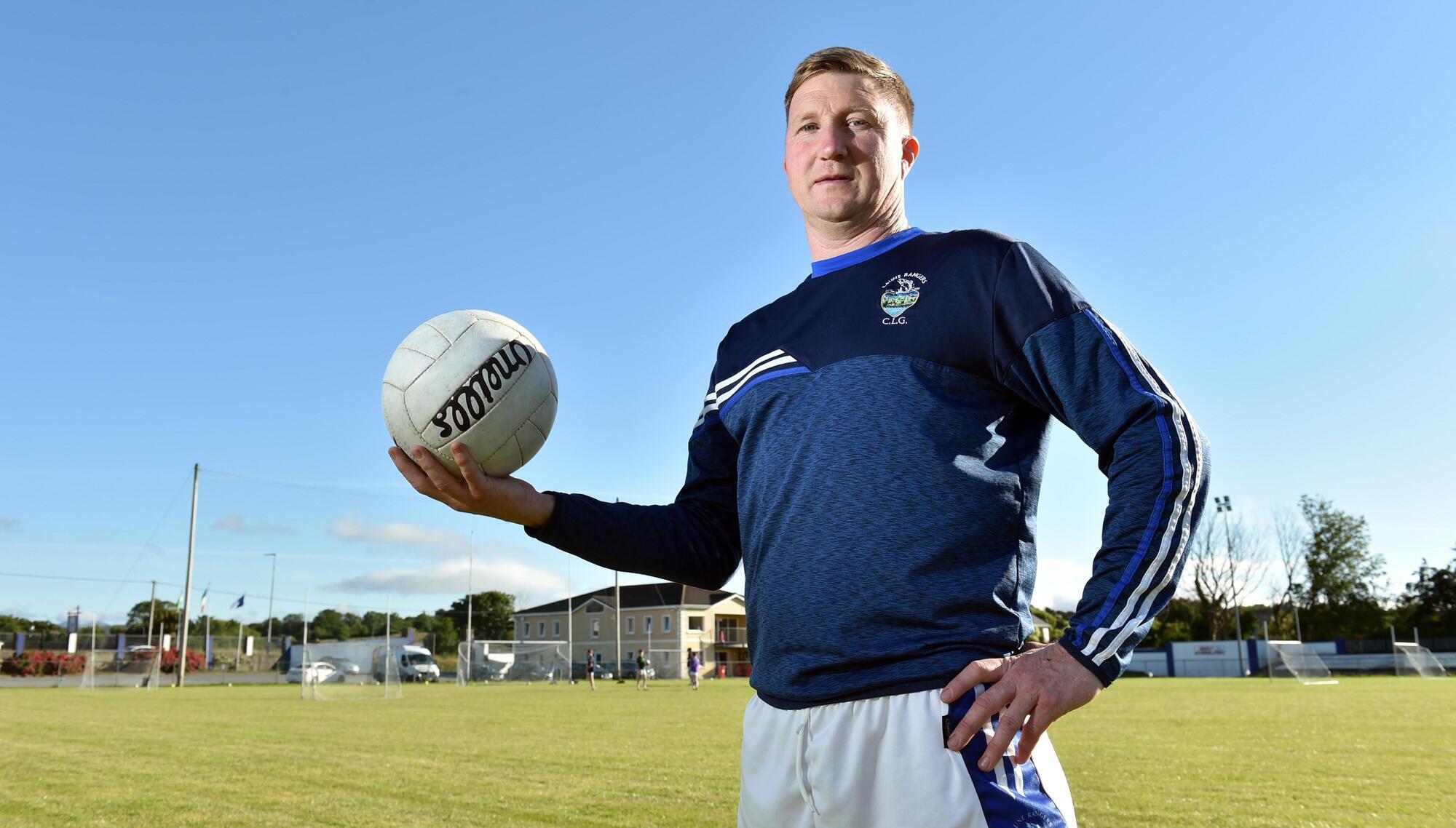
ONE OF A KIND: Former Kerry footballer Mike Frank Russell pictured during a training session with his club Laune Rangers in Killorglin, County Kerry on Thursday evening. Pic: Don MacMonagle
He still treads the boards. The theatre may no longer be Croke Park or the stage an All-Ireland semi-final where he was so often the leading man, but for the artist widely known as Mike Frank there is still a visceral thrill in simply the Play. The act. Performing. Doesn’t matter if it’s off Broadway or how large the audience is. Even the rehearsals light him all up.
The Tuesday before last, he came on at halftime for the Laune Rangers Bs in a home Mid-Kerry league game against Glenbeigh; actually, he was still playing with the As up to last year before deciding over the winter that at 44 it was time to drop down to the juniors. At the break Glenbeigh were two up. Within minutes of his introduction though Russell had found the net.
Then in the closing moments with the sides level he kicked what the club’s online match report has described as “an outstanding pointed free from the sideline”. A full quarter of a century on from taking that pass from Maurice to score that super-sub semi-final goal against Cavan, there he still was, coming on to turn and win games.
“I suppose it’s still a bit of a drug to me,” he smiles modestly. “Like, when I got that goal the other night, I felt like a child! I was saying to myself, ‘God, this feels great!’ Just knowing you’re still contributing to your club, still competing. Fielding a ball, turning…
“I just love kicking a ball. I know it might sound a bit perverse but just kicking a ball in an empty field, making that connection, hitting that sweet spot as I call it, God, I still get a fierce buzz from it.
“Some other lads have gone off playing golf but look, I never drank, never smoked, it’s kept me fresh and fit. I’d find it hard to let go.
“People ask themselves why the play. For me, walking behind the band in front of 80,000 in Croke Park with the ground shaking; nothing will replace those goosebumps. But even just playing with the club and you kick your first score of the night and that feeling, ‘Right, I’m here, I’m back, I’m at it again’, that’s addictive. The same with just taking a bag of balls and taking a few frees and kicking around at home. I don’t think that will ever leave me.”
The last time I interviewed Russell he was half the age he is now; it was back in December 2000 when he was a reigning All-Star, a second-time All Ireland champion and the most lethal forward in all of football. That summer he’d taken a Cork backline that had contested the previous All-Ireland final for four points from play; a notoriously mean, physical Armagh fullback line for 2-3 from play in an All-Ireland semi-final replay; and kicked a further five points from play over the drawn and replayed All-Ireland final against Galway.
When I sat down with him in his parents’ home in Killorglin he attributed such proficiency to the set of goalposts in his grandparents’ back garden next door. Twelve months earlier, having missed the entire 1999 season due to tearing his ACL, he wanted to make up for lost time by buying that Christmas present for himself and putting up those posts.
He still has those posts. He still dissects them. Sometimes with his and Sinead’s two kids, Zoe (seven) and Adam (five), and often by himself, still being a big kid himself.
For a WhatsApp profile he forsakes a pen pic. Instead his image is of an O’Neill’s ball. Sure why not when it’s his favourite thing in the world?
It’s only fitting then that a large part of his spare time is taken up trying to pass on that love and art of kicking that O’Neill’s. In recent years he’s got heavily involved coaching Laune Rangers underage teams. Partly it’s because he thinks it’s the best place for a coach to start out (“I see some lads going straight into senior and it’s a fierce landing for them”) but also because it’s where the game is at its purest.
He’s helped out with the U14s but he’s been primarily involved with the minors. As it happens the club has won three of the last four county championships in that grade, offering the promise that the club should some year in the future return to the senior championship but the real reward is seeing how they’ve gone about winning and playing those games.
“My philosophy is to try to kick the ball a lot. I’ve been on the sidelines at U14 and U16 and you hear a lot of shouting for lads to drop back and all that but I just think at that age they should just be let enjoy it because you want to keep them involved. They’ll be bogged down enough with dropping men back and all that at adult level.
“We try to play positive football. Leave at least four forwards up and kick the ball up to them.”
It’s one thing to encourage kicking; another to emphasise and coach it. In an individual sport like tennis or even a team one like basketball, a coach would see it as a dereliction of their duty were they not to guide their players through the mechanics of the shot.
Such conscientiousness isn’t as pervasive in football, a laissez-faire approach is more common, but Russell is one of those who feels obliged to mentor players in one of the most fundamental skills – and for him, joys – of the game.
“We would do a lot of kicking for scores, left and right, in our sessions. If you think about it, with how big the gym culture is now, young lads are now more likely to go to the gym outside of training than head down to the field with a bag of balls like we used to do and practise, practise and practise.
"So when you have two collective sessions a week, we try to do as much kicking and shooting as possible. Because how often after a game do you hear ‘Ah, we left that after us, we had so any chances but just didn’t convert’?”
And so he breaks it down with them, prompting reflection, offering feedback.
“You’ll look at what a fella did. Maybe he came around the cone and kicked it straight away, so you’d ask him if he possibly rushed his kick and then he’ll go do it again and give himself that extra second on the ball to compose himself. Or maybe his shot dropped and so he recognises he has to put more power into it. Or maybe it was his posture.
“Then you add in a defender or two to make it more game-like. And what you find is the more you do it the better and the more confident you become at it.”
He’ll openly admit his outlook is rooted in his upbringing. “In Kerry we believe, whether we are or not, that we have the best kickers around to kick the ball.”
He’s cognisant other counties don’t think like Kerry, not least because they’ve calculated they can’t be like Kerry. When Russell began his senior inter-county career, it coincided with that point where the ball was handpassed as often as it was kicked. Now the ratio is more than three is to one. The length of time a team holds possession is infinitely more again. As teams have become smarter, though, Russell feels the game hasn’t necessarily gotten better.
“I was at a fundraiser the other night for Fossa GAA with Larry Tompkins and we made the point that football has to be careful where it’s going. For years I would have watched any game I could but over the last three or four years there have been a lot of times where I could actually get up during a match and make a cup of tea and hardly miss anything. Whereas most days with the hurling, you can’t do that. I mean, Limerick-Galway last weekend, you could not take your eyes off it.
“The game has to look at itself. Make a few rule changes. Personally I’d like if every kickout had to go beyond the 45. Because what you don’t want is young lads watching it and saying ‘This is boring.’
“Looking back, I was lucky to play when I did. Or at least start out when I did. I think I’d find it hard starting out now.”
******************************************
Jack O’Connor, Keys To The Kingdom
By the time Mike Frank Russell was 19 he’d won every team honour there was to win in football. A minor, U21 and senior All-Ireland with Kerry as well as a national league. A Hogan Cup with Killorglin intermediate school. An All-Ireland club with Laune Rangers. A Sigerson with Tralee IT.
By 22 he’d won almost every individual honour too. The first time they ever handed out a Young Footballer of the Year award, it was to him, in 1997. By 2000 he was an All-Star, and only missed out by a whisker to Seamus Moynihan on being the Footballer of the Year.
And he’d get better still. In 2002 himself and Colm Cooper would combine to play possibly the most scintillating football any corner forward tandem ever has. In that year’s All Ireland quarter-final defeat of reigning champions Galway they’d each kick 0-4 from play.
In the semi-final demolition of Cork Gooch would go for 1-5 and Russell one point better with 1-6. By halftime in the final, they’d combined to take the Armagh fullback line for a further five points from play. As Russell says himself, “2002 was the best football we played. To be honest, I think that was the best football any Kerry team has played.
“But I don’t think you’d be let play that football now.”
In truth, football seemed to change after half-time that particular September, and it would change all the more when Tyrone joined the top table, similarly coming up with ways to stifle a freescoring combo like Cooper and Russell.
As O’Connor would touch upon in his book, it was a particularly challenging time for Kerry football, personified in the talent and dilemma that was Russell; for the second half of his career he spent as much time out of the starting 15 as on it. In the end a bit of ingenuity on O’Connor’s own part would accommodate the genius that was Russell and the Killorglin man would prosper enough to win five All Irelands.
He didn’t quite get to finish up on his own terms. Whereas in September 2009 an older member of the ’97 team like Darragh Ó Sé was still around to claim a sixth All Ireland, Russell had departed the panel a few months earlier around the same time Mike McCarthy famously rejoined it.
“It didn’t end up the way I wanted to. At 31 I felt I had a bit more to give. But I didn’t have a choice really, and on top of that I had been there for 13 years so you can’t be too greedy either. And it definitely had an upside. I know a lot of lads who stay around with the county until they’re 34, 35 and their bodies are crocked. My body was still in good enough shape to give a good few years back to the club which I’m proud to say.”
If anything he’s now glad to have played county when he did and for as long as he did. That he got to play with Maurice Fitzgerald at the start of his career and Gooch for the latter half of it. That the primary role of an inside forward back then was still to score. Now? He’d worry for a player like him. Again, it’s why he’s a bit worried about the game and feels it needs to be careful to remain attractive to the more skilful, less athletic lad.
“I’d definitely have to change my ways. Nowadays with full forwards having to chase back all the way into their own fullback line, you’d need that aerobic capacity. Get fitter, more powerful. To be honest, I don’t know if I’d survive. Coaches are now looking for a different kind of players. It’s not automatically the most skilful player that is going to get picked.
"I don’t want to sound cocky or anything but I knew I was one of the most skilful players on a field. I usually wouldn’t say something like that about myself but I had the confidence to say that because I knew that I could get scores from all the work and kicking I’d put in. It’s not all about that now. It’s about your GPS, tracking back…”
For him though it remains the main thing. And he’d like to think that’s true for kids today. Back in his formative years, he’d gorge on the Kerry Golden Years but also videos of the top forwards of the Ulster teams that were winning or reaching All Irelands: Tony Boyle, Peter Canavan and especially Mickey Linden. And of course there was Maurice.
“Kerry were in the doldrums back then but Maurice would still kick 10 points against Cork.”
Some of the points he’d kick against them, Russell would later kick them too.
Cillian O’Connor is a player who has referenced how he modelled some of his game on Russell’s but the true legacy is probably closer to home.
“I think the big advantage we have in Kerry is that we have that pedigree, that tradition: you’ve players to look up to the whole time. I grew up watching Maurice. You’d hope then a few players looked up to you and you passed the baton on to them.
"David Clifford would have watched Gooch. Dublin have that now. They’ve a generation of kids who grew up watching the Brogans and Connolly. Now they’ve Kilkenny, Rock, Con. It’s a big thing to have, role models kids aspire to.”
But it’s not solely kids who’ll take to their back gardens after what they see in Croker this weekend. On Monday evening you’ll likely see a middle-aged school teacher out with his ball in his back garden by Caragh Lake.
Call him old school if you like (“A lot of young lads, they’ll nearly prefer going to the gym than go kicking but give me a bag of balls any day!”), or call him childish, trying out some kick he saw Clifford go for the previous day.
Either way, he’s still the same Mike Frank.


CONNECT WITH US TODAY



Be the first to know the latest news and updates