The GAA’s disciplinary process has become a bit of a lottery which brings the Association itself into disrepute
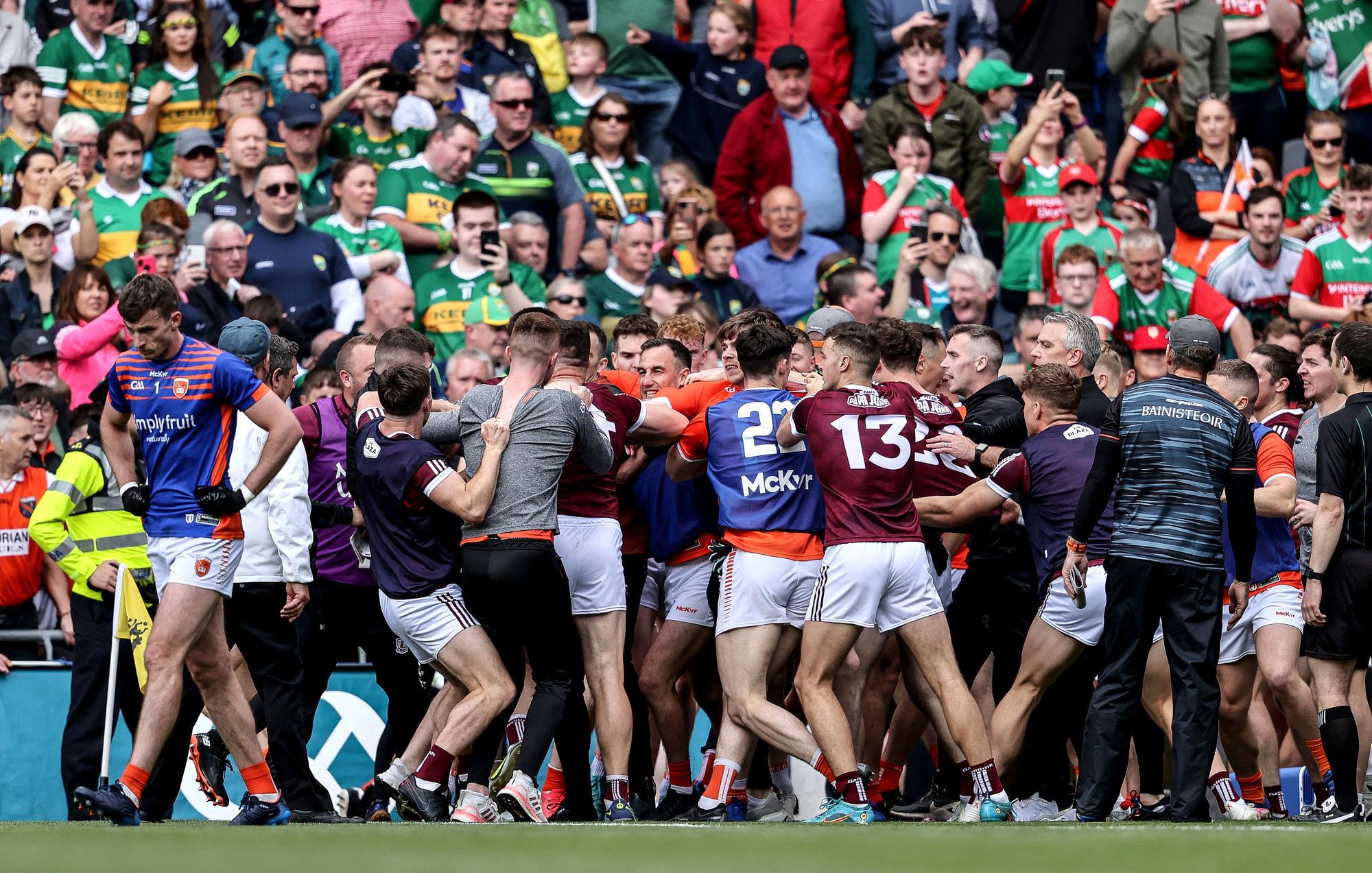
TAINTED SPECTACLES: Both the best hurling (Limerick v Clare in the Munster Final) and football (the All-Ireland quarter final between Galway and Armagh) games of the season thus far have been tainted by ill-discipline
On the interminable flight home from Australia, I watched Jason Ferguson’s documentary Never Give In about his father Alex. Ferguson’s rationale for his post-match rant after his Aberdeen side had defeated Rangers in the 1983 Cup was uniquely Scottish in nature – viscerally bitter yet poignant.
Ferguson was of little doubt that his 1999 Champions’ League victory over Bayern Munich was his greatest night in football. In the tumult of the final whistle, Ferguson retreated to the tunnel but was ambushed by two non-playing members of his squad – Paul Scholes and Roy Keane. Both had been suspended for cards picked up in previous games.
United had quickly accepted that the players would not feature in final. Speculation about legal challenges was not a feature of the build up to that game. Appeals are rarely part of the backdrop to major soccer games or tournaments. Unfortunately for the GAA, its disciplinary process is too often central to the post-match story.
Both the best hurling (Limerick v Clare in the Munster Final) and football (the All-Ireland quarter final between Galway and Armagh) games of the season thus far have been tainted by ill-discipline. In hurling, there was a calamitous effort by the CCCC to retrospectively ban two Clare players and a Galway player (from the Leinster final).
The CCCC’s case was struck down on procedural grounds by the GAA’s Central Hearing Committee (CHC); grounds that were later held to be, well, procedurally wrong. It was farcical stuff. After more than 2 years of Covid, when so many have worked from home and zoom has become a noun of a different meaning, communicating online was apparently enough to see all charges relating to the provincial hurling finals being struck out.
This hints at one the biggest problems with the GAA disciplinary process: the triumph of procedure over merit; of form over substance. I remember chairing one hearing and being told, in a case involving a serious infraction, that it should be thrown out because a report by an official had not been signed in Irish. My Irish is not great, but I had enough to say, as Gaeilge, that given the appellants’ honourable commitment to our native tongue, the rest of the meeting would be conducted in Irish. The objection was sheepishly withdrawn, in English.
Some of the stuff that goes on in GAA hearings is just nonsense – asking a referee multiple questions in order to “clarify” his report when the real game is an attempt to catch him out and use the discrepancy to have the case thrown out.
GAA hearings and appeals are not courts of law. They are not bound by strict rules of evidence. A notice to appear at a hearing is not a summons. A referee’s report is not a warrant. Minor procedural errors can be ignored or easily rectified and should not, as is currently the case, be used as an excuse not to sanction a player.
The GAA disciplinary process is not helped by its rule book which, simply put, is a mess. At times, it is too prescriptive, on occasion, too ambiguous. When Humpty Dumpty replied to Alice in Wonderland, he had the GAA rule book in mind: “When I use a word… it means just what I choose it to mean – neither more nor less.”
The alphabet soup of bodies – CCCC, CHC, CAC, DRA – tasked with upholding the rule book lends itself to further unwieldiness and one that does not fit well with the current condensed championship season.
Ideally, the GAA would have a full-time disciplinary officer who on Sunday nights during league and championship would review all reports and video evidence of the weekend games as assisted by match review panels of former referees and players. This match review panels would replace the CCCC and the full-time disciplinary officer would prosecute cases against players by announcing charges on the Monday after games.
If necessary, a full hearing could be heard on the Tuesday or Wednesday and then players would have one shot (only) at an appeal. There is no need for the GAA to have a Central Appeals Committee and the Dispute Resolution Authority; they could easily be merged to better effect.
At present, at both county and club level, there is a view that a suspension will rarely stick at the business end of a championship. Let’s be honest, we, as GAA followers, are all hypocrites in this regard. I include myself in this as someone who if a fellow club or county player is “in trouble” will look for a loophole. The culture when it comes to appeals in the GAA is a twist on Alex Ferguson’s mantra – never give in.
The problem is in part with the current rule book which is one of the few disciplinary codes I know that seems to lay booby traps for those seeking to uphold it (especially referees) and not those who have breached it.
A final difficulty for the GAA is that it still takes relatively few matches (5 to 7) to win a senior inter-county championship. This means that match bans are of much more impact in the GAA than in other sports. The GAA really needs to give greater consideration to “on the day” sanctions for misbehaviour - extending the range of sin bin fouls, the use of a TMO, automatic 21 yard frees for accumulated team fouls, moving the ball 50 meters forward, as in the AFL, for any dissent.
That being said, no such sanctions could have assisted referee David McGoldrick for the brawl that occurred during the Galway v Armagh game on Sunday. If such a brawl occurred on Jones’s Road it would, rightly, have led to Garda intervention. Will it take the same – criminal sanction – to stop the type of violence we saw on Sunday. A GAA jersey does not make any player or sub or maor uisce immune from the law.
The photo of a Galway player being gouged in the eye was on the front of most papers on Monday. Those front pages should have featured the Galway players celebrating their penalties or Rian O’Neill’s magnificent catch to set up Armagh’s second goal. We should be talking about skill not sanctions.
The disciplinary process now creaks into actions. Expect the usual guff about certain players not being that “type of character”; of players not being able to get a “fair trial” and Jesuitical debate over what exactly “contributing to a melee “means. It’s all a legal game.
The real game Armagh v Galway was a very good contest player before a colourful crowd of 70,000 on one of those (now) rare days when the GAA has a captive Irish sporting audience. It was eventually decided by the lottery of penalty kicks.
Unfortunately, as currently constituted, the GAA’s disciplinary process is also a bit of a lottery. It is neither respected nor feared; indeed, at times, it brings the GAA itself into disrepute.


CONNECT WITH US TODAY



Be the first to know the latest news and updates