Kingston on Galway duels: 'Analysis was what you saw in the flesh or a bit on television, maybe'
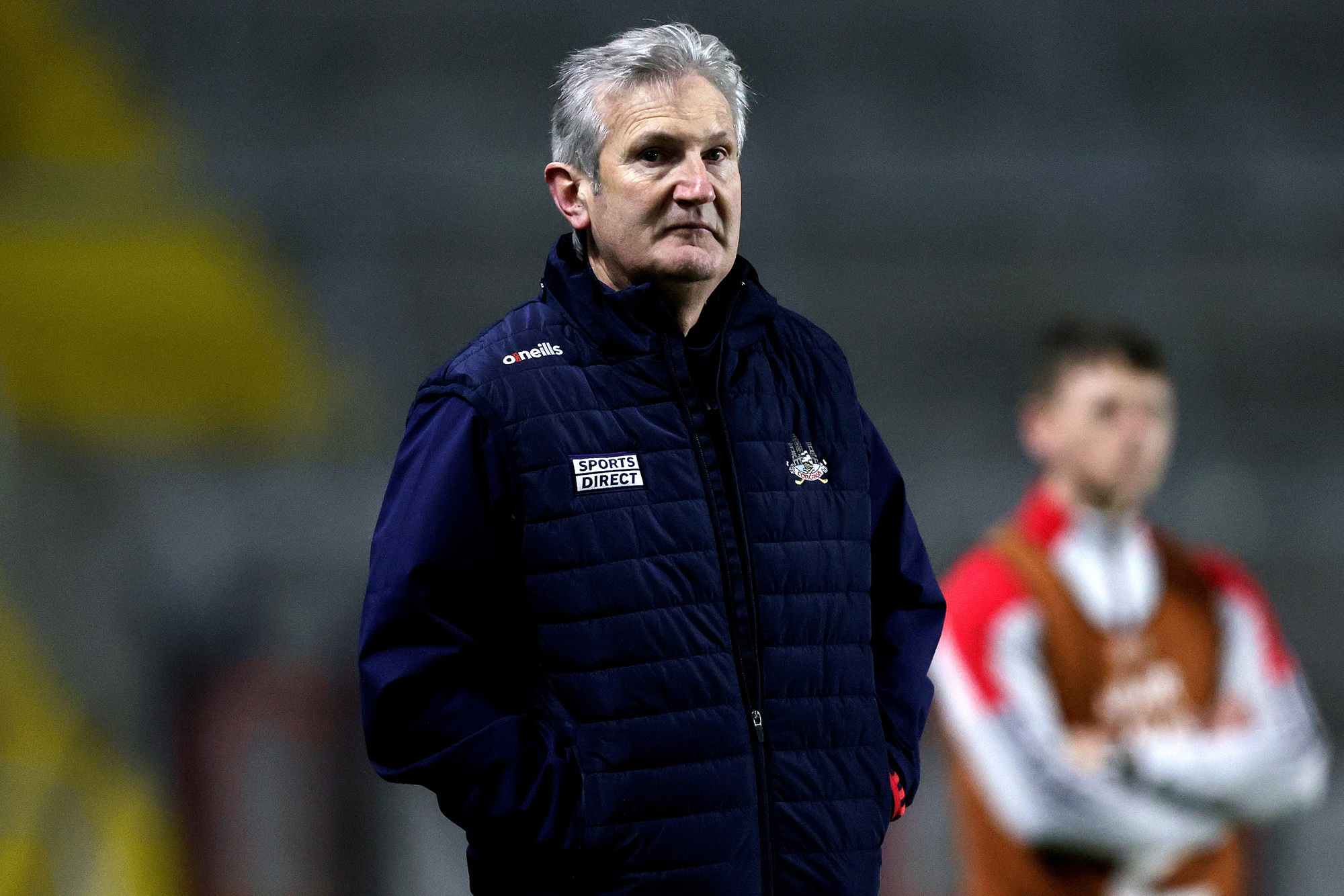
Cork manager Kieran Kingston during the Galway league game.
Kieran Kingston has been here before. Cork v Galway has been an attractive fixture before, and this weekend’s All-Ireland quarter-final (Semple Stadium, 1.45pm) should add to the list of good games between the sides.
One of them came in 1986, when Kingston was a lively corner-forward on the Cork selection.
“Looking back now, it was a year when Cork weren’t expected to win an All-Ireland, even though we’d been doing well in the Munster championship - that was our fifth Munster title in a row - the league hadn’t gone well for us. We’d lost the league semi-final heavily to Kilkenny.
“Galway, on the other hand, came into that All-Ireland with huge momentum - they'd beaten a fancied Kilkenny side well in the semi-final in Thurles. That was the day they famously moved their corner-forward, Anthony Cunningham, out the field and Kilkenny struggled to deal with that.
“It was a big tactical switch by Cyril Farrell (Galway manager) because those kinds of moves were unheard of, really, at that time, and Galway won a super game.
“We came through that campaign to beat Antrim in the semi-final - we scored 7-11 that day and still only won by five points, so the two teams arrived into that final in very different circumstances.”
That’s where past and present cross. Cork qualified to face Galway by beating Antrim in Corrigan Park last Saturday.
“In 1986 Antrim were a very good side, they were building well and three years later they beat Offaly in the All-Ireland semi-final to qualify for the final against Tipperary, so in 1986 we obviously saw that team in its early days.
“That was one of the reasons I was very conscious about the team last weekend when we went to Antrim to play them - they’ve been building momentum in the last few years in the Joe McDonagh Cup, and playing them in Corrigan Park, their home spot . ..
“It proved difficult enough for us last weekend, trying to deal with a gale force wind and a tight pitch, but we would have pointed back to the experience of playing in 1986 as an example for the players. We used that comparison going into the game last weekend, which was good preparation for the game.”
Back in 1986 Cork began to focus on Galway after their win over Antrim - and on their famous tactics.
“There’s no comparison, really, between preparation then and now. Our training would have been a game of backs and forwards and a bit of a run, while analysis was almost unheard of.
“Having said that, we were well aware of the tactic that Galway had used against Kilkenny in the semi-final. Johnny Clifford (coach) and Johnny Crowley probably discussed it between the two of them - I say probably because that was a time when management didn't have big meetings with the entire panel to discuss tactics.
“I don’t know if Johnny Crowley had a bit of a hamstring issue going into that game or what, but he stayed in his position at corner-back and left Anthony Cunningham roam out the field - there was plenty of ball dropped into Johnny’s corner and he cleared it all.
“He had been a stalwart for Cork for ten years at that stage, an outstanding player, and he had huge experience. He wasn’t going to be flustered if he had nobody to mark, and he cleaned up.” One difference between preparation then and now, as Kingston says, is the tactic to counter Galway’s approach wouldn’t have been broadcast in the Cork dressing-room.
“It’s funny, I can’t remember if we all knew at the time that Johnny (Crowley) would be staying in the corner, and that shows how things have changed. If a modern team was coming up against such a big tactical challenge then the whole team would be aware of the plan to deal with it.
“There’d be more communication these days of tactics - necessarily, because the game itself is far more tactical - whereas in that time it was more off-the-cuff, you went out and played it as you saw it a lot more.
“The difference was that every team played like that, so there wouldn’t have been a lot of analysis done beforehand - there wouldn’t have been a lot of video available in the first place. Analysis was what you saw in the flesh or a bit on television, maybe.”
It was also a time when many teams didn’t have an identifiable ‘manager’ as such, but Johnny Clifford was the main man. “Absolutely he was - he had been involved with Cork teams for decades and had seen it all, he had great knowledge of the game, but the most important thing was his manner - he had a great way with him.
“I was working in the bank that time and he’d often drop in just to say hello, to ask how you were getting on and so forth. Players wanted to play for him, and he could bring people with him, which is a basic requirement for any manager.
“He didn’t speak all the time but when he spoke everybody listened. And of course he was very close always to Jimmy Barry-Murphy, who was an icon of the game and a key man on the team. It was Jimmy’s last year as a Cork senior hurler so there were a lot of big personalities in that dressing-room.”
Galway had beaten Cork in the 1985 All-Ireland semi-final, a game played on “a terrible wet day,” says Kingston.
“The Cork minors beat Galway the same day and some of those lads featured in 1990 - and that was the start of that great Galway team.
“Cork won in 1986 but Galway were a dominant side for the rest of the decade, winning two All-Irelands and appearing in another All-Ireland final.” The Leesiders had too much for them in 1986. Kingston came on as a sub to hit two points, having been tipped off by Dr Con Murphy that he’d figure in the game.
“He was a selector even then but I don’t know if he got all those calls right,” laughs Kingston.“That’s changed too, communication with players has changed within teams, but even then good managers would know how to let a player know he’d be playing or coming on as a sub. For myself coming in . . . growing up the only ambition was to play hurling for Cork, and winning an All-Ireland was the ultimate. It’s something you’d always cherish - being associated with an All-Ireland-winning team is what every hurler dreams of.”
CONNECT WITH US TODAY



Be the first to know the latest news and updates