Championship Talking Points: Has Gallagher’s Derry won the last ‘real’ Ulster final?
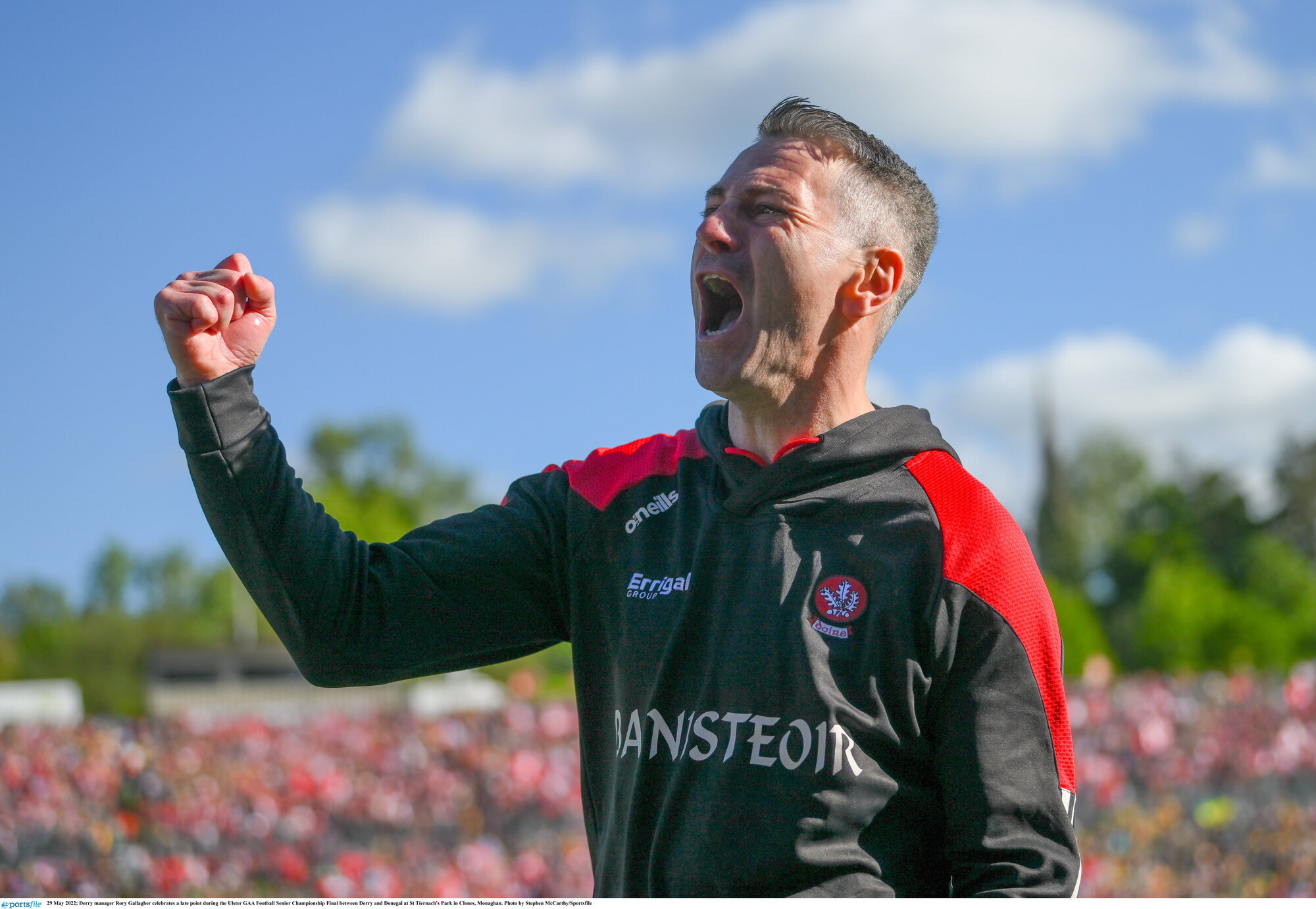
29 May 2022; Derry manager Rory Gallagher celebrates a late point during the Ulster GAA Football Senior Championship Final between Derry and Donegal at St Tiernach's Park in Clones, Monaghan. Photo by Stephen McCarthy/Sportsfile
FOR the years 2000, 2001 and 2002, Rory Gallagher was the leading scorer in the Ulster Championship. Not only was that some feat in playing for Fermanagh, but it was in the era of Oisin McConville, Stephen McDonnell, Peter Canavan and others.
What came next was fairly odd, in Gaelic football terms. He dropped off the panel and left the reservation. In 2005 he popped up with a goal against Armagh in the Ulster preliminary round and promptly left again, only returning for the 2010 season before he bowed out of playing.
And since 2011, he has been involved in seven Ulster finals as part of management teams. For more than two decades, when involved, he has been a monumental figure of Ulster football and the Ulster Championship. It is difficult to name any other individual right now that has been right in the middle of things like he has.
But here’s the thing. Next year, there will be an Ulster Championship of sorts. But we all know that it will not be the same, it will not feel the same. It will not provoke a crowd of thousands to storm a pitch and set off flares in a welter of pure excitement.
So if this is the end, farewell old friends.
“Maybe we’ve won the last real Ulster Championship,” said Gallagher afterwards.
“I don’t know. Certainly in my mind, I wanted these lads to win it and will next years’ mean the same? Probably not.”
After coming through that Championship and beating three Division One teams, including the All-Ireland champions, then where are we placing Derry in the race for Sam?
Top three? Ahead of Galway?
Or could you just look at their methods and the style and wonder how it all might work in Croke Park.
So much for the condensed season. Jack O'Connor puffed out his cheeks and queried the long gap until Kerry's next game after beating Limerick on Saturday and Dublin manager Dessie Farrell did likewise after overcoming Kildare. Like Kerry, Dublin won't be back in action again until the weekend of June 25/26 when they will play a Round 2 qualifier winner in the All-Ireland quarter-finals. It's the old chestnut of feeling like there isn't really much of a reward for winning the provincial title when all your energy and momentum could be sapped by the long delay to the All-Ireland series. "It's an interesting one," said Farrell. "With the two-week cycle, you get into a rhythm, you get comfortable, you get used to that dynamic and now there's a pause. In the two-week periods, everyone stays really focused because you've no alternative but to stay focused. Now we have a bit of a break. How do you manage that four weeks? It would seem to be a long time in a tight schedule but it's a case for us of making it as productive as possible."
Beaten Leinster finalists Kildare perhaps have the ideal scenario, another game in a fortnight and, should they win that Round 2 qualifier, then another two weeks until an All-Ireland quarter-final.
Given he has been beaten in two of his last three All-Ireland quarter-finals as Kerry senior manager, Jack O’Connor’s wariness about last eight games is understandable. Even if the last time Kerry lost one of them was 10 years ago against would-be champions Donegal, which marked the last game of O’Connor’s second coming, the manager’s concern about the four-week lead-up to the game is well-placed.
In 2018, Kerry as Munster champions were four weeks without a game before Galway beat them in their opening Super 8 game, which was the beginning of the end of their championship. Kerry weren’t provincial winners in 2012 when Donegal edged them out by two points but they had been in ‘10 as Down dismissed O’Connor’s side minus Paul Galvin and Tomás Ó Sé by six points. Again, the margin between their Munster final win (v Limerick) and the quarter-final was four weeks. In 2007, Pat O’Shea’s team struggled to squeeze past Monaghan after a six-week lay-off from capturing the Munster SFC title. No wonder Jack is looking forward to the draw for the final round of Qualifiers…
Tipperary's football season is over after Sunday’s surprise Tailteann Cup exit but for manager David Power the real work is probably just beginning. Given the revolving door that has been in operation in the county, he will have his work cut out to keep his 2022 panel in place for next season. It's only 18 months since Tipp were crowned Munster champions yet just five of the team that lined out in that landmark win over Cork - Jimmy Feehan, Colm O'Shaughnessy, Kevin Fahey, Conal Kennedy and Conor Sweeney - started their Tailteann Cup tie against Carlow. Aside from captain Sweeney, it's an entirely different forward line. Colin O'Riordan is back in the AFL while Michael Quinlivan had to step away this season due to work commitments. Padraic Looram and Emmet Moloney - who came on in the 2020 provincial decider - weren't available either this year while Brian Fox retired. Bill Maher and Robbie Kiely are currently injured. "Our goal is to just see where we're going now in terms of player availability and that stuff," said Power of the months ahead. "That's the big thing with us, we're turning over a lot of players every year. There's too many players turning over on the panel and that's something that's tough." Power himself is almost certainly staying put, indicating that he's happy to honour the remaining two years on his agreement with the county board.
They became the darlings of Irish sport with last year's All-Ireland breakthrough, at Dublin's expense, but are the Meath ladies in danger of becoming a hard team to love? After scoring just one point in the first-half of Saturday's Leinster final, and eventually losing to Dublin, it was put to Dublin manager Mick Bohan that the Royal County's blanket defence approach would remind you of Jim McGuinness' Donegal, circa 2011. And we all know how history will record the blanket defence era. Bohan was diplomatic and said that playing Meath is like 'a game of chess, which is frustrating at times' and urged the media to be honest about what they saw. "It's one of those systems that's really difficult to break down," said Bohan. "It'll be interesting to see how you report on it because, as I said, last week, I think the game is at a stage where it needs to be reported on, for an accurate description to be given of what the game is about."
Bohan outlined how attempting to break through Meath's green and gold wall risks conceding a free, allowing the Royals to break forward at speed. Similarly, he said long kick-passes beyond the blanket aren't a feature of the women's game. Hence the game of chess. From Meath's perspective, it's mightily effective, most of the time, but Saturday's provincial decider was a tough watch with just 14 scores in perfect conditions at spacious Croke Park.

CONNECT WITH US TODAY



Be the first to know the latest news and updates