Stepping up: Love them or hate them, penalty shootouts are here to stay
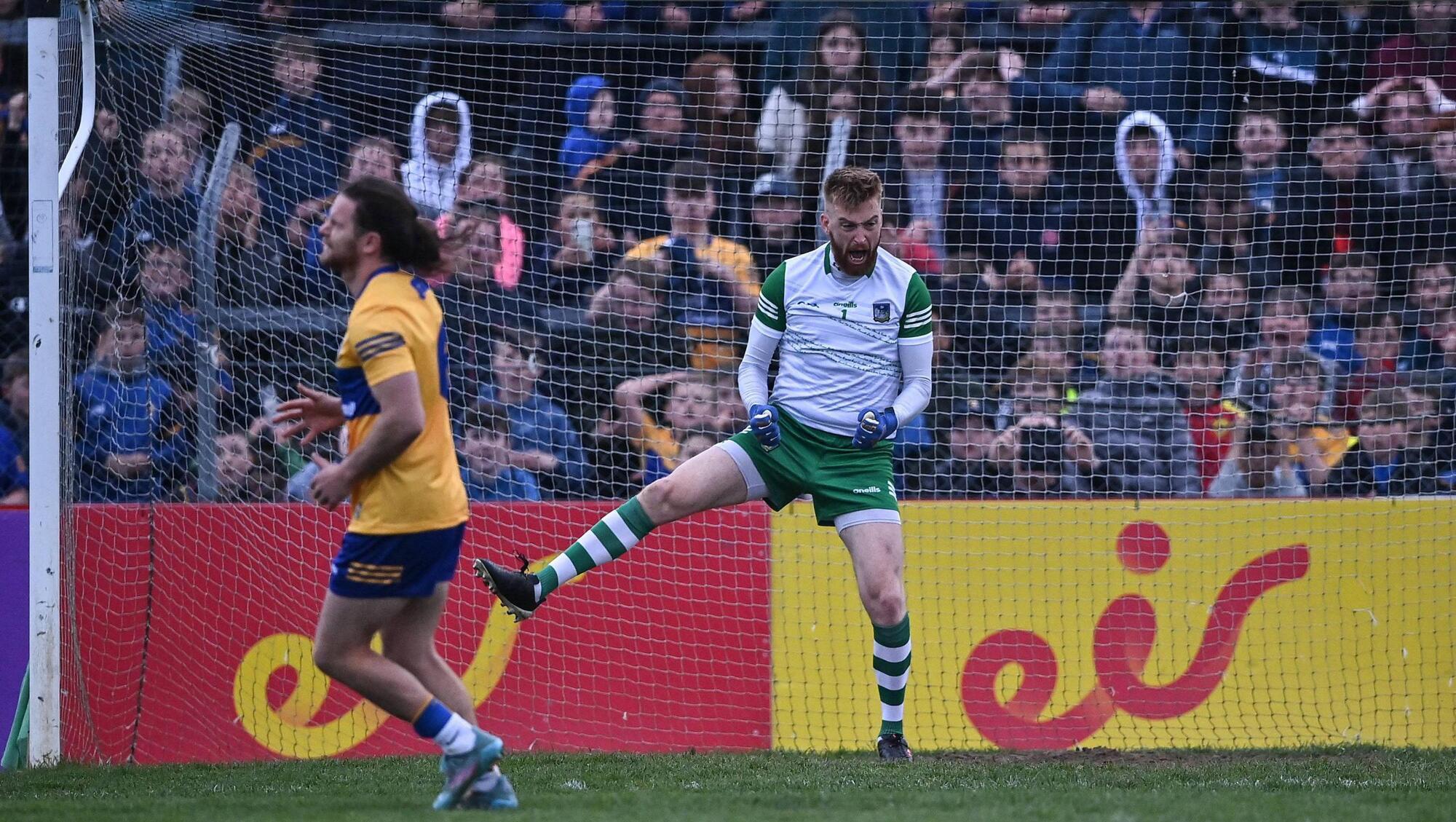
Limerick goalkeeper Donal O'Sullivan celebrates after Cian O'Dea of Clare missed his penalty in the Munster SFC quarter-final penalty shoot-out at Cusack Park in Ennis last month. Photo by Piaras Ó Mídheach/Sportsfile
When referee Luke Pearce blew the final whistle after extra-time in Saturday’s Munster-Toulouse Champions Cup quarter-final, the tension was shot through with confusion. Everybody was aware that a penalty competition was going to decide the tie but not everyone was sure of the format.
BT Sport tried to inform the viewers of what was about to happen next, displaying a graphic with yellow markers to show how three different kickers were to take six kicks from different areas of the pitch. The graphic also included a block of text, 78 words, outlining the protocol, especially if the competition went to sudden death.
It was a lot to take in because the practise has been such a rarity in rugby. Prior to Saturday, the most famous, or infamous, shootout was the 2009 Heineken Cup semi-final when Leicester edged past Cardiff Blues 7-6 on penalties, all of which were taken directly in front of the posts on the 22-metre line by a different place-kicker each time.
When Argentina beat Wales 9-8 on penalties in the 2010 World Rugby U20 championship, the format saw each team pick five players to take kicks from different positions along the 22. When Biarritz were promoted into the Top 14 in France last year after winning 6-5 on penalties against Bayonne, the shoot-out protocol was the same as the Cardiff-Leicester game 12 years earlier.
The format last Saturday though, was completely new again, which added to the confusion - and the debate. England’s Mario Itoje tweeted afterwards that “it would have been better if there were six kickers instead of three”.
There is never an easy way to lose a game, especially one so big, but acceptance is all the harder again when shootouts have never been part of rugby’s culture.
The GAA is now dealing with a similar issue. When they decided last November that the All-Ireland hurling and football finals will be the only championship games in 2022 with a provision for replays, the rule was certainly bound to mean a whole pile more of extra-time and, inevitably, penalty shootouts.
Yet nobody really knew what it would be like until it actually happened. Down beat Offaly in the 2020 Christy Ring semi-final in hurling’s first championship penalty shootout, but the Clare-Limerick Munster quarter-final 11 days ago was the first time it happened in the football championship. The drama was electrifying but the cost for Clare was devastatingly sudden and concussive.
On ‘The Sunday Game’ the following evening, Colm Cooper argued that a 40-metre free competition was a better way of deciding a contest in that scenario. When that rule was first introduced in 2018 – with a free from the 65-metre line in hurling – it was ironic that Clare and Limerick were also involved. After 100 plus minutes, Limerick won a league quarter-final in the Gaelic Grounds 7-6 in a free-taking shootout.
Later that year, the Mullahoran-Banagher Ulster Intermediate football semi-final was the first club game to be decided by a freetaking shootout, with Mullahoran winning 5-3.
A freetaking competition is just as cruel but it isn’t loaded with the same tension or intrigue a penalty shootout brings.
A penalty competition is also a fairer and more equitable means of deciding a game in those circumstances.
The freetaking format was all on the free-taker – you either score or miss. Missing the final penalty of a shootout would still lead to the same outcome as a missed free but it would be easier for the taker to accept if the goalkeeper made an incredible save.
There are other options such as to keep playing until a ‘Golden Score’. That would be too sudden, especially in hurling, but a ‘Silver Score’ would be fairer where the team leading at half-time in an additional period of extra-time wins.
Yet the GAA have settled on penalties and the biggest challenge for everyone now is to adjust to that culture change the practice creates.
Before New Zealand’s 2019 Rugby World Cup semi-final against England, All Blacks head coach Steve Hansen spoke about possibly having to win the game on penalties. “It’s unlikely to happen, but you’d be foolish if you hadn’t prepared for it,” said Hansen. “Have we prepared for it? Yes.”
Trying to cover all bases in an amateur game is never easy but it is something hurling and football teams have to seriously consider now. Replicating match-day pressure is impossible but players can at least work on technique and routine as a safeguarding mechanism if they are forced to step up in a shootout.
Penalty takers are becoming more nerveless. On the same weekend as the Clare-Limerick game, five penalties were scored in four football games. Yet the main penalty taker has experience of that pressure, something at least three of the first five takers in a shootout would not have at inter-county level. Dealing with culture change – as Munster and Clare discovered in recent weeks – is never easy to accept in such cruel circumstances. But every team has to realise that it’s possible. Because penalty shootouts are going to become a lot more common.


CONNECT WITH US TODAY



Be the first to know the latest news and updates