Michael Moynihan: Limerick's ruthless efficiency trumps hurried improvisations
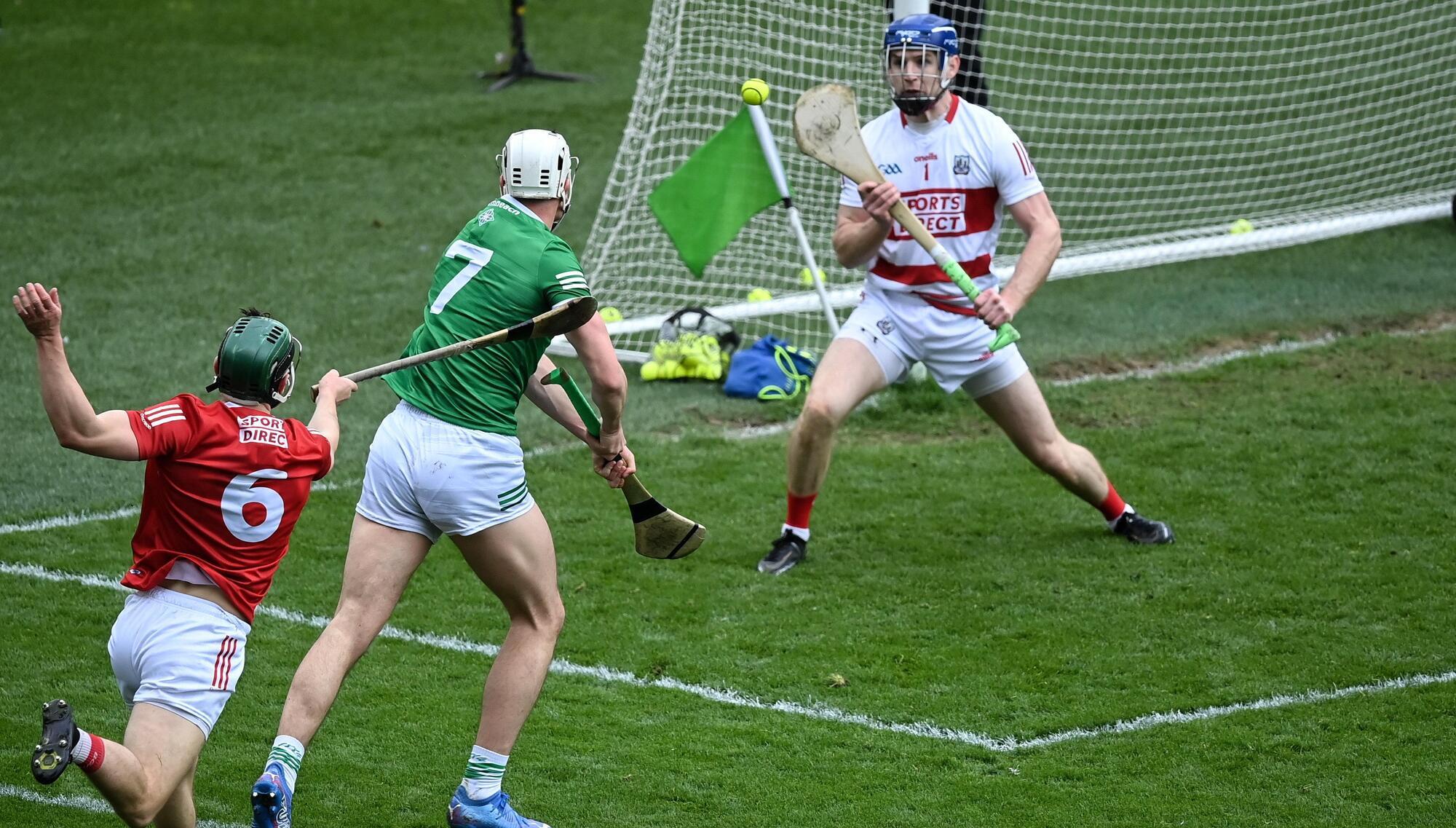
Kyle Hayes of Limerick scoring his side's first goal during the Munster SHC Round 1 against Cork at Páirc Uí Chaoimh
With 69 minutes played in Páirc Uúí Chaoimh yesterday the score between Limerick and Cork was 2-22 to 1-16 in favour of the All-Ireland champions.
Last year the final score between the two in the Munster championship was almost identical, 2-22 to 1-17. This year, however, Limerick added another three points before the end of proceedings, while Cork just about equalled last year’s tally in injury time.
What can we infer? That Limerick have improved on their 2021 standards while Cork have stalled? The evidence is strong in both cases.
It was an unusual championship day in Páirc Uí Chaoimh - you could be unkind and call it the only one of its type this year, in fact, but not for scheduling reasons alone. An unusual side effect of the Easter timing is the approximate sensation of an oddly popular NHL clash: the skies are grey and the dress code winter-appropriate, even if the players’ appetite is appropriate to high summer. Call it NHL Redux, maybe.
This one had one of the stand-out features of the League fixture in the influence of a strong breeze on proceedings. It aided Cork in the first half, but only up to a point. The home side’s puck-out strategy isn’t based on picking out skyscraping targets as a first option, or even a last option: getting an extra 20 yards on a puck-out is no great boon if the ball can’t be won.
Accordingly, Cork had to work the ball out, and after an even enough first half they were punished for a little sloppiness a couple of minutes before half-time. They didn’t do too much wrong but Limerick insist on extreme sanctions: when Cork coughed up the ball on the 45-metre line it was transferred to Aaron Gillane with admirable swiftness. His goal was the appropriate and unsparing punishment.
Not so at the other end a minute or two later, when Darragh Fitzgibbon’s gamble on a long delivery paid off with a kind bounce. He curved inside and passed to Conor Lehane but credit to Nickie Quaid, who was quick off his line to save.
We didn’t know it then, but that was a neat mirror of the two teams in the game as a whole. Ruthless efficiency against its opposite.
When the teams re-emerged for the second half the score was 2-9 to 1-8, and Cork surged with four points, but one of those should have been a goal from Shane Barrett, with all due respect to Nickie Quaid’s stunning save. The same when substitute Jack O’Connor’s shot whistled past the Limerick post later.
And Cork needed a second-half goal to have any chance but even with Seamus Harnedy on as a puck-out target they couldn’t make headway against the Limerick half-back line, while the champions’ distribution from there, and from midfielders Darragh O’Donovan and Will O’Donoghue, was exceptional. They weren’t flattered by the winning margin and have arguable a stronger hand than last year, given Mike Casey’s return to action led to a daisy chain of switches further out the field that made Limerick even more potent.
The winners’ physical power was a feature of the game, but to focus unduly on that side of their play does a disservice to the smooth execution in other areas. Their sharpness with sideline cuts - making players available, recycling the ball through sharp triangles to a shooter - was in sharp contrast to Cork’s hurried improvisations, which often broke down under Limerick’s focus.
Those tracking the events in Walsh Park can foresee a clash between Waterford and Limerick which must be described, according to long tradition, as mouthwatering. Once Limerick shook off the rust from a couple of weeks’ inaction their win in Cork was inevitable, so the challenge from the league champions should settle the rankings at the top of the tree.
For Cork there are questions everywhere, from their under-pressure restarts to an inability to make the ball stick up front. The energy which saw them beat Limerick in the Gaelic Grounds was notable by its absence, with players all too frequently isolated and lacking support runners, including goalkeeper Patrick Collins; leaking a goal so late in the first half had uncomfortable echoes of last year’s lapse in concentration against the same opponents, and at the same time of the game.
Cork will have chances to improve in the upcoming games, of course. There is no shortage of area which need improvement. Yesterday Rebel boss Kieran Kingston focused on his side’s use of the ball: “We tried to mix it a bit. Hindsight is great.
“If you hit everything long and you are not winning it and it’s coming back up, then you’re putting yourself under pressure because you are giving possession to a team who are really good at using possession . . . “Possession is precious against most teams now, and it’s how you work that and vary it. At times we varied it well and at times we didn’t. We can’t say we did it all the time because if we did we’d have won the game, and we didn’t.”
For the Limerick manager, John Kiely, there was a sense of satisfaction to the win “from the point of view of the work, how hard the boys worked for the team and for themselves.
“They managed to generate a huge amount of energy onto the pitch and to get that energy exerted on the ball a lot. I think that was the key piece, really, so very happy about that aspect of it. Seventeen wides as well so shooting efficiency would be something we’d be disappointed with. There were one or two line breaks that I wouldn’t be happy with either but they were of our own making as opposed to Cork’s making.”
Always room to improve. Always making those improvements. That’s the difference.
CONNECT WITH US TODAY



Be the first to know the latest news and updates