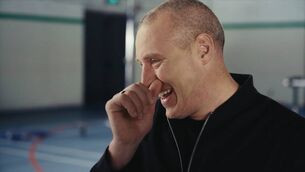
What is the goal? Bigger, better, faster, stronger?
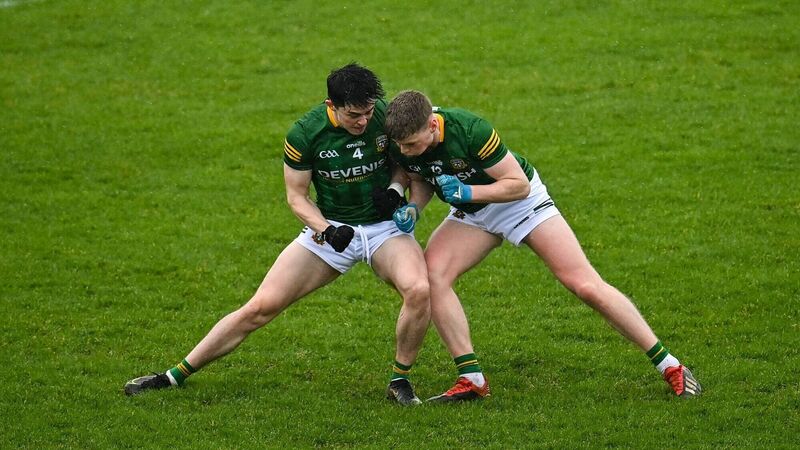
Meath's Mathew Costello, left, and Eoin Harkin of warm-up before the Allianz Football League Division 2 match against Galway.
How big is too big? How fast is too fast? And where, in the recipe for building a champion player, does an intercounty strength and conditioning coach strike the right balance?
Joe O’Connor has spent two decades trying to figure that out, working with a who’s-who of top-level GAA talent, from the Kerry footballers of 2011 to the All-Ireland-winning Clare hurlers of 2013 to the Limerick hurlers of 2018 – building the all-round athletes who are as renowned for their strength and speed as they are for their skill.
These days, O’Connor is “semi-retired” from intercounty GAA work, though he still trains some individuals alongside his day job as a lecturer at Munster Technological University (MTU) and the running of his Tralee-based company, Nisus Fitness. Having been at the coalface of GAA strength and conditioning for 17 years, how has he seen the pendulum swing between speed and strength in that time?
“It’s gone in circles,” says O’Connor. “For a period hurling and football came closer together and then moved further apart. Where we’re back to now is that rather than focusing on size and bulk, we’re getting back to the fundamentals of functions.
“There was a period teams were focusing on mass, then they were focused on speed. But we’ve progressed by stepping back and asking: What are the demands of the sport? We’ve realised: strength and conditioning is not the be-all and end-all. It’s a supplementary part of your preparation that allows you to play the sport injury-free at a high level.”
O’Connor noticed the “bigger is better” trend across both codes from 2010 to 2015, while he believes hurling has become particularly obsessed with the need for speed. O’Connor counts himself “very lucky” to have worked under Limerick coach Paul Kinnerk who “always went with the integrated approach”, with the prime objective of getting clear outcomes from a session and the secondary objective of making the volume as low as possible.
“It’s a cliche, but going for the minimal effective dose,” says O’Connor. “Sometimes players spend too much time on strength and conditioning.”
Several teams have utilised sprints coaches over the last decade to improve players’ running mechanics, and while O’Connor’s background is in athletics he’s sceptical of how much benefit it provides on the pitch.
“My attitude with speed is that you have to be fast enough,” he says. “What I mean is if you’ve a really, really fast forward, but they go so fast they can’t decelerate or change direction, it kind of defeats the purpose. When you look at GPS data, players might make 40-50 sprints in the game in zone-four speed but you don’t hit max velocity that often. If you do hit max velocity, you probably outrun the pass or run out of space or are going so fast that you can’t execute the skills of the game.”
As such, his approach is to develop “sport-specific, position-specific speed.”
The key target is not maximal speed but optimal speed for skill execution. “Can you do this fast and maintain very high levels of skill?”
With intercounty teams he integrated running mechanics training into every warm-up. “You’d do 80-100 sessions a year so my philosophy was: if I do six to eight minutes of mechanics, speed-based work in every session, that’s a hell of a lot over a season. If you do that with a player over two to three years, you can have a massive impact.”
When it comes to strength, O’Connor followed a similar long-term plan. When a player joined a senior panel around the age of 20, O’Connor always asked them to think of physical development as an Olympic cycle – laying out a four-year plan to progress strength, speed and power metrics.
The number one goal was not a hulking chest or arms that could wallop an opponent into next week.
“For me strength training is about function, injury-prevention and thirdly performance. We start with good movement quality. The athlete has to move well before you start adding strength, mass or power.”
O’Connor knows hamstring tears remain the most common injury so his focus was on posterior chain work like deadlifts and hip thrusts in the off-season because “it prevents injury, and also because there’s a direct correlation between posterior chain strength and horizontal displacement, which is the key to acceleration.”
When players became obsessed with a certain metric – like better acceleration or upper-body strength – O’Connor got them to imagine their development like a DJ’s decks: “You’ve all the dials and if you push one to the max, it’ll mess up everything. You can’t have outliers and just focus on strength or speed or injury-prevention – they have to tie together.”
By using DEXA scans to monitor players’ relative skeletal muscle index (RSMI), they’d identify what players could benefit from putting on mass, their gym and nutrition programmes lining up to achieve that.
“But you’re looking at all ingredients from a helicopter view, as opposed to obsessing over one.” Of course, a player’s S&C programme always depends on their needs, and with the Waterford hurlers in 2010, O’Connor’s work with elder statesmen like Dan Shanahan, Ken McGrath, Tony Browne and John Mullane was not about speed, power or explosiveness, but maintaining longevity.
When he looks at Limerick – the towering trendsetters of hurling, with its seemingly endless production line of top-tier players – O’Connor cites the influence of Darragh Droog, the head of youth athletic performance.
“He does phenomenal work developing players athletically from when they come in at 14 all the way through. He sees the long-term picture, looks at their growth maturity levels, trains and prepares them for when they’re ready. It’s not just strength and conditioning Darragh influences, it’s the culture in terms of timekeeping, hydration. It’s not a shock for young players when they step into the senior or U21 setup.”
As such, it seems unlikely the success of O’Connor’s native county will stop anytime soon.
As for the future of strength and conditioning in GAA, O’Connor knows it’s a different world to what he grew up in.
“For young players, the gym is the new night club,” he says. “That’s both a positive and something we need to be aware of. I’d be very conscious of the influence of social media and the information that’s put out to young players by people that are clearly not regulated. The gym culture is very positive, but we have to be careful we don’t overdo it. It’s very much supplementary to the core technical and tactical attributes of the sport. It’s not the shortcut to the top.”
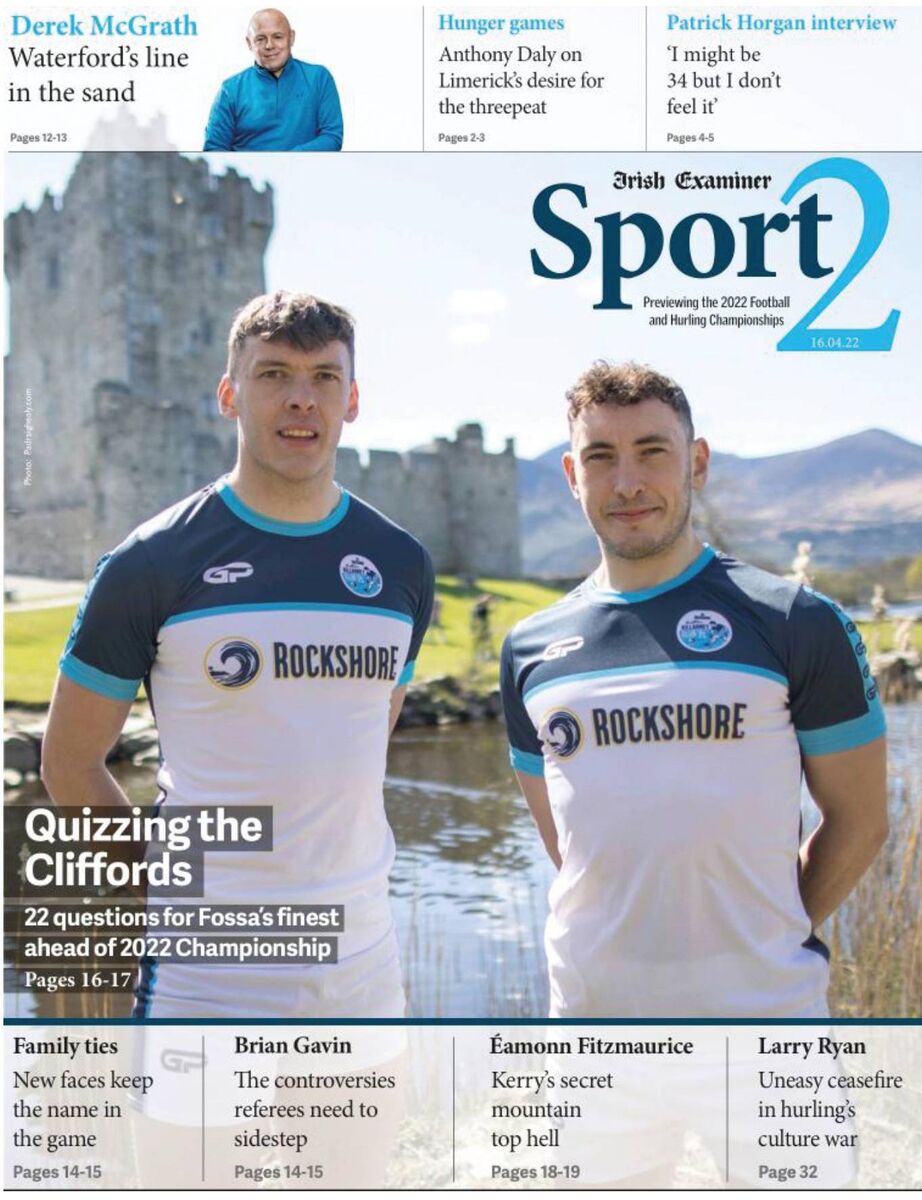
Read our exclusive 32 page GAA Championship supplement in Saturday's Irish Examiner. Featuring expert analysis from Anthony Daly, Éamonn Fitzmaurice, Derek McGrath, Liam Sheedy, Eoin Cadogan, and Gary Brennan.


CONNECT WITH US TODAY



Be the first to know the latest news and updates