Pierce Higgins, the older brother of Mayo legend Keith, was diagnosed with Motor Neurone Disease in 2017. Despite the numerous challenges that he now faces, his unbending stoicism and radiant positivity has been an inspiration, especially to those closest to him
***
MID-MORNING in Bargariff outside Ballyhaunis and Storm Franklin’s belly is rumbling with anger, belching out vicious gusts, spewing sheets of rain across the open plains of south Mayo.
Clare Higgins arrives in the door with a basket of turf to feed the blazing stove in the sitting room, a little warm cave, a peaceful haven from Franklin’s booming voice and beating chest.
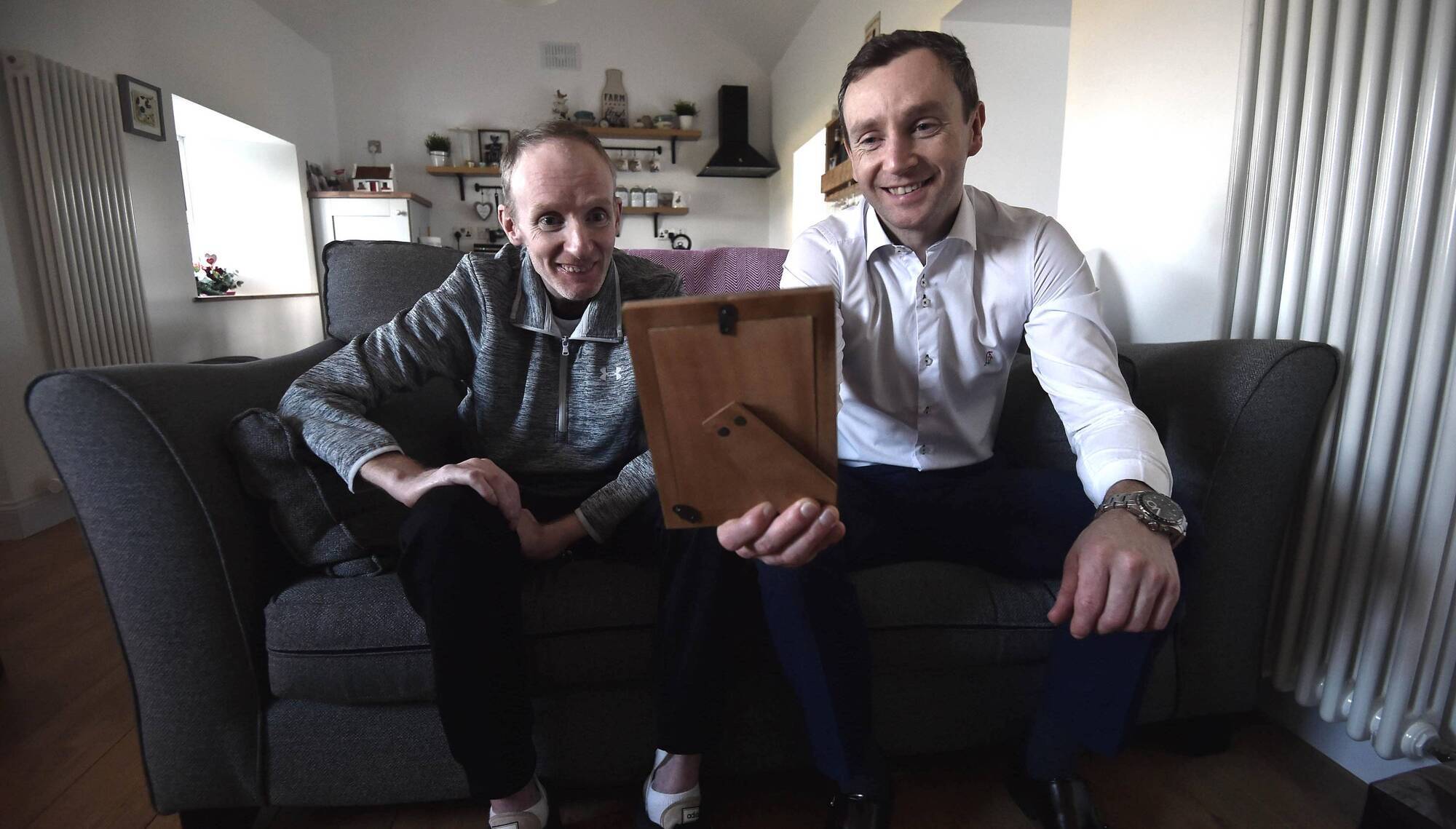
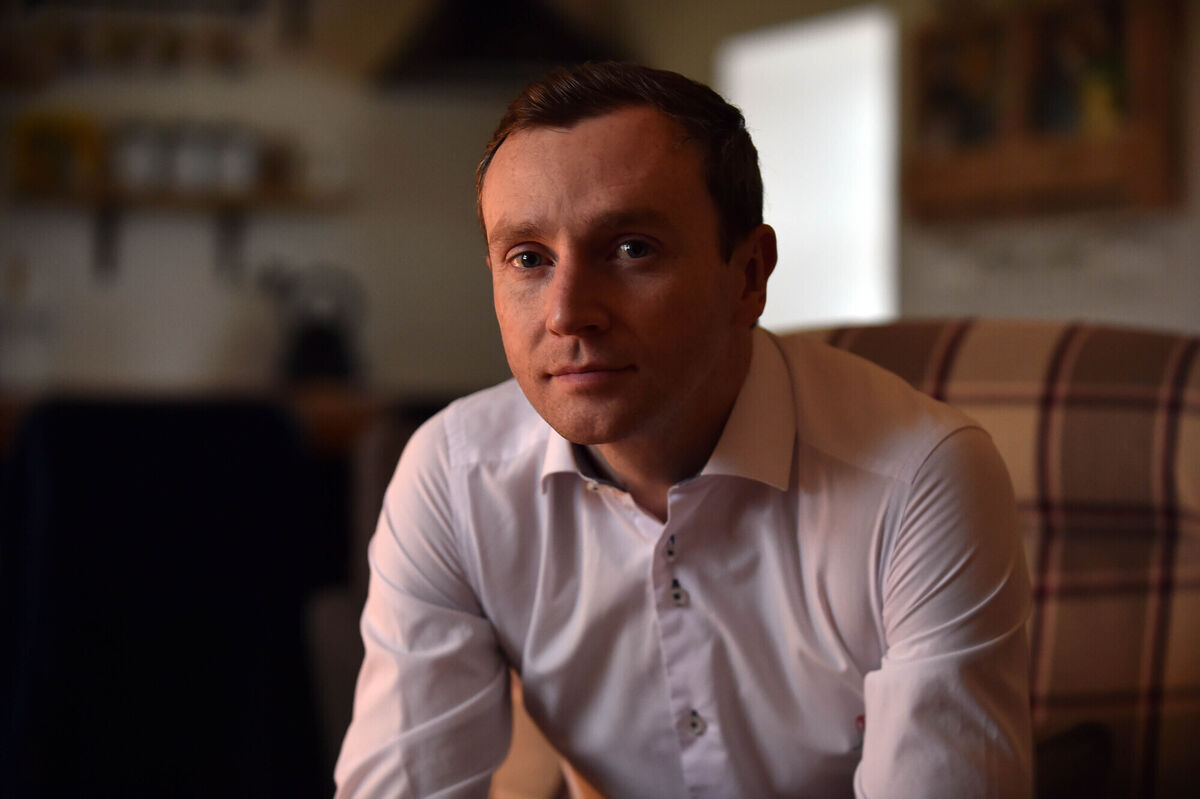
Her husband Pierce sits on the couch, his broad smile lighting up the room like an orb. His frame is frail but his bright demeanour belies the turmoil raging inside his head, his positive outlook providing a compelling contrast to the disease ravaging his body.
Pierce’s younger brother Keith sits across from him in an armchair beside the window of a cottage owned by Clare’s sister. The Higgins’ have been living here since early January when work started on an extension to their two-storey house in Ballyhaunis.
They had looked at other options around making the house more suitable for Pierce, even a house-swap, but he wanted to stay in the family home in Esker Pines. Once he did, Clare’s father, Pete, took on the lead role like Baz Ashmawy on the TV show DIY SOS.
The family and community response have been like an extended version of that show; brothers, uncles, friends, neighbours, hurlers, footballers, all bound up in a heroic communal effort to try and make a difference.
In no time, a modern extension with a huge bedroom and a wet-room has been constructed. Pierce, Clare and their two young daughters, Erin and Ellie, hope to move back home in around three weeks.
“It has been unreal,” says Pierce. “It will make life so much easier.”
***
With the gentle touch of a man who has taught himself to accept the things in the world he cannot control, Pierce Higgins walks you through the most difficult journey imaginable, an almost unspeakable burden set to pillage him and his family of their future.
When Pierce first noticed a twitching in his thumb at the end of 2016, he put it down to the cold in his carpentry workshop. Yet the sensation never eased as the winter segued into spring and the hurling season began again.
The ash felt different in his hands. Catching the ball was his biggest issue so he just strapped up his thumbs. Yet when Pierce went to his physio Gerry O’Keeffe in Castlerea that summer, O’Keeffe said that he needed to visit his doctor.
After being referred to a neurologist in Sligo, he underwent a battery of tests. The diagnosis wasn’t definite, but all the signs pointed towards motor neurone disease.
Denial is often the first refuge of hope, but there was minimal substance in that pursuit. “You’re absolutely hoping it isn’t,” says Pierce. “But deep in my heart, I knew that it was.”
As a protection mechanism, Pierce and Clare confided in their close friends before telling their families. A week before the 2017 All-Ireland football final, the news was confirmed. “It was hard to take in,” says Pierce. “Shock. Disbelief. I won’t say anger, but fear — a lot of fear.”
That evening, Pierce went to the pitch for hurling training. Even now, he can’t really understand why, the only rational explanation being that it was what he always did. Hurling was what made him happy. If he wanted to tranquilize fear and try and disarm the terror for a brief moment, hurling was the only thing that made sense.
His wife was already trying to process the apocalyptic implications of the diagnosis. “I was in absolute bits,” says Clare.
At that stage, the last person they wanted to tell was Keith. Before that
All-Ireland final, the brothers met one afternoon in Charlestown. Keith was living in Castlebar at the time. Pierce was on his way to Sligo and it was a handy meeting point for Keith to pass on match tickets. They chatted about the game. Pierce just said he was going for tests. Keith didn’t need to know any more.
“We just put on a show going up to that All-Ireland final,” says Clare. “We didn’t even tell Kay and Pete (Pierce and Keith’s parents). There’s a picture at home of us and the little girleens before we went into the match and the two of us look half-dead. I didn’t notice it until I looked at that picture on the wall years later. I’d say we were just about breathing.”
Mayo lost.
Keith spent the following few days with the squad. On the Wednesday, he called down to see Pierce and Clare. He was expecting a discussion on the match. He never saw the hammer-blow coming.
“You’re pissed off after the game,” says Keith. “You have a couple of days drowning in your sorrows. You’re feeling sorry for yourself. I hadn’t a clue what had gone on. At the time, I didn’t really know what motor neurone disease was. I’d heard of it, but I didn’t realise the full extent of it. It took a few days for it to hit home and realise what all this actually meant.”
Pierce just kept on keeping on. He was still hurling with Ballyhaunis, but he wasn’t on the starting team because he didn’t have the power in his hands.
“I knew my hurling days were over, but I don’t think I gave it an awful lot of thought,” says Pierce. “I wouldn’t say I was awfully pissed off about it. Maybe I thought it was all a nightmare. I don’t know.”
Pierce’s final time togging out was the 2017 county final, which Ballyhaunis lost to their neighbours and great rivals Tooreen. “Normally you’d be devastated losing a final to Tooreen,” says Keith. “But I didn’t really feel anything.”
“It nearly reflected the whole mood that day,” says Clare. “I remember looking out and thinking: ‘Yeah, we were supposed to lose because everybody was feeling so crap’.
“All our friends, all the team knew by that stage. Even the Tooreen players knew. They were coming up to the lads afterwards, not saying sorry about the match, but nearly commiserating about Pierce.”
Sadness and sorrow had gripped Keith by then, but he was still in denial about the cold, hard reality. He remembers meeting a gang of his and Pierce’s friends after that county final and them trying to make sense of it all.
“One of the lads said: ‘Don’t look it up too much’,” says Keith. “That really hit home the extent of what it was and what it really meant. But I was still guilty of, not burying my head in the sand, but putting it to the back of my mind and of not dealing with it fully.”
Suppressing the fear and impending reality was easier for all of them when Pierce’s symptoms weren’t overtly obvious. MND affects the motor neurones in the brain and spinal cord that tell muscles what to do. As the nerves become damaged, the muscles they control weaken and waste.
It is often referred to as the 1,000-day disease as most people die within 1,000 days of the onset of symptoms. Yet while MND is a progressive, life-limiting disease, the rate of progression varies greatly from one person to another.
For the first couple of years, the regression was minimal. Pierce was still working as a cabinet maker. He was still coaching the hurling team.
“I didn’t think too far ahead,” he says. “Maybe I was a bit daft thinking that it wasn’t getting worse and that maybe this is as bad as it will ever get.”
Gradually though, the neurodegeneration became more obvious. Pierce was struggling in the workshop. Tying his shoes or buckling his belt was an ordeal. “We just started doing it for him, me and Erin,” says Clare.
“So gradually, you didn’t notice it.” Habit and routine provided a concealment until Clare and her husband finally discovered what they had become almost oblivious to. This time two years ago they were flying to Benidorm with a large group of friends. As they were going through security checks in Shannon airport, one of the security personnel approached Pierce.
“I was taking off my belt and shoes, but she told Pierce that he didn’t need to,” says Clare. “The two of us looked at each other as if to say: ‘What’s that all about?’ Then it hit me. She could obviously see that this person, who she didn’t know, had something. You can ignore it for so long until it’s put right there in front of you.”
After Covid hit and the first lockdown arrived, Pierce wasn’t working.
Clare was at home. She noticed herself and Erin doing more.
“Erin is unreal,” says Clare. “She doesn’t even know what she does. When I’m at work, she does everything for Pierce and never ever gives out, within reason. Ellie is only five and she just goes with the flow. She is oblivious to it. ‘Oh, how can Daddy do that with his bad hands.’
“In one way, that’s great but it’s different for Erin. She’s at that age now and she’s seeing the regression. We had to sit down last week and have that conversation with her. I just never wanted Erin knowing that word, especially with Google. But she is 12 now. She needed to know.”
The signs have been more evident in recent months. Pierce’s voice is less audible. Mobility is more difficult. Swallowing is becoming harder. Clare has found herself cutting up his food into smaller pieces, coating his dinners in more gravy.
Catering for her husband’s physical needs from a living perspective was harder to deal with. The occupational therapist arrived one afternoon last August and outlined what needed to be done in loud and broad terms.
Because Clare wasn’t hearing it. “I remember nearly telling her where to go,” she says. “Because we didn’t want to face reality. I just wanted to ignore it.
“She was on about a wet room and a special toilet. Then the bedroom had to be a certain size. She said we have to think about a hoist, a chair, having the place wheelchair accessible. I was asking why the bedroom had to be so big. I was questioning everything, but it was just almost ignoring the inevitable. It’s there in the back of your head. You know the day will come but you’re just putting it off until it does come.”
***
KEITH HIGGINS was one of the greatest football defenders of his generation. In a career that spanned 16 seasons, he made 90 appearances for Mayo in the league and 75 in the championship, more than any other player in that period. Boundless energy and class were his calling cards but there were stages towards the end of Keith’s career when the silent terror in his heart was screaming into his face and roaring in his head.
“At the start of 2018, I didn’t really have any motivation to go back playing football,” he says. “I met Stephen Rochford and told him that I didn’t want to go back, that I had no ambition to go back. I never thought or said that Pierce was the reason. But at the back of my head, I think it was.”
One of Pierce and Keith’s best friends Derek Walsh was managing the Mayo hurlers that year and he asked Keith if he was interested in coming on board. Keith stayed with the hurlers for the league before returning to the footballers for the summer.
He kept searching for that elusive All-Ireland medal. Higgins finished up with the footballers after the 2020 All-Ireland final, his sixth All-Ireland final defeat.
“The situation with Pierce probably didn’t change my perspective, ambition or motivation an awful lot but, deep down, I think it did,” he says. “When I finished up in 2020 after we lost the All-Ireland, you’d be chatting to people and the disappointments were brought up. I remember thinking: ‘Jeez, I’ve bigger regrets in my life’. It’s just...”
Tears well up in Keith’s eyes. His voice is straining with an audible quiver. The love of a brother isn’t always deep and romantic but that unique bond is far stronger and deeper than romance.
“It’s hard,” he says. “When I look back at the biggest influences on my career from different coaches, he (pointing across the room) was the best coach I ever had out the back garden. That will always be the hardest part of this.
“There have been nights when you’re lying in bed thinking about it with tears running down your face. He’s my bigger brother, he has always been there for me. He’s the person I always went to. I nearly feel guilty now that I can’t do anything to help. Not knowing what to say is one of the hardest things.”
It was easy for Pierce to be Keith’s idol growing up — he has 14 county senior hurling medals, 12 with Ballyhaunis and two with Tooreen. Their father Pete is a hurling fanatic from Mountbellew in Galway and all of his sons were raised in that faith.
Pete and Pierce were instrumental in Ballyhaunis first forming as a senior hurling club in 1997. That was the year Pierce first played senior hurling for Mayo, a career that lasted 14 years. The closest he and Keith came to the big-time together was the 2008 Christy Ring Cup when Mayo lost the semi-final to Carlow with a last-minute goal.
Last July, Keith Higgins finally got to climb those steps in Croke Park when captaining Mayo to the Christy Ring Cup. The hardest part of the build-up for Keith was knowing that Pierce wouldn’t be there, particularly when he had always been in Croke Park for previous finals.
The only brief low moment of the day was when the squad arrived back into Ballyhaunis with the cup. All of Keith’s family, friends and Ballyhaunis team-mates were in the square that evening.
But Pierce wasn’t.
***
Before Christmas, Clare’s father said that he had been approached about fundraising for the family. Clare immediately turned it down.
“Straight away, I said no,” she says.
“It’s not being ungrateful. I’m not saying no forever. I don’t know what the future holds. I don’t know if I’ll have to give up my job. But I just wasn’t comfortable with it.”
Their great friend, Frank Browne, the former Mayo ladies football manager, came up with a compromise. He and a group of friends and team-mates from the Ballyhaunis club organised a fundraising event called ‘Hurling for Hope’ to support two charities, the Irish Motor Neurone Disease Association and the Mayo-Roscommon Hospice Foundation.
Driven by Browne, the fundraiser will see Keith and his club-mates solo a sliotar from the Mayo Roscommon Hospice in Castlebar to the Mayo Roscommon Hospice in Roscommon. Covering a distance of 100kms, the event will take place over four days between March 23-26.
“When you first get the diagnosis, there is no hope,” says Clare. “That’s why the Hurling for Hope slogan is so apt. I know there is no hope for Pierce being cured but you have to have some hope. Plus, so many people down the line will benefit from any funds raised.”
The wider benefits for the family have been subtler, but profoundly impactful. It has forced them all to get more in touch with their altered reality.
“It has definitely been a positive because we are talking about it more,” says Keith. “Because of the charity, Clare and I had a conversation recently that we hadn’t had in four years. I was just too afraid to talk about it. I was 31 years of age and I didn’t even know what motor neurone
disease was.”
“I’ve spoken about it more in the last four months than I did in the previous four years,” says Clare. “Even between us (Clare and Pierce), weeks would have gone by and we wouldn’t have addressed anything. It’s there all the time but you just learn to live with it at the level it is, at that moment.”
Of course, there are times when anger intrudes into that space, when no amount of perspective can soothe the pain and trauma. Two years of Covid has burgled them of precious time and opportunity they no longer have.
“Things we should have done, we didn’t get the chance to,” says Clare. “We never got the chance to go on another family holiday.”
Time has become more precious and less disposable. On the other hand, time and perspective are a persuasive healer.
They know now that they will never have this time again. And that makes it even more precious.
“At the start, I remember being silly like: ‘Oh there’s something nice, take a photo, quick’,” says Clare. “I nearly didn’t want Pierce to know I was doing it, just to have memories. But you can’t be doing that either. The memories are in your head and in your heart.”
Pierce’s attitude and acceptance of his plight has painted a stunning portrait of his quiet endurance and unbending stoicism. His response to the daily challenges he has been faced with has been an inspiration to those closest to him.
“Those first few weeks, I’d be in work down in the room roaring crying,” says Clare. “I’d say I didn’t eat for about a month. Then something just flicked. Maybe it was just looking at Pierce being so positive and thinking: ‘If he’s so positive and he is the one that has this, I have to be positive’. It’s all we can do. You just keep going. You just live every day.”
In her book, I found my Tribe, Ruth Fitzmaurice writes vividly about the nobility of that struggle.
“A single moment won’t save you,” she writes at one stage. “We all need saving again and again and again.”
Fitzmaurice, whose husband Simon died from MND, fully understood that profound truth: That life is about getting through the day, the next 10 minutes, the next hour.
And Pierce fully understands it too. “It is what it is,” he says. “I don’t see the point in being down and out about this because I’d only drive myself mad. I just look forward to the simple things. Watching a match on TV. A few beers.
“I don’t look too far down the line. I can only deal with today and see what tomorrow brings. Look, who knows. You have to have some bit of hope. Keep my eyes open. I can’t do any more.”
Pierce’s thin limbs make the tattoos on both of his upper arms more pronounced, almost more visible. The black lettering and symbolic drawings were all inked in different places across the globe — Australia, Bulgaria, San Francisco; a Celtic Cross is on the outside of his right bicep; his eldest daughter’s name Erin is on his inner left bicep; an ancient and intricate symbol is drawn just beyond it.
“I’m not sure,” says Pierce. “But I think it means victory.”
Another hour. Another day. Another week. Another month.
Another victory.
The ‘Hurling for Hope’ solo run takes place between March 23-26 — a fundraiser for the Irish Motor Neurone Disease Association and the Mayo-Roscommon Hospice Foundation. Donations can be made at
idonate.ie/hurlingforhope


Cancel anytime
CONNECT WITH US TODAY



Be the first to know the latest news and updates