Kilmoyley's western outpost: 'Dingle was the only school I was in where everyone played hurling'
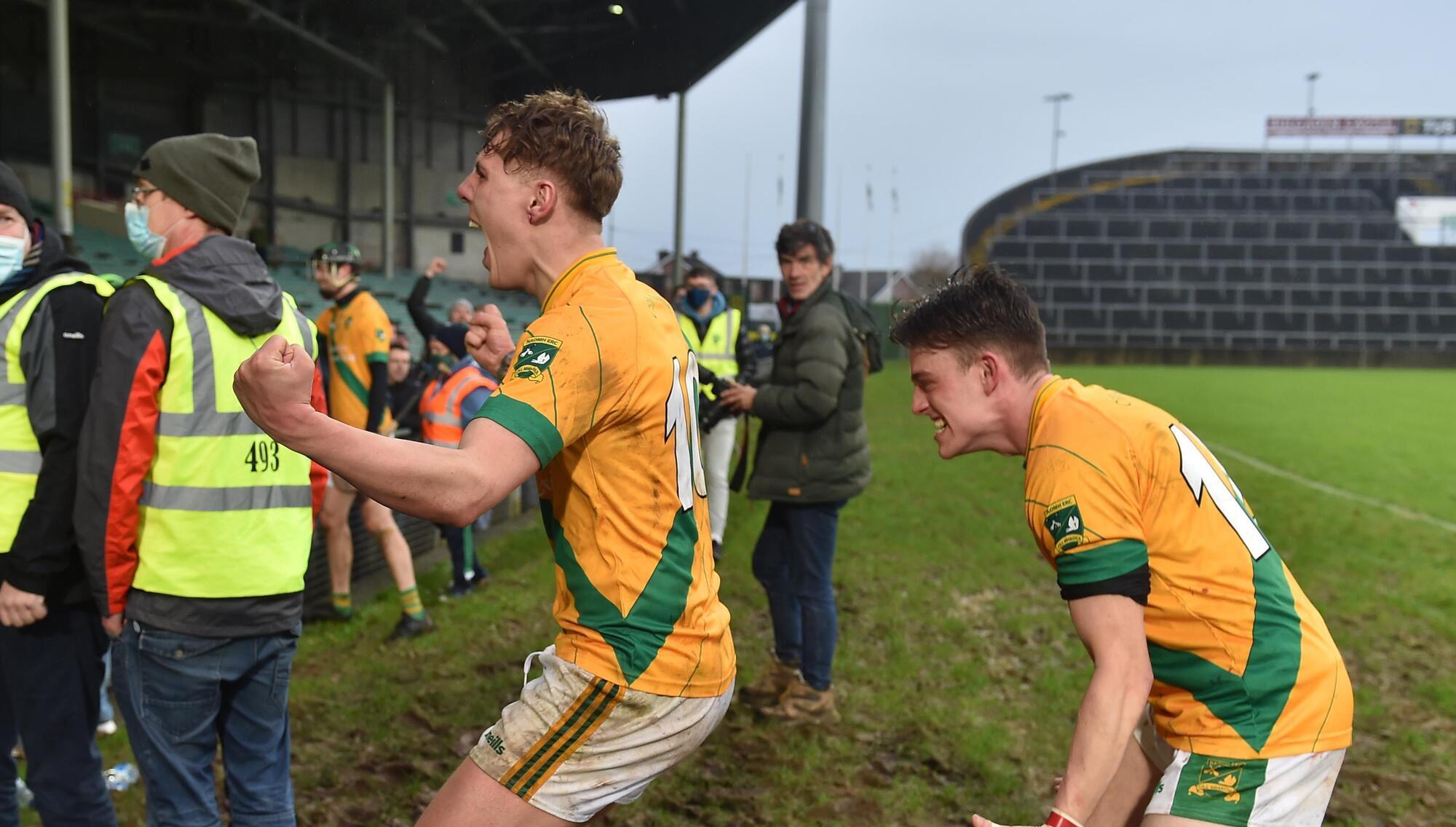
Kilmoyley players Matthew Flaherty and Jordan Brick celebrate after their victory over Coursey Rovers In the Munster Club I.H.C. final at the Gaelic Grounds, Limerick. Picture Dan Linehan
“Two young Kilmoyley men passed with hurleys. When my friend Mike Joe Hogan heard they won he punched the air with delight and shouted ‘come on Kilmoyley, the home of the hurlers’. Those words were magic. I’ve never forgotten them.”
Club historian Seán Seosamh Ó Conchubhair wasn’t yet a teenager when he heard this Kilmoyley chant for the first time — he’s now in his mid-80s and the boyhood memory still fires his hurling imagination. Especially this week.
Indeed, ‘come on Kilmoyley, the home of the hurlers’ resonates from the club’s hub in Lerrig all the way back west to the hurling outpost of Dingle, as the storied football town produces its latest All-Ireland hurler.
“There’s been a few of them,” says Br Seán Ó Catháin, from Kilbaha on the Loophead Peninsula, who as a teacher on the Dingle Peninsula became a hurling missionary in football country.
“Joe O’Sullivan won a junior All-Ireland in the 1960s, while Paul Geaney’s first All-Ireland was an Under 21B in 2010. I was in Semple Stadium to see Paul win that day; Darragh O’Sullivan was also on that squad, while Barry O’Sullivan followed on and won his All-Ireland in 2017.”
Now, there’s Matthew Flaherty, himself an All-Ireland winning footballer at minor level with Kerry in 2014, who is now one of the beating hearts of Kilmoyley’s All-Ireland dream that becomes a reality when they play Naas in Saturday’s intermediate final in Croke Park.
“Would you believe,” says former Kerry star Ian Brick, “the only player on our squad with an Under 14 county medal is Matthew, but not with Kilmoyley — he won it with Dingle when they were the best in Kerry”.
Micheál Ó Conchúir, the retired principal of Scoil Iognáid Rís, reels off some of the names of the team that beat Causeway in the 2010 Under 14 final, four years before they were driving forces for Kerry’s minor footballers. The same players were the spine of Dingle hurling — Geelong Aussie Rules star Mark O’Connor in goal; two-time All-Star Tom O’Sullivan at full-back, Barry O’Sullivan and Tomás Ó Sé manned midfield, with Flaherty centre-forward and captain, while Brian Rayle was full-forward.
“This was the team that showed what Dingle lads could do with hurleys,” says Ó Conchúir. “Hurling started with Br Ó Catháin at primary and Br John Minogue at secondary and I then brought it into the club. We started at C level, but got up to A grade. Some said we were destroying the grass on the pitch, taking the head off it with hurleys. Others said that they’d never be able to play, but I said they’d be like lads from Kilkenny if they had enough time at it,” he adds.
“If Paul Geaney, Barry O'Sullivan and Matthew Flaherty went to school in St Flannan’s or St Kieran’s they’d be master hurlers,” says Br Ó Catháin. “They were that good. They had it. It was just to nurture it.
“Dingle was the only school I was in where everyone played hurling — even in places like Thurles you’d only get about 50 per cent playing, but in Dingle they all wanted to play.
“When I came to Scoil Iognáid Rís in 1993 I swamped the place with hurleys and sliotars. I gave Matthew his first hurley. We used to give out sliotars as prizes. In training, I’d be in one goal and Br Minogue would be in the other and we’d be pucking balls out to the lads. They loved it.”
It’s this infectious enthusiasm among a small hardcore group of hurling aficionados in Dingle that Kilmoyley have tapped into for nearly two decades, starting with Paul Geaney’s generation at underage level and continuing through to Matthew Flaherty at senior level.
“Paul was the first to come up,” remembers Brick, “and played under 15, minor and under 21. Darragh O’Sullivan and Gene O’Connor won a minor county title in 2009 against Ballyduff and I remember Darragh did a great job marking Paudge Boyle in the final. We were the better for having the Dingle lads.”
“Kilmoyley were fantastic,” says Ó Conchúir.
“They gave the Dingle players tremendous encouragement. Brendan McElligott used to drive back to Dingle from Kilmoyley to pick up lads for matches and then bring them home again.”
Flaherty first started making the journey for senior hurling four years ago, because of what he calls “a great grá for the game”, from his schooldays, but also from a background where his father Enda O’Dowd played for his native Sixmilebridge, while his granduncle Fr Hugh O’Dowd coached St Flannan’s to Harty and Croke Cup titles.
“Matthew is a vital player for us,” says Brick. “In the county final the hottest player St Brendan’s had was Fionán Mackessy and Matthew marked him. He got a couple of points, but Matthew did an exceptional job. It’s his work ethic. It’s phenomenal — a lot of hooking, blocking, tackling. His energy and enthusiasm rubs off on the whole team. Everyone benefits from it.
“I saw his tears after the Munster final. That tells you something. That a player can come in and be so passionate about it, says it all. It means everything to him. It’s great to have that in the club.”
“It’s this spirit that John Meyler has brought to Kilmoyley,” says club chairman Joe Walsh. “Before John came to us for the first time in 2001 we were without a county title in 30 years. We were doing well in all competitions, but not in the senior county. The longer it was going on the worse we were getting. It clicked when John came in.
“That first team he had won four-in-a-row and were very competitive against teams like Blackrock and Toomevara in the Munster Club. That time there was a Munster League and we got to three finals, beating a Na Piarsaigh team in 2003 that went on to win the Cork senior title in 2004. Now nearly 20 years later we’ve finally made the championship breakthrough.
“We’re on a great journey,” continues Walsh. “The three games in Munster, the Connacht Centre of Excellence and now the biggest one of all. Croke Park. The biggest stadium in the world to us.”
“Until we go up there and until we see the Kilmoyley crest up on the big screen, it won’t sink in,” says Brick. “It is mind-boggling stuff really. The players are still very much on the ground and still focused, but for everyone else, it’s just dreamland. It’s hard to believe.”
“We’re up against it with this Naas gang,” muses Walsh. “We’ll want our support from Dingle — what’s more we want support from all over Ireland because Naas are a huge club; we might be outnumbered up in the stand, but out in the field we’ll be right there with them.”
“Dingle will be there in force,” confirms local publican Fergus O’Flaherty, “to support Matthew. He plays the drums for the Green and Gold Wren and now wears the green and gold of Kilmoyley. It’s a great story.
“There’s a connection between the Wren and Kilmoyley because going back 20 years myself and Danny Murphy would go up to John Flanagan in Kilmoyley to collect oats and straw to make our costumes for Wren’s Day. John was hurling mad and many times he showed us the All-Ireland medal his grandfather won with Kerry in 1891,” adds O'Flaherty.
“Maybe there’s an omen for us in that,” says Joe Walsh. “Fifty years ago John Flanagan won his own medal when he captained the Kerry juniors and scored two goals in the 1972 All-Ireland final. And there were ten Kilmoyley players on the Ballyduff team for that 1891 All-Ireland final that was played in February 1892. That’s 130 years ago this month when Kilmoyley’s Patcheen Quane got the winning goal. Maybe there’ll be another winning Kilmoyley goal on Saturday.”
If it happens, they’ll again chant ‘come on Kilmoyley, the home of the hurlers’.
CONNECT WITH US TODAY



Be the first to know the latest news and updates