Kinnerk code: Making Limerick the great problem-solvers
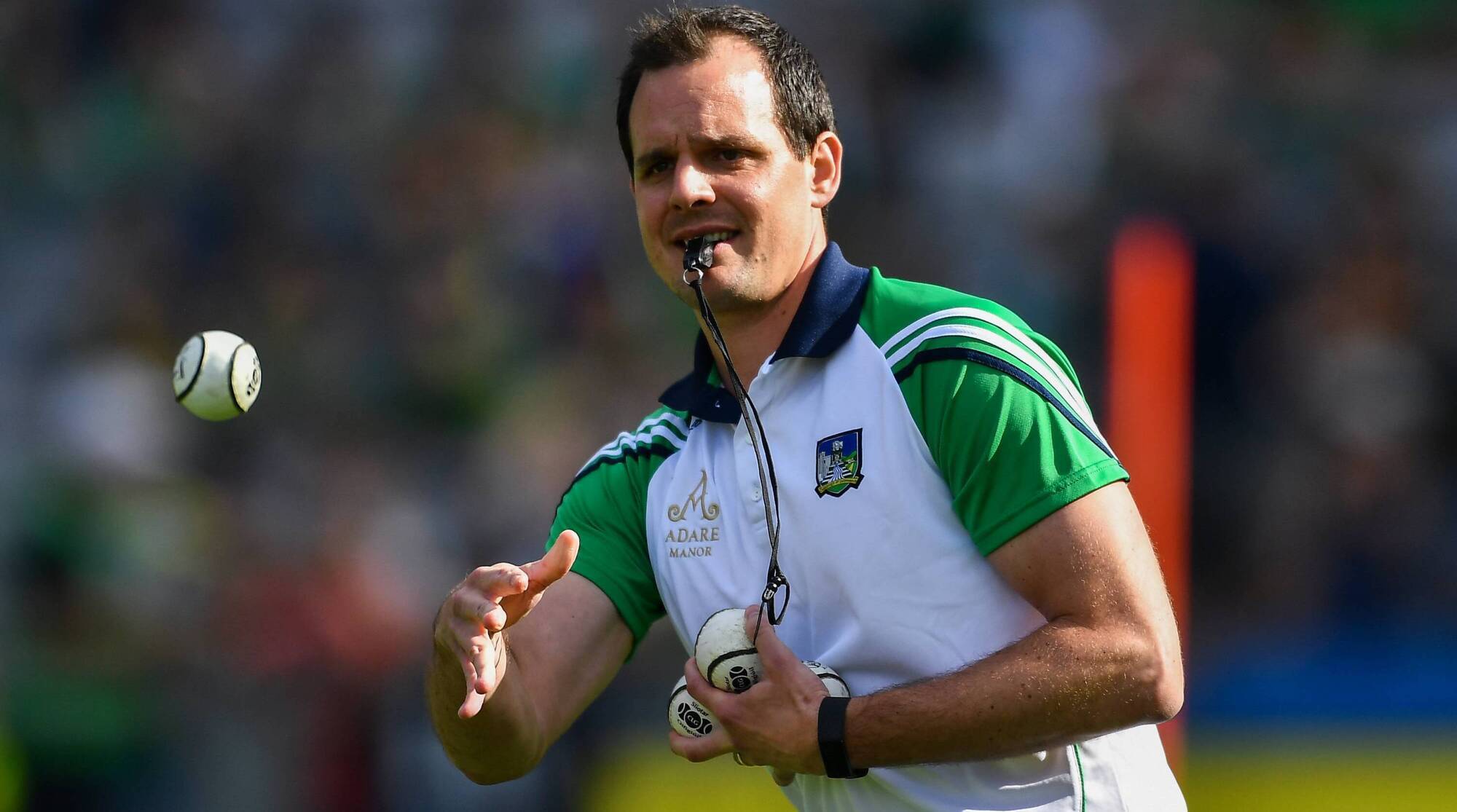
Monaleen man and Limerick hurling coach Paul Kinnerk Kinnerk is also head of the Limerick football Academy.
In Seamus Flanagan’s All-Star season, his signature performance came in the All-Ireland semi-final against Waterford; from 11 possessions, Flanagan got off six shots, four of which he nailed, all of which were classic Flanagan scores.
His point in the 21st minute was Flanagan’s best score, not just for the beauty of his over-the-shoulder execution, but because of the ingenuity of its construction.
Peter Hogan was in possession inside the Limerick 20-metre line when he was hunted down by Seán Finn, Dan Morrissey and Declan Hannon. After Morrissey forced the turnover, he handed the ball off to his brother Tom inside the 45-metre line, who popped it off to Darragh O’Donovan, who instantly shipped it to Will O’Donoghue coming off his shoulder.
As soon as O’Donoghue had possession, Flanagan began his run from inside the 13-metre line to the right of the D. After a perfect first touch, Flanagan took a handful of steps inside before shooting over his shoulder and splitting the posts.
It was Flanagan’s second point of the match from that zone, but that sector of the field was where Flanagan inflicted most of his damage throughout the 2021 season; in league and championship, Flanagan had a 79% conversion rate in that zone.
For opponents trying to study and stop the Limerick machine, Flanagan provides the ideal case study in how hard the code is to crack; everybody knows what Flanagan and Limerick are going to do, both in score construction and execution. But nobody can do anything about it.
Every match Limerick play is analysed in microscopic detail, frame by frame, but there is no secret. Limerick’s predictability in so much of their play is their greatest strength because they are so comfortable and so good at what they do.
They are the exemplars of the philosophy of the late motor behaviour scientist Nikolai A Bernstein, whose governing principle is that “practice is a particular type of repetition without repetition”.
Much of that philosophy governs the thinking of Paul Kinnerk, the tactical mastermind and key strategist behind Limerick’s dominance. Limerick’s system of play has become heavily ingrained now from repetition without repetition because Kinnerk repeatedly challenges the players through representative learning design.
Kinnerk has been such an advocate of a games-based approach that he did a PhD on the subject. He is clearly applying a lot of the key strategies within game-based approaches to his coaching but the PhD enabled him to theoretically explore and underpin those strategies to a whole new level.
The huge volume of research he has undertaken on the subject allows Kinnerk to identify a greater understanding of what works best, especially in how to change and tweak games in training. Bringing that expertise onto the training ground has enabled Limerick to become the great problem solvers, especially when they have long had such a huge target on their backs.
The breadth of Kinnerk’s expertise is fully evident from his academic research. Earlier this year, Kinnerk co-authored a paper in the International Sport Coaching Journal titled: “An Investigation of the Self-Reported Practice Activities and Session Sequencing of Inter-County Gaelic Football Coaches”.

Written by Kinnerk, Stephen Harvey, Philip Kearney, Ciarán MacDonncha, and Mark Lyons, the paper sought to ascertain how games-based approaches were being adopted in training in light of increasing support for them in academic literature.
Only last week, Kinnerk, Harvey, Kearney and Lyons published another research paper in the ‘Sports Coaching Review’ titled ‘An investigation of high-performance team sport coaches’ planning practices’.
Seeking to evaluate those practices in light of the Game-Based Approach literature and Complex Learning Theory, 12 inter-county Gaelic football coaches (five operating from Division 1) were recruited to participate in semi-structured interviews and preparing session plans.
One of the key findings revealed missed opportunities, with coaches failing to provide explicit learning intentions for session plans, inattention to session sequencing, and limited small-sided game designs.
The paper illustrates how coaches can engage with research and theory to elevate the quality of their planning of coaching sessions. Yet Kinnerk’s understanding of the theory and practise is so technically and tactically advanced that his coaching adaptation and application of it is driving Limerick to a whole new level.
“Everybody is saying how good Limerick are but they’re not overly asking why,” says Paul Kilgannon, the renowned coach, coach-educator and author. “Why do they continue to get better? Why are there more layers of complexity to what Limerick are doing?”
The most important element for any coach is to create a game model, where simplifying the defining principles ensure clarity, with those principles then driving proper execution of the skills and systems applied.
When Kinnerk did a coaching Zoom with the Tyrone county board in March, he spoke in detail about one of his guiding principles of exaggeration by placing particular conditions and constraints in his games. Whatever is thrown at Limerick in games, the nuance in the design of Kinnerk’s sessions has prepared them for it.
Most of top coaches change the rules of a training game to overstate or emphasise a specific tactical problem. But Kinnerk’s coaching detail has developed so many enablers within their team that Limerick thrive on pattern recognition within their system.
The make-up of the Limerick half-back line is the perfect example of how much of that pattern development stems from the strengths of each individual player – Diarmaid Byrnes, Declan Hannon and Kyle Hayes.
There are three ways to attack or move the ball from that half-back platform – long ball, short ball or recognising gaps to attack space. Limerick ideally incorporate all of those principles in each sector; Hannon builds the play with short dink balls, Hayes is deadly at identifying gaps and attacking space while Byrnes is accurate from deep, either shooting or playing long diagonal ball to the attack.
Everything else then fits into their system, particularly in how they build the play through their platform in the middle third; the third-man runs they create when Cian Lynch comes into the pocket; the off-the-shoulder options that open up when Hayes spots gaps; that long ball into Flanagan or Aaron Gillane either side of the D.
Limerick understand the principles and patterns and they can perceive and action those moments faster because there is a logic or a curriculum to what they are doing. And they play with such synchronicity because they have recognised the patterns developing.
Kinnerk clearly designs games around identifying gaps, third-man runs, of putting half-backs and midfielders under extreme pressure so they can deliver that right ball inside.
“The game isn’t the teacher,” says Kilgannon. “The game needs to be manipulated to teach. So, when you design games that are true to the game model, you can deliver the game model under pressure, at high speed more often. It’s almost like a computer programme.”
The intensity, precision and scaffolding of Kinnerk’s sessions is like a firewall to prevent it from shutting down or being shut down by their opponents. The physical and mental toll on the players is enormous during a session because Kinnerk pitches them well above match-day intensity.
“Your lungs would be on the floor,” said former player Tom Condon earlier this year. “It wouldn’t be from running mindless laps and sprints, it would be from the intense tackling and the worst-case scenario drills. You got accustomed to being on your last legs.”
In ‘Man in the Arena’, the ESPN series on Tom Brady, the Hall-of-Fame quarter-back speaks in one episode about that symbiotic relationship between players and coach which drove the New England Patriots to six Super Bowls under Bill Bellichick.
“The one thing about hard coaching is that it’s only as good as the ability of the players to receive it,” said Brady. “And we had built a culture and a locker-room of players willing to receive it.”
All of the successful teams have those leaders in the dressing room but having a coach who challenges the players so much on the training ground fosters that culture even more.
As with any successful team though, there can be a tendency to inflate the myth around them from the outside. In so many ways, Limerick now are a carbon copy of Kilkenny at their peak under Brian Cody; they have the best players; they are physically superior to everyone else; their culture drives their ambition; their success pumps their confidence; their manager constantly demands more; the crucible of their training ground environment sets their standards.
The game is more tactical and technical now, but Kinnerk has constructed a system which is lifting Limerick towards Kilkenny’s level. His research portfolio has expanded his knowledge of sports science but his expertise in pedagogy has put him in total command of his plan, and everyone’s place in it.
When Kinnerk did one of his first research papers a few years back, it entailed the recruitment of 150 inter-county football coaches (men’s U14 to senior) in the 2017 season. Stephen Lavin had played with Kinnerk with the Limerick footballers and was coaching the Limerick Academy U-14s at the time when Kinnerk asked him and the group to take part in the study.
After six weeks of traditional skills-based training, they did up to 12 weeks of games-based training. Everything was recorded. Then Kinnerk compared the players’ decision making from the first training block to the second. “They improved in every metric, especially their skills,” says Lavin.
Kinnerk is still head of the Limerick football Academy. When Lavin started off under Kinnerk’s guidance, he would design his sessions and then send them to Kinnerk for feedback. “I thought I knew a bit about coaching, but Paul’s advice was an eye-opener as to how a games-based session should look,” says Lavin.
“You think you have a lot of the answers and then you chat to Paul and you realise you have so much more to learn. He is such a great teacher, but he has a passionate belief about the games-based approach.”
Lavin had pooled so many ideas together that he felt they should be shared. When Lavin put the brilliant website ‘Game Sense Coaching’ together with his brothers, Kinnerk was an ideal sounding board for their powerful coaching resource which provides access to over 300 games for all levels.
Limerick have become a machine but Kinnerk is clearly the man behind how it runs so smoothly on the field. At the end of 2020, Kinnerk did an interview with Phil Kearney for TGFU (Teaching Games for Understanding). When asked for his reasons for doing his PhD on game-based approaches, Kinnerk’s reply was multifaceted, but there was one standout element.
“I felt that by undertaking a PhD within that sphere (games-based approach) that I was putting myself in an excellent position to advance my own understanding and expertise within the area, ultimately leading to challenging my coaching approach and extending it further.”
And like Limerick, on and on it goes.


CONNECT WITH US TODAY



Be the first to know the latest news and updates