With the benefit of hindsight, Kilmallock may rue easy semi-final win
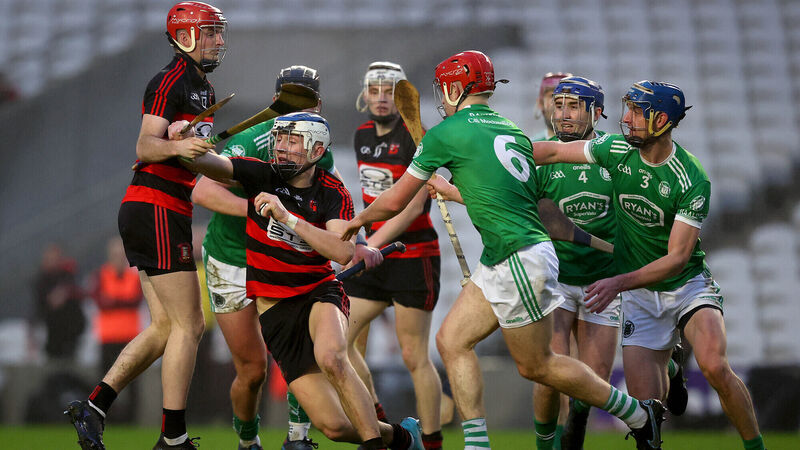
Kilmallock’s Ciaran O’Connor and Paddy Leavey of Ballygunner. Picture: INPHO/Ryan Byrne
What did we learn? Or what did we learn all over again?
The lessons from the Munster club final in Páirc Uí Chaoimh were evergreen in some ways, but that makes them no easier to learn, it seems.
The value of experience is one obvious part of the homework. Ballygunner had been in four of the previous five provincial finals, for instance. Even if they’d only won one of those, back in 2018, familiarity with the occasion had to be a help.
That can be expressed in several different ways, all of them concrete.
Though Kilmallock fielded a potent attack, Ballygunner’s defence denied the Limerick champions a scorable free for the first 28 minutes of the opening half, a considerable achievement. It’s one of the great cliches that a free-taker thirsts for an easy opening shot in a big game, but Kilmallock weren’t allowed a pot at the posts from a free of any type for almost the entire half.
(By the time a free was won their first-choice free-taker, Micheal Houlihan, had already been replaced through injury, with Kevin O’Donnell stepping in to take up the responsibility.)
The contrast with the Waterford champions is an obvious one. Pauric Mahony’s distinctive left-handed style has been a feature of the inter-county scene for years, and at club level his unerring eye is a huge asset for the men in red and black. In the same first half he hit four points and a '65: The same total that the entire Kilmallock side managed in the opening 30 minutes.
(Mahony also had a very good point from play before the break to go with the placed balls.)
In the war against cliché one of the first offenders to be put up against the wall is the need to win the midfield battle, but here we had one of those examples — fortunate? unfortunate? — of just how durable that cliche can be.
On paper Kilmallock looked set to do well between the two 45-metre lines. Robbie Hanley and Aaron Costello are two strong, durable midfielders who looked to have a physical edge over Conor Sheahan and Paddy Leavey of Ballygunner. Oisín O’Reilly’s clever movement had been a huge advantage in Kilmallock’s county final win in Limerick as well and was expected to feature in Páirc Uí Chaoimh.
As the game turned out, however, Sheahan and Leavey’s speed and passing ability gave Ballygunner a distinct edge, and they were helped by the other wiling helpers in black and red around the middle of the field.
Mikey Mahony built on a good display against Loughmore-Castleiney by dropping deep to screen the Kilmallock puck-outs and to function as an outlet for his defence. He, Sheahan and Leavey were helped by Pauric Mahony’s presence out the field as well.
Mahony’s ability to get involved in the play around the half-forward and midfield area was a lesson to younger players who might fear being made peripheral by that kind of posting: It’s easy for players given a roving commission to find themselves being bypassed by the game, but Mahony is a past master at getting possession and distributing cleverly to the players inside - players like Dessie Hutchinson, making the most of the room left by the Ballygunner number 13 on his travels further afield.
The ultimate expression of this ability to process possession calmly through the middle of the field came on the stroke of half-time, when Ballygunner broke up a Kilmallock attack on their own 20-metre line.
Five calm passes later and Peter Hogan struck a long-range point into the City End: the direct route, straight through the middle, paying off in spades.
We've already discussed experience, but that’s a commodity which comes with more benefits than knowing what the anthem before a Munster final sounds like. It means seeing the small things for what they are: adding up to the big things.
In the seventh minute, when the game was still a contest, Ballygunner ’keeper Stephen O’Keeffe pulled down a Kevin O’Donnell shot that seemed destined to be a point and cleared the ball out the field.
VAR might have looked unkindly on O’Keeffe’s save, but he and his teammates know better than to give away even one per cent in a game. He made the save and play continued. Two minutes later Dessie Hutchinson found the net and Ballygunner were on their way.
That attention to detail — and maintenance of standards — also explains O’Keeffe’s late saves when faced by Kilmallock sub Conor Hanley. Twice the Ballygunner ’keeper denied Hanley goals even though the game was long gone from the Limerick side: an indication of the focus and intent that Ballygunner manager Darragh O’Sullivan mentioned after the game.
(Credit to Hanley for not giving up, in fairness, and finding the net with a terrific free with time almost up.)
Ballygunner also dictated the pace of the game and played it on their terms, with the former ensuring the latter.
How? The evidence was clear. In the first half in particular it was striking how often Kilmallock were blocked and hooked, particularly around the middle of the field, as though Ballygunner were playing at a slightly faster tempo than their opponents were used to.
The Waterford side were certainly quick to shut down space when danger threatened: Oisín O’Reilly, central to Kilmallock’s county final win in Limerick, had a sniff of goal in the first half but was turned back with a superb block.
When they look back Kilmallock may rue their easy win over Midleton in the semi-final. Ballygunner had a far more testing challenge in their semi-final, edging out Loughmore-Castleiney in a tough battle in Dungarvan. In retrospect that looks like far better preparation for a final than the shoot-out Kilmallock enjoyed in the Gaelic Grounds.


CONNECT WITH US TODAY



Be the first to know the latest news and updates